War

Ukraine, Rutte: if Europe does not rearm soon, security risks as early as 2027. Kiev: army withdraws from Siversk

Volodymyr Zelensky reported on X that he had a "very warm and fruitful" conversation with European Commission President Ursula von der Leyen

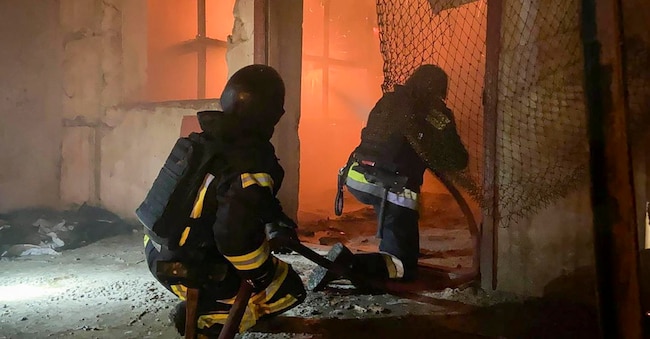
Una foto diffusa dal Servizio di emergenza statale mostra i soccorritori ucraini al lavoro sul luogo di un attacco russo contro un’infrastruttura portuale nella regione di Odessa, in Ucraina, il 23 dicembre 2025, durante l’invasione russa. Secondo il Servizio di emergenza statale ucraino, la Russia ha utilizzato più di 650 droni d’urto e 38 missili di diverso tipo negli attacchi combinati notturni in tutta l’Ucraina.

6' min read

Translated by AI
Versione italiana

6' min read

Translated by AI
Versione italiana

Volodymyr Zelensky reported on X that he had a "very warm and fruitful" conversation with European Commission President Ursula von der Leyen, thanking her for her support since the start of the large-scale Russian invasion. The Ukrainian president referred to the European Council's decision last week on EUR 90 billion in financial assistance to Ukraine for 2026-2027 as an 'extremely important' step. Zelensky argues that the EU's support comes at a 'diplomatic, in many respects decisive moment' and links the negotiation phase to the need to maintain adequate pressure on Moscow.

Zelensky: "Putin continuerà la guerra finché avrà soldi per farlo"

Pressure on Russia and positions at the negotiating table

In his message, Zelensky speaks of ongoing negotiations that "can radically change the situation" and insists on "just pressure" on Moscow "for the sake of peace", to be exercised jointly with all partners. With von der Leyen, he adds, he would discuss the importance of supporting Ukraine's resilience and strengthening Ukrainian positions at the negotiating table, agreeing on further contacts in the coming days. "Although the whole world is already looking forward to Christmas," he writes,"we do not stop working for a single day" for peace and security.

Loading...

From Miami the dossier on security guarantees

The president also wrote that he wanted to continue the dialogue with the US after receiving a detailed report from negotiators Rustem Umerov and Andrii Hnatov, who returned from Miami after meetings with the US team. In another message, the Ukrainian president says that drafts of several documents would be prepared with President Trump's representatives, including texts on security guarantees for Ukraine, restoration and a "basic structure" to end the war. Zelensky reiterates that diplomacy, pressure on Russia and support for Ukraine must proceed together, arguing that Russian attacks and the intensity of the fighting demonstrate a Ukrainian determination to end the conflict that is greater than the Russian determination.

Orban challenges EU loan and predicts climate change in the West

Hungarian Prime Minister Viktor Orban said he expects an increase in opponents of the continuation of the war in Ukraine in Western European countries after the EU's decision to take out a loan for Kiev. Orban recalls the words of European Council President Antonio Costa, who on Friday indicated a EUR 90 billion loan based on the EU budget and potentially repayable using frozen Russian assets, and points out thatHungary, Slovakia and the Czech Republic have refused to participate in the guarantees. According to Orban, the idea that the war would not cost the population because it was 'paid for with Russian assets' is clashing with reality and in countries such as Germany and France, he argues, those who oppose the war already seem to outnumber those who support it.

Frozen Russian assets and Putin's warning

In the above-mentioned framework, since the start of Russia's 2022 military operation the EU and G7 countries have frozen almost half of Russia's foreign exchange reserves of about EUR 300 billion, of which about EUR 200 billion are in Europe, mainly at Euroclear in Belgium. The European Commission, it is recalled, had sought the approval of member states to use these assets to support the Ukrainian war effort. Russian President Vladimir Putin called the idea of seizing the assets a 'robbery' and warned that this could erode confidence in the Eurozone.

Rutte: risks for European security as early as 2027

Nato Secretary General Mark Rutte warned that, if Europe loosens support for Ukraine and does not speed up defence build-up, security risks for the bloc will increase as early as 2027, according to some intelligence assessments. Rutte says Ukraine must remain strong to prevent Vladimir Putin from trying to attack a NATO country and returns to calling on the Europeans to increase defence spending in line with commitments made at the Hague summit last June. In the same interview, he refers to Russia's military spending, which is reported to be over 40% of the budget, and cites an estimate of 1.1 million Russian soldiers killed or wounded in Ukraine.

Siversk, Vinnytsia and the Unicef warning about children

On the ground, the Ukrainian General Staff announced the withdrawal from the town of Siversk, in Donetsk, after Russian attacks and after Moscow claimed to have captured the town on 11 December. The decision, according to Kiev, was made 'to preserve the lives' of the soldiers and the combat capability of the units, while Russian troops allegedly advanced due to numerical superiority and constant pressure from small assault groups in difficult weather conditions. In the Vinnytsia region, the deputy governor Natalia Zabolotna reported that 14 homes were damaged in a raid, speaking of broken windows and hit roofs and facades, but no injuries. And Unicef reported "tragic news" of a child killed and three injured between Kiev, Vyshhorod and Zhytomyr in another wave of attacks, calling for a halt to the offensives and describing a winter with disruptions to heating, electricity and water.

Moscow claims new conquests between Kharkiv and Dnipropetrovsk

The Russian Defence Ministry has claimed control of two more localities: Prylipka in the Kharkiv region and Andriivka in the Dnipropetrovsk region. The claims come while, according to the Ukrainian General Staff, Moscow's forces maintain a "significant" advantage in men and means and continue offensive operations despite "heavy losses". In this web of diplomacy, finance and fighting, Kiev insists on the same point: negotiate yes, but without reducing pressure and support while the attacks continue.

The Starlink node

Moscow is developing a weapon to hit the Starlink network and thus deprive Ukraine of an important defence tool. The alarm was raised by the intelligence services of two NATO countries according to which - the Associated Press reports - the Russian project is for a 'zone effect' system to flood the orbits of Musk's satellites with hundreds of thousands of high-density projectiles, with the aim of disabling several satellites at once. However, the warning issued does not convince all analysts. Many believe it is possible that the Kremlin would have given such an order, given the increasingly aggressive attitude in space and the rumours of a space nuclear weapon. Many others, however, are sceptical as such a weapon would cause uncontrollable chaos in space for many countries, including Russia and its ally China.

Both depend on orbiting satellites for communication, defence and other vital needs. Starlink is nevertheless considered a serious threat by Moscow: its low-orbit satellites have proved crucial to Ukraine's resistance to its invasion. Kiev troops use its high-speed internet for battlefield communications and also for civil use. Without it, it would be much more difficult for Ukrainian forces to defend themselves and try to attack. Hitting Starlink, however, risks causing quite a few problems for Moscow. Beyond the effects in space, of which Russia would be the first to pay the consequences, there are the political ones. The company is headed by Elon Musk, a former member of the Trump administration and a major backer of the Republican party.

Although the idyll with the US president has faded somewhat, Musk and Trump have recently grown closer and the billionaire continues to have close relations with the tycoon's sons and vice-president J. D. Vance. Hitting a US company could therefore be very risky for the Kremlin and trigger US retaliation. The projectiles of a potential 'zone effect' weapon - experts explain - would actually be so small (in the order of a few millimetres) that they would escape ground and space-based detection systems. But it is also true that the truth about who would have carried out the attack would eventually be uncovered, exposing Russia to potential 'revenge' from the stars and stripes.

Ukraine 30 missiles and 650 drones

"Since last night, Russia has been launching a massive attack on Ukraine, especially on our energy, civil infrastructure, practically the entire infrastructure of life. More than 650 drones have already been launched. More than 30 missiles." He writes this on Telegram Volodymyr Zelensky explaining that 13 regions have been targeted. "At the moment, a large part of Ukrainian territory is still on air alert. Unfortunately, there have been casualties. In the Kiev region, a woman was killed by a drone. One person is known to have died in the Khmelnytskyi region. In Zhytomyr, a four-year-old child died'.

Russian shelling has left three regions almost completely without electricity. This was stated by the Ukrainian Energy Ministry, reported by Rbc. "Tonight and this morning, the enemy launched another massive attack on the Ukrainian power grid, the ninth since the beginning of the year. As a result, consumers in the Rivne, Ternopil and Khmelnytskyi regions were almost completely without electricity," the Energy Ministry reported. In the Odessa region, work is underway to repair several serious damages to the energy infrastructure in the region, which left a significant number of people without electricity.

Poland deployed Polish and allied fighter planes this morning after Russia launched air strikes towards western Ukraine, near the Polish border. "Combat aircraft have been dispatched and ground-based air defence and radar reconnaissance systems have been put on high alert," the Polish Armed Forces Operations Command said on X. "These measures are preventive in nature and aim to protect and secure the airspace, especially in areas adjacent to the threatened regions," the Polish Armed Forces added.

Copyright reserved ©
Loading...

Brand connect

Loading...

Newsletter

Notizie e approfondimenti sugli avvenimenti politici, economici e finanziari.

Iscriviti