
1- and 2-cent coins: they are still in force, but are no longer minted
The 1- and 2-cent coins are no longer minted in Italy, but remain valid for cash payments. In other European countries, however, they will soon disappear
by Davide Madeddu (Il Sole 24 Ore) and Ieva Kniukštienė (Delphi, Lithuania)
 Aggiungi Il Sole 24 Ore
ai preferiti su Google
3' min read
3' min read
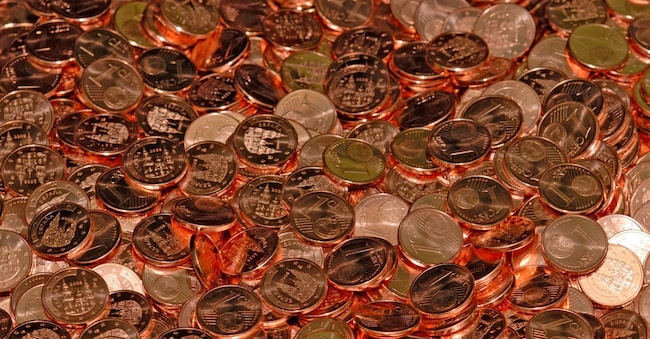
In digital payments the figures are always counted to the nearest cent, but in cash payments they are not, as it is preferred to round up or down. All because, very often, you don't have the 1- and 2-cent coins, the so-called 'coppers' that not everyone wants. It is certainly no coincidence that these coins, although valid, are not accepted by coffee machines or 24-hour vending machines.
Although present, these coins are no longer minted in Italy, as the Ministry of Economy and Finance points out. "Parliament has established among other things that " with effect from 1 January 2018, the minting by Italy of euro coins with a unit value of 1 and 2 euro cents is suspended. The savings resulting from the implementation of this paragraph shall be allocated to the Government Bond Amortisation Fund,' the Ministry said. And it introduced rounding up or down for cash payments to the nearest multiple of 5 cents. In essence, as of 1 January 2018, the State Mint and Mint suspended the production of 1- and 2-cent coins and the State consequently suspended the distribution of these coin denominations to the market."
For the time being, however, the coins will still be in force since the "matter of coins in ordinary circulation in the countries of the Euro Area is the competence of the European Union". "A possible suppression of the 1- and 2-cent coins and the rules for their withdrawal from circulation must be established by a European Union Regulation," argue the MEF. "With the same regulation, the modalities and timing for their removal from circulation and for their reimbursement to citizens in possession of them in the event that they should be taken out of circulation by the European Union must also be provided for. Of course, the 1- and 2-cent coins in circulation and "those that will be produced until their eventual suppression," they reiterate at the MEF, "are to be considered, to all intents and purposes, ordinary circulation coins in Eurozone countries and must be accepted for cash payments.
Suggesting a solution to obviate misunderstandings and what he sees as 'an inflationary effect linked to the rounding-up push that needs to be tempered' is Michele Carrus, national president of Federconsumatori, the association that deals with the protection of consumer rights: 'One way forward and the one we support is digital payment,' he says. 'It is a way that can avoid rounding-up and, at the same time, help combat evasion.
The Lithuanian case
.As of May this year, 1- and 2-cent coins will no longer circulate in Lithuania. This decision marks a significant change in the everyday life of consumers and businesses, driven as much by economic reasons as by practical considerations. The cost of minting these small denominations, in fact, often exceeds their face value, making them a non-negligible item of expenditure for the entire eurozone, according to the Bank of Lithuania, which also explained how the elimination of the coins follows a logic of efficiency and economic sustainability, in line with the strategies adopted by other European countries as well.

