SpaceX

Musk reopens the game with China to conquer the Moon: successful completion of 11th Starship test

SpaceX's shuttle arrived at about 200 kilometres, released its cargo of eight copies of Starlink satellites and perfectly executed a descent manoeuvre into the Indian Ocean

by Leopoldo Benacchio

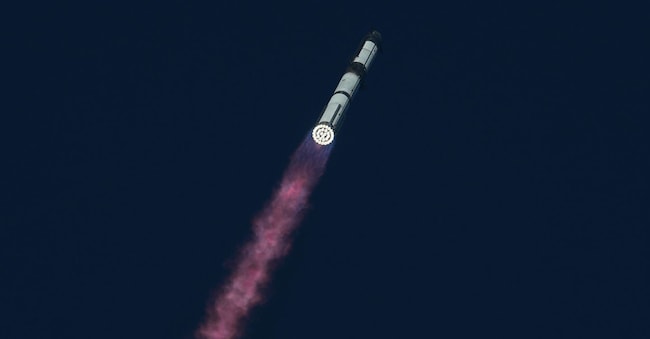
Il mega razzo Starship di SpaceX effettua un volo di prova dalla base Star, in Texas, lunedì 13 ottobre 2025. (Foto AP/Eric Gay) Stampa associata/LaPresse

3' min read

Translated by AI
Versione italiana

3' min read

Translated by AI
Versione italiana

Elon Musk reopened the game with China for the conquest of the Moon. Tonight, in Italy, at 1:23 a.m., SpaceX's Starship took off, the V2 version with an acronym that is not very nice for those who know the history of astronautics at the least. The largest and most powerful rocket ever built, which is supposed to take us first to the Moon and then to Mars, as Musk wants, has nevertheless set off and has perfectly accomplished its mission.

From Starbase, SpaceX's launch base in Texas, this incredible 123-metre-high steel 'skyscraper' took off, its 33 ultra-powerful Raptor engines this time working properly and taking the Starship shuttle to a height of over 150 kilometres. In all, 66 minutes to make a half circle of the Earth and release Starlink satellite models into orbit, eight to be precise, another dress rehearsal that had been assigned to this launch.

Loading...
SpaceX lancia l'undicesimo volo di prova del suo razzo Starship

Not only will this powerful rocket be used to take us to the Moon, many times over, and also to transport vehicles and materials, but it will also be used massively to bring the number of Starlink satellites in orbit for the transmission of data and voices from space to the frightening figure of 40,000. Practically a monopoly in the making.

The return of both components of the rocket, booster and shuttle, which are reusable, was also a success, with obvious cost savings in a project involving many flights. This brings to an end a fluctuating period of positive tests and resounding summer failures: 10 launches before this one and some, this summer, had not gone at all well.

Spazio, Starship di SpaceX effettua con successo l'11mo volo di prova

Of course, unlike NASA's Apollo programme almost 60 years ago, which got off to a perfect start thanks to the German ingenuity of Werner Von Braun, Musk has accustomed us to mistakes, even glaring ones, in its launches, but which serve to obtain data on what went wrong and to improve. A method, often used in research, which has led SpaceX to conquer the world market with a hundred or more launches a year, as opposed to one or two in Europe; only China is holding its own, and is the real challenger in the conquest of the Moon's south pole, where both countries want to establish terrestrial activities.

As far as reusability is concerned, this was a double test, since the booster, the part with the most powerful engines and the fuel that carries the second stage into space, had already been used in test number 8 and passed the complex and scenic re-entry phase perfectly. The Starship shuttle part, the part that will carry the astronauts, also passed the test perfectly, after detaching itself from the booster in the initial phase: everything went well and it re-entered the Indian Ocean perfectly, with final testing of the heat shield, an essential part of any spacecraft returning to Earth. Overheating due to the atmosphere and the speed of re-entry brings the vehicle to temperatures that are unbelievable for us.

Now SpaceX is leaving for the V3 version of StarShip, the one that will have to carry out the many flights envisaged by Project Artemis for the return to the Moon: it will be even more powerful, with new engines, and above all it will test in-orbit refuelling. This is really the crucial point of the mission, Starship does not have enough fuel to fly to the Moon when it is in orbit around the Earth and will have to be refuelled by special in-orbit servos that will be carried by other Starship launchers specialised in this. A project as daring as it is interesting, and they are already thinking of mass production of this rocket, as they have been doing for some time with the smaller, and very efficient, Falcon 9, also by SpaceX, which dominates the world market.

Musk is so sure that everything will go well, that we will go with him both to the Moon to set up operations, laboratories and mines, and to Mars, his real pet project, that he has also finally given the price to use his new jewel and bring something to the two planetary destinations: $100,000 per kilo is the price of the cargo. Although it doesn't look like it, it is a low-cost price.

Copyright reserved ©
Loading...

Brand connect

Loading...

Newsletter

Notizie e approfondimenti sugli avvenimenti politici, economici e finanziari.

Iscriviti