
125 years of Fiat, the history, milestones and key models
A full 125 years have passed since the birth of Fiat, a brand that started with the 3 HP and ended with the Grande Panda

8' min read
Key points
8' min read
When and where was Fiat born? In Palazzo Bricherasio, Turin, on 11 July 1899. This is the place and date where 125 years ago Fiat was born, founded at the time as 'Società Anonima Fabbrica Italiana di Automobili - Torino'. The first president was Ludovico Scarfiotti but the creators of the project were Count Emanuele Cacherano di Bricherasio and lawyer Cesare Goria Gatti, both founders of the ACI Automobile Club d'Italia. Before Cav. Dr. Ernesto Torretta, Notary Public of the Royal Household, the members paid in a capital of 800,000 lire.
From Birth to the Second World War
.Who were the founders of Fiat? Emanuele Cacherano di Bricherasio, Alfonso Ferrero de Gubernatis Ventimiglia, Carlo Biscaretti di Ruffia, Lodovico Scarfiotto, Cesare Goria-Gatti and Giovanni Agnelli. The latter, who as is well known became the owner of the Turin-based company and progenitor of a dynasty that still survives today, later joined the project to create the first automobile brand on an industrial scale. The first model built by the fledgling company was the 3 Hp, produced in 8 examples during 1899 and derived from the Welleneys To see the birth of the Lingotto, we have to wait until 1916, with the end of work in 1923. Fiat's 20 years were characterised first by difficult periods and then by sudden growth, rising from 73 cars produced in 1902 to 1,097 four years later. That same year, the first Fiat company was liquidated and reconstituted with a capital of nine million and a very broad corporate purpose, including, in addition to cars, rail transport, shipping and aeroplanes. After the tragic and mysterious death of Emanuele Cacherano di Bricherasio, who committed suicide in 1904 in the midst of a clash with his partners, Agnelli became the company's largest shareholder. In 1937, construction began on the Mirafiori plant, which was inaugurated two years later. Despite the loss of his two sons, Aniceta and Edoardo, Agnelli continued to achieve excellent results by building key models such as the 508 Balilla and the 500 Topolino and extending his successes outside the automotive sector.
From the post-war period to the oil crisis
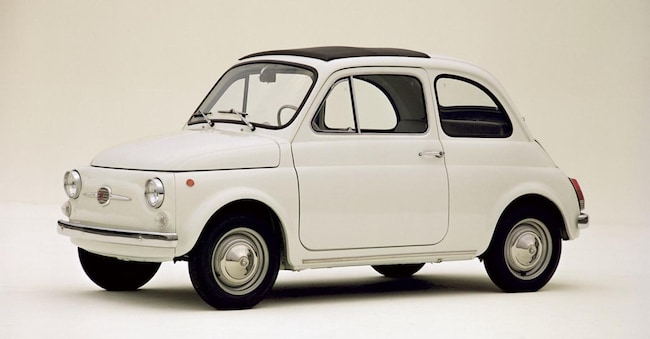
The end of the Second World War was a complicated period for Fiat. On 23 March 1945, Giovanni Agnelli was accused by the National Liberation Committee of compromising with the fascist regime, an accusation that caused him to temporarily lose ownership of the company. The situation was resolved by Gianni Agnelli, son of the late Edoardo and grandfather of the senator who died on 16 December 1945. The role of CEO returned in 1946 to the hands of Vittorio Valletta, who had held the position since 1939. After a difficult post-war recovery, Fiat resumed presenting new models, starting with the 500 B, the 500 Giardiniera, up to the 1100 B and D. The early 1950s saw the birth of the off-road Campagnola, the sporty 8V capable of reaching 200 km/h and debuts such as the 1400 diesel, Italy's first diesel-powered car. Fiat is a company that provides over 70,000 jobs and is about to launch models that will accompany Italy in its economic boom, starting with the 600 up to the iconic New 500 launched on 4 July 1957. The range continued to grow, ranging from saloons to spyders, and in 1966 Gianni Agnelli replaced Valletta (who died the following year) by taking over the reins of the company. In 1967, the Turin-based company won the Auto dell'Anno award with the 124, an honour also won by the 128 (the first Fiat-branded car with front engine and drive) in 1969. In addition to the Fiat Dino, made in collaboration with Ferrari, the range saw models with large displacements such as the 130 powered by the 2.8 and 3.2-litre V6s. In the 1960s and 1970s, Fiat's production increased decisively: cars rose from 425,000 to 1,741,000; trucks from 19,000 to 64,800; tractors from 22,637 to 50,558; and earth-moving machines from 3,000 to 6,255. In 1971, the 127 was presented, which achieved extraordinary success and won the 'Car of the Year' award the following year. Abarth, the historic sports car brand, joined the Group. The energy crisis that began in 1973 marked a profound slowdown for the new ones, starting with the slow disappearance of the most powerful models. On a company level, 1968 is remembered for the total takeover of the Autobianchi brand, while in 1969, 100% of Lancia was acquired and Ferrari became part of the Turin group, as reported in the press release of the time on 21 June: 'Following the meeting between the president of Fiat Dr. Giovanni Agnelli and Eng. Enzo Ferrari, it was decided, with the pre-eminent aim of ensuring continuity and development for Ferrari Automobili, that the current technical collaboration relationship with Fiat would be transformed into an equal shareholding within the year'. The end of the 1960s also brought the first worker struggles and paved the way for discontent that would lead to violent clashes in the following decade.
From 1974 to 2004: From the March of the 40,000 to the accounts in the red
In 1974, the Fiat 131 arrived as the replacement for the 124, in one of the most complex periods in Fiat's history. 70,000 workers were laid off, 400,000 cars were idle in the Mirafiori and Rivalta yards waiting to be sold. Despite the entry of Gaddafi's capital, the situation was still critical, sales did not take off and, above all, the clash between the company and the trade unions was increasingly harsh. Terrorist attacks continue and the suspicion of criminal infiltration inside the plants is ever higher. In September 1980, lay-offs were announced for 24,000 employees, including 22,000 workers, for a period of 18 months. The next step was the announcement of almost 15,000 redundancies, a decision that led to a general strike and the blocking of the Mirafiori gates. On the 35th day of picketing the gates, a group of employees (the so-called white-collar workers) began to demonstrate in the streets of Turin, creating the historic 'March of Forty Thousand'. The trade unions lost while the hard line of managing director Cesare Romiti triumphed. Fiat withdrew the dismissals but maintained the zero-hour redundancy fund for the twenty-two thousand workers. Returning to the late 1970s, mention should be made of the creation of Fiat Auto where the Fiat, Lancia, Autobianchi and Abarth brands were grouped together. In 1986, Alfa Romeo also joined the group, and the 1980s marked the farewell to the North American market and growth in South America. Among the iconic models of this decade were the Fiat Panda, the Uno, the Croma, the Y10 and the debut of the Fire engines. The 1990s saw the arrival of other models that were crucial to Fiat's coffers, such as the Punto, which was also awarded Car of the Year. In 1993, Maserati also joined the group. The new millennium saw a continuous decline for the Turin brand, reaching its lowest point in 2004 after the death of Gianni Agnelli in 2003 and with the death of his brother Umberto (who became president) the following year. To give a snapshot of the situation, four CEOs were changed between 2002 and 2004, with losses of over 6 billion euros; every day Fiat lost 5 million euros.
From 2004 to 2018: the Sergio Marchionne era and the birth of FCA
The last 15 years of Fiat have all the qualities to become a guide on how to save a company, turning it from a purely national reality in deep crisis to the eighth manufacturer in the world. However, it is necessary to go step by step to understand how all this was possible. John Elkann, the Avvocato's grandson, has to find a new CEO to save the family business. He does this by identifying Sergio Marchionne as the ideal candidate and convincing him to become CEO. An Italian manager but raised in Canada, Marchionne from the moment he took office changed the spirit and modus operandi of the Italian group at a time when it was losing 5 million a day. Marchionne's first victory came with the 2005 agreement with General Motors. In 2000, Fiat and the Detroit brand had signed to buy the Turin-based company, when the accounts were not yet so far in the red. The Italian-Canadian manager got $2 million from the Americans to cancel the put option, after pointing out to Gm the damage caused by the Fiat purchase. Thanks to this injection of cash, the 500 was born, presented on 4 July 2007, a model that would revive the brand. The second stroke of genius came with the intuition to take possession of Chrysler, a historic American brand in deep crisis that was losing $8 billion in 2008. It was President Obama himself who indicated Sergio Marchionne and Fiat as Chrysler's new partner, without the slightest financial outlay. How did he succeed? By bringing innovation and promising to repay the loan from the US government, which he did in the following years. On 10 June 2009, the new Chrysler was born, of which Fiat owns 20%. In 2010, after an absence of 27 years, the Fiat brand returned to North America with the presentation of the new 500 at the Los Angeles Auto Show. In 2011, Fiat's shareholding in Chrysler Group rose to 53.5%, rising to 58.5% in 2012. Another novelty brought by Marchionne is the focus on production plants. In fact, in 2013, the plants in Pomigliano d'Arco (Italy), Tychy (Poland) and Bursa (Turkey) are the first three assembly plants to be awarded World Class Manufacturing gold, while Maserati presents the new Ghibli. 2014 is the year of Marchionne's third triumph. In January, the Fiat Group increases its stake in Chrysler Group to 100 per cent. In October, the two companies merge to form Fiat Chrysler Automobiles (FCA), and the new company is listed on the New York Stock Exchange and the Milan Stock Exchange. Also in 2014, the 500X, a city SUV built on the same platform as the Jeep Renegade, debuted. Fast-forward to 2018 and FCA is now a zero-debt company with €456 million in liquidity as of 25 July, the date of Sergio Marchionne's death. In his place comes Mike Manley, capable in less than 10 years of taking Jeep from 300,000 cars in 2009 to over 1.6 million in 2008. In 2019, the Centoventi concept car is unveiled at the Geneva Motor Show.

