
15th edition of the FAI School Days
Exclusive tours for students organised by the FAI’s ‘Apprendisti Ciceroni’ at over 250 sites open exceptionally throughout Italia

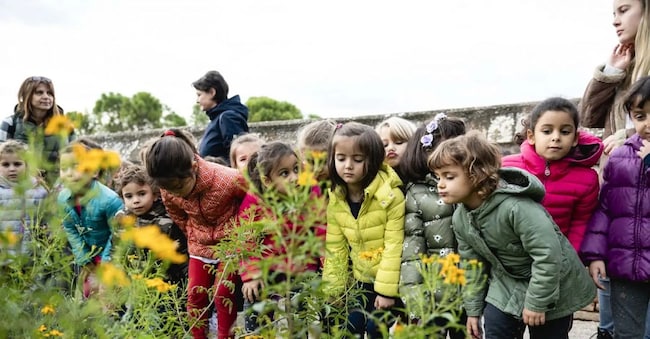
From Monday 23 to Saturday 28 November 2026, the FAI – Fondo per l’Ambiente Italiano ETS – is opening up over 250 sites across Italia to schools. During the ‘FAI Days for Schools’, now in their 15th edition, pupils of all ages and school levels will be able to visit sites in their towns and local areas that have been exceptionally opened to the public thanks to the Foundation’s volunteers, accompanied by special guides: the ‘Apprendisti Ciceroni’ (Ciceroni Apprentices), who are students themselves and take part with their class in an educational project devised by the FAI some 30 years ago. This project involves thousands of young people every year, not only educating them but also making them key players in promoting the cultural heritage of their local area.
For the education sector
Modelled on the more famous FAI Spring and Autumn Open Days, the ‘FAI Open Days for Schools’ are exclusively reserved for the education sector. For a whole week, historic buildings, gardens, nature reserves, parks, churches and monuments will open their doors exclusively to pupils of all ages and school levels, and to the ‘Apprendisti Ciceroni’ (trainee tour guides) who will lead them – these guides having been specially trained by FAI volunteers in collaboration with their teachers.
The figures
An event which, in 2025, saw the participation of 7,500 Ciceroni apprentices and 36,000 students in total, and provided an exceptional educational experience based on the concept of peer education, and which revolutionises the traditional relationship between teacher and learner to encourage young people to discover Italia’s historical, artistic and natural heritage first-hand and actively, and to instil in them the desire to participate, as citizens of today and tomorrow, in its protection and promotion.
Open attractions across Italia
For the 2026 ‘FAI Days for Schools’ too, the sites open across Italia – thanks to the FAI delegations and groups active throughout all regions – encompass a variety of types and offer schools of all levels a wealth of educational opportunities, ranging from art to history, and from nature to science, through visits to historic and institutional buildings, sites linked to our country’s history, theatres and natural heritage sites.
Historic institutions also take centre stage
The school buildings themselves also take centre stage, standing out for their history and uniqueness, such as Palazzo Provaglio in Brescia, an 18th-century building designed by Antonio Turbino and now home to a state-recognised secondary school, and the Vittorio Veneto Institute in Latina, an example of Rationalist architecture, with its fine frescoes in the Aula Magna, which have recently been restored. To mark the 800th anniversary of the death of St Francis, classes will be able to visit various sites across Italia, including the Franciscan Church in Bolzano, built in the 13th century, and the Church and cloister of St Francis in Potenza, whilst there will be a focus on sites linked to 20th-century history, such as the air-raid shelter in Via Lambioi in Belluno and the Indian Cemetery in Forlì, with the graves of the 496 soldiers who fell during the Second World War. Historic residences are also opening their doors, such as Villa Grock in Imperia – commissioned by the famous clown Charles Adrien Wettach and featuring eclectic architecture inspired by the world of the circus – and Palazzo Cerretani in Florence, now the headquarters of the Regional Council and home to some remarkably decorated rooms, including the Sala del Barbarossa, frescoed by Vincenzo Meucci, whilst in terms of natural heritage, visits are planned to the Faggeta Vetusta in Vieste (FG), with its rich biodiversity, and to the pine forest in Alba Adriatica (TE). Among the institutional venues hosting the school groups are the Police Headquarters in Messina and Foligno Town Hall (PG), which, throughout its history from the 13th century to the present day, has undergone several periods of renewal and reconstruction, whilst in Milan, students will be able to discover the ‘secrets’ of the Palazzo delle Finanze, with access also to the vault, the air-raid shelter and the ‘loggia della fortuna’, where the lottery draws took place. There will also be venues run by cultural organisations, such as the ‘Gabriele Rossetti’ Municipal Theatre in Vasto (CH), founded over two centuries ago under the name ‘Real Teatro Borbonico’, the Lauro Rossi Theatre in Macerata and the Teatro Sociale in Valenza (AL), designed by engineer Ernesto Clerico, an example of an Italian-style theatre with a neoclassical façade, a horseshoe-shaped auditorium and interior decorations.

Brand connect


Newsletter Scuola+
La newsletter premium dedicata al mondo della scuola con approfondimenti normativi, analisi e guide operative
Abbonati