
1976: when the Davis Cup made history
Eliana Di Caro recounts the controversial story of the final won by Panatta and his teammates in Pinochet’s Chile, set against the backdrop of a turbulent year for Italian society

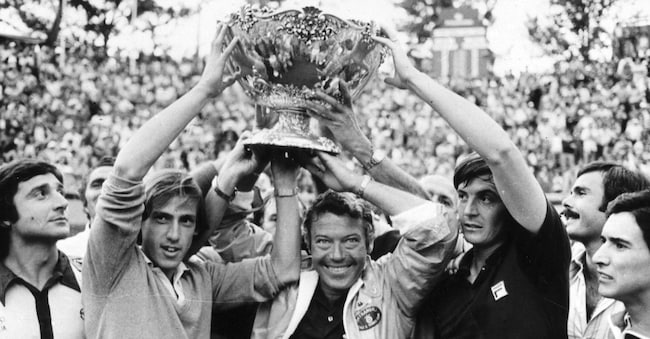
It is a book that, right from the very first pages, impresses with both its thoroughly enjoyable style and its consistently gripping narrative. And after a while, the meticulousness of the research also becomes apparent. The author has drawn on a wide variety of sources, including the invaluable (for tennis) Gianni Clerici Archive, housed at the Brescia campus of the Catholic University, where she also listened to the radio commentaries with which Mario Giobbe provided Italians, on Rai Radio 2, with the only live coverage of the controversial Davis Cup final between Chile and Italia on 17–19 December 1976.
What does he offer us in these densely packed pages? First and foremost, multi-faceted portraits of the six characters at the heart of the story: Mario Belardinelli, technical manager of the national team and director of the Formia Centre, where he had trained and nurtured almost all of the finest Italian tennis players; Nicola Pietrangeli, the non-playing captain with a wealth of honours to his name; and then the four members of the team: Adriano Panatta, Corrado Barazzutti, Paolo Bertolucci and Tonino Zugarelli. It is left to the reader to piece together these portraits of the six characters bit by bit, through the details of their private lives, their vices and virtues, their human and tennis-related qualities, and the very conflicts between them. Even those who already know them will find something here they did not know. And they come to know them better: Belardinelli, mentor and father figure; Pietrangeli, sustained and tormented by the conviction that he was unrivalled; Panatta, a talented suitor and object of admiration, though at times distracted; Barazzutti, with his unrivalled tenacity both on and off the court; Bertolucci, a golden arm with a love of good food stronger than himself; Zugarelli, who feels he has been unfairly treated as an afterthought. Anyone who loves tennis and its history will read these pages without missing a single line. Then, of course, there is the story itself and the climate in which it unfolds, dominated by the question: to go or not to go? Would going be an undeserved favour to Pinochet’s bloodthirsty regime? The sporting world tended to favour going; the media and politicians were divided, but the ‘no’ vote seemed to prevail. There had only just been the boycott of the still-racist South Africa for the Montreal Olympics. And in the Davis Cup itself, Chile had reached the final because the Soviet Union had refused to play the semi-final. And now Italia?
As I myself recall in this book (in the writing of which the author generously involved me), I – who was then the odd one out – was in favour of going to Santiago. I was among those who believed that not everyone in Chile was Pinochet and that the regime did not deserve to claim, as it would have done, the final victory in the Davis Cup. But the political parties, especially on the left, seemed entrenched in their positions. Opposition was a given from the outset, and if in the end – primarily on the part of the Communists – a tacit acceptance was reached, it was thanks to the wisdom of our Ambassador (rectius, chargé d’affaires) there, Tomaso De Vergottini, who had already earned great credit for the many opposition figures to whom he had granted refuge, subsequently facilitating their departure from the country. It was he who negotiated the release of two members of the local Communist Party in exchange for the removal of Italian political obstacles. On that occasion, the Chilean Communists made it known to their Italian comrades that a ‘no’ vote could well result in greater nationalist support for the regime. And so the team set off, but the atmosphere remained uncertain, with more people turning their backs on the event than supporting it. Not all newspapers sent their correspondents; *La Repubblica* decided at the last minute to send Saverio Tutino, but only to report on the regime’s atrocities, not the Davis Cup final. Television provided only evening news bulletins, and the only live commentary was that of Mario Giobbe on Rai Radio 2, as mentioned earlier. When the team returned to Italia with the Cup, there was no one waiting for them at the airport.This was the general atmosphere, but the victory was experienced by the sporting world – and not only by it – precisely as a victory, a source of Italian pride that had been sought for years, at least since 1961, when we had lost the final to Australia. Now we had succeeded, and the popularity of our players soared, first and foremost that of Panatta, the star of a marvellous year (he had also won the Rome and Paris Internationals), and the man who had chosen to play the doubles in Santiago wearing a red shirt, red like the handkerchiefs sewn by Chilean mothers bearing the names of their missing sons (“They’ll shoot us,” Bertolucci had said, but they’d done it anyway). The argument that we had prevented fascist Chile from inscribing its name on the Davis Cup began, thanks in part to this, to gain ground.
And here is the Italia of sport, of tennis, leaving its positive mark on a period of our history – the 1970s – which we tend, however, to remember above all as the ‘Years of Lead’. No, it was not just that, and the book, in providing the general context of the Chilean adventure, makes this clear. It reminds us of the strength of our democracy, not only in combating terrorism, but also in enacting reforms that stemmed from the ongoing social evolution in the country: family law, divorce, the abolition of mental asylums, and the national health service. We realise that the fabric of democracy, against which the ‘strategy of tension’ ran aground, was, first and foremost, solid amongst Italians themselves. And we discover that this fabric also included the educational influence of Mario Belardinelli’s Formia Centre, the sporting and personal qualities of the tennis players who emerged from it, and their red shirts on the courts of Santiago.
Eliana Di Caro

