
2020 Workers’ Regularisation Scheme: 130,000 new legally employed workers and revenue of 140 million over five years
However, of the more than 220,000 applications submitted, 40 per cent were unsuccessful. By the end of 2025, an estimated 339,000 foreign nationals will be residing in Italia without proper authorisation. In the same year, there were a total of 6,772 repatriations. The proposal to introduce a mechanism for regularisation on an individual basis, accessible subject to specific requirements

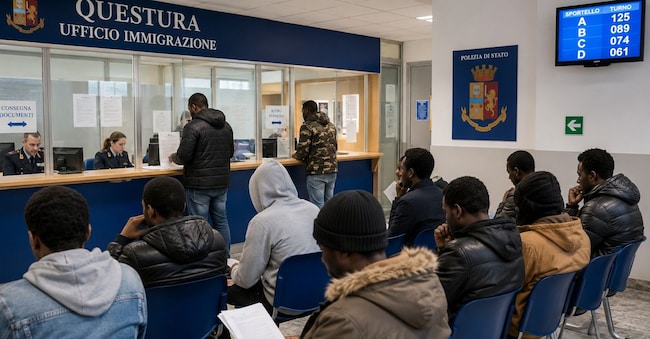
Among the measures contained in the ‘Relaunch’ Decree Law 130/2020 – adopted at the height of the pandemic to tackle the health emergency and with sufficient resources to handle a significant volume of applications – the 2020 regularisation scheme for undocumented workers stands out. Over time, the measure has enabled the regularisation of over 130,000 people who now live and work in our country. It took the authorities – led by the prefectures – five very long years to complete the process: as at 31 December 2025 59.75 per cent of the more than 220,000 applications for regularisation submitted had resulted in over 131,000 employment contracts and residence permits, with domestic work and care work (caregivers) accounting for the vast majority, at over 85 per cent of applications. These significant figures also reflect an economic aspect: €140 million in direct revenue for the State budget, resulting from the payment of fees associated with submitting regularisation applications, and approximately €228 million per year in new social security contributions (estimated) paid by those regularised after entering the labour market.
The aim of the “Ero straniero” campaign is to provide, for the first time, an up-to-date and verified overview of the 2020 extraordinary amnesty for irregular employment and the issue of residence permits to foreign workers already present in Italia – promoted by A Buon Diritto, ActionAid, ASGI, the Federation of Italian Evangelical Churches, Oxfam, ARCI, CNCA and CILD – which centres on the report ‘(Ir)Regularity. Why a new paradigm is necessary”, which is the result of analysing the findings from freedom of information requests submitted to the main ministries involved in the extraordinary regularisation process, which “Ero Straniero” has been monitoring constantly over the past six years. The report will be presented to the Senate on Tuesday 22 September during the conference “Regularisation is good”, a political debate in which MPs from both the government and the opposition will discuss current measures and respond to the concrete proposals put forward by “Ero Straniero” to combat the invisibility and exploitation of foreign nationals and to tackle xenophobia.
Repatriation and deportation: a blunt weapon against undocumented migrants
The report supporting the “Ero Straniero” campaign provides an analysis of the measures used over the last twenty years to tackle irregular migration, in the light of the results achieved. By the end of 2025, an estimated 339,000 foreign nationals are expected to be residing in Italia without valid residence permits. In the same year, there were a total of 6,772 repatriations. Over the five-year period 2020–2024, 141,675 expulsion orders were issued, yet only 13,491 actual repatriations took place (9.5 per cent of the total number of expulsion orders). The figures show that repatriations amount to only a few thousand people a year, with an extremely low success rate in terms of tackling irregular migration, and confirm that the security-focused policy strategy relying on detention and repatriation to reduce irregular migration is ineffective. On the contrary, many of the measures introduced have consistently generated new cases of irregular migration. The population in an irregular situation is, in fact, fuelled by various factors such as the loss of residence permits, slow bureaucratic procedures or, paradoxically, planned entries for work under the immigration quota decree that have not resulted in regular employment and residency status in the country.
The other tool used to date to tackle irregular migration and periodically correct the distortions that the standard system has been unable or unwilling to manage has been regularisation schemes, which have certainly served, on each occasion, to reduce the number of people in an irregular situation. Since 2002, over a million people have regularised their status in Italia through amnesties. This pool, however, is destined to fill up again almost immediately due to a rigid regulatory framework that does nothing but generate further irregularity, including the immigration quota decree.
The 2020 Special Regularisation Scheme
The previously unpublished data summarised in the report demonstrate why an amnesty cannot be the only solution to irregular migration. On the one hand, bringing over 130,000 workers – both men and women – into the open, with all the protections and benefits that this entails in economic and social terms, is a significant achievement, and demonstrates how essential it is – not only for this group, but also for businesses and families – to offer them an opportunity to emerge from invisibility. Consider the sheer volume of applications – 85 per cent of the total – submitted for domestic work and personal care, two of the sectors targeted by the 2020 regularisation scheme, alongside agriculture, involving people with deep roots in the local area who were able to rely on families willing to offer them stable employment.

