
2024 gives value to the Surrealists and neglects Arte Povera
Auction trends reward female works and those under $10,000

3' min read
3' min read
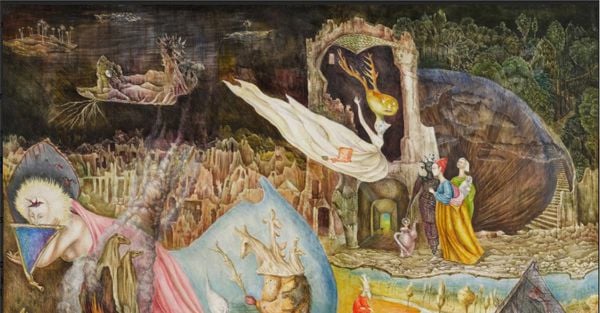
The year 2024 is drawing to a close, leaving us with some legacies. Some tracing the past, others new. It has become clear to everyone how the centenary of André Breton's first Surrealist Manifesto (1924) has propelled some of the movement's big names to new auction heights and has been one of the art market's main 'safe havens' in recent months. In addition to the usual names such as René Magritte - whose The Empire of Lights, 1954, fetched $105m to the seller and another $16m to Christie's who brought it to auction in New York on 19 November -, or Salvador Dali and Max Ernst, key female figures of Surrealism as artists and Surrealists have enjoyed a double boost in value. After notable records in 2021 for Frida Kahlo ($34.9 million), Leonor Fini ($2.3 million), Valentine Hugo ($1.34 million) and Dorothea Tanning the following year ($1.44 million), 2024 in May saw a new record of $28,5 million for Leonora Carrington with Dagobert's Distractions, purchased by Argentinean entrepreneur Eduardo Costantini, founder of the Museum of Latin American Art in Buenos Aires (Malba), thus surpassing Surrealist contemporaries Ernst (record of 16.3 million) and Dali (record of 21.67 million). Not bad, although far behind. And other female artists linked to the Surrealist movement - scrolling through Artprice's data - also achieved exceptional auction results, reflecting a trend that recovers values for female works over those achieved by their peers. The BelgianJane Graverol with "La frôleuse" doubled its estimate to reach $620,000, a sculpture byEileen Agar multiplied its estimate as did the adjudications of Jacqueline Lamba, Remedios Varo and Kay Sage. The centenary on the market thus gave a new voice to the other half of Surrealism.
L'Arte Povera up and down
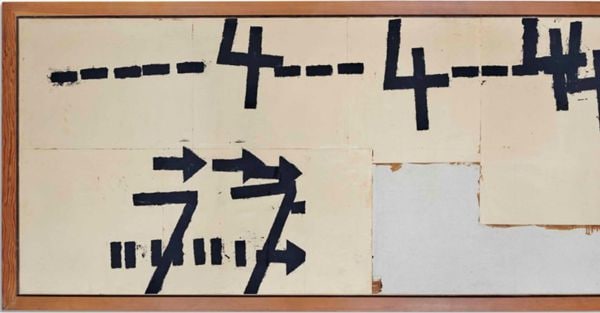
But the market has not been on the rise for everyone. The major exhibition in Paris at Pinault's Bourse de Commerce celebrating Arte Povera until 20 January did not boost values as one might have imagined. Nearly a decade ago, key Arte Povera works by artists such as Giovanni Anselmo and Luciano Fabro had reached the highest highs in auction rooms amid renewed interest in the movement theorised in 1967 by Germano Celant. The historical revaluation between 2014-2016 was followed by market appreciation with auction records also for Jannis Kounellis, Mario and Marisa Merz, Giuseppe Penone, Giulio Paolini, Pino Pascali and Gilberto Zorio. But the only one who kept running was Boetti ($8.8 million in 2022). After all, 2017 marked the 50th anniversary of the movement's birth and with it possible limits to the export of its works from Italy. This risk may have prompted many international collectors and dealers to redouble their efforts to acquire the poveristas who transformed raw and natural materials into works of art, before they became 'inaccessible'. The result was a spike in competition that inflated prices in a short period. And then? In recent years, works with reduced valuations and a lower unsold rate have returned to the market. Has Arte Povera become even more popular and well-known despite or thanks to lower prices? This latest exhibition in Paris was an opportunity to draw new connections with contemporary artists and to relaunch it on the international scene. The market will tell us whether it is still undervalued.
works under 10,000
.Another phenomenon that cannot be ignored is the exponential growth in the volume of affordable art, works traded at auctions under $10,000: 91% of works sold under the hammer worldwide in the first half of the year continuing into the second. Two years ago, the volume was 89%, a small 2% growth in two years actually represents another 30,000 works of art that found buyers in international auction halls under $10,000. This segment of course contains everything from decorative works that can no longer be offered on the market, and it is good to enjoy them without fretting, to hidden treasures that can revalue. It is all about guessing, having an eye and a study, which work is undervalued. Gallerists with an experienced eye often look for this at smaller auctions.
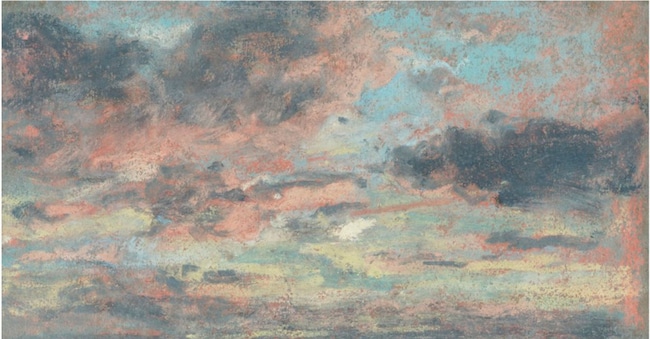
A few examples? A drawing by Eugène Boudin, bought for less than $6,000 in 2017, resold for $259,000 this year, generating an impressive $253,000 profit in just seven years.


