
Summer sales 2026: it’s almost dead calm
Resca: “Customers are only buying what they really need.” Sales have remained largely stable in the first few days

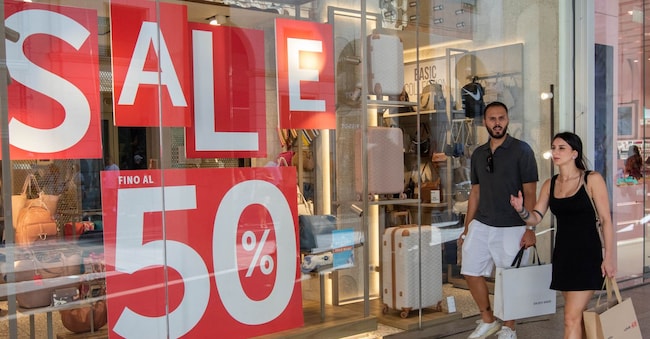
Broadly in line with the trend of the previous year. The first few days of the ‘2026 summer sales’ have seen a slight dip in sales figures, in the region of a few tenths of a percentage point compared with the previous year. This is what emerges from the first survey carried out by the Confimprese Research Centre, but with one common factor: the discounts are not enough to boost demand. Since 4 July, when the sales began across almost all of Italia, sales of clothing and accessories have fallen by 0.4%, whilst other retail sectors have seen a 0.1% decline – a slightly negative trend. The average receipt shows similar trends in terms of value, with no significant changes compared to 2025. In terms of footfall, the clothing and accessories sector recorded a fall of -2.4%, whilst the ‘other retail’ sector showed a slight increase in footfall compared with 2025, at +1.4%.
“Sales are no longer, on their own, a driver of consumption,” warns Mario Resca, president of Confimprese. “Customers are looking for value for money, but they only buy what they consider to be truly necessary. Consumers are now more selective and informed; they compare prices and put off non-essential purchases. This is why, today, competitiveness in the retail sector increasingly hinges on the quality of the product range, service and shopping experience, as well as on discounts. Consumers are keeping a close eye on the total on their receipt, confirming a cautious approach even during promotional periods.”
Thus, in the clothing and accessories sector, a mismatch between footfall and sales is evident: whilst visitor numbers have fallen and the average receipt value has remained broadly stable, sales have seen only a modest decline. Conversely, in other retail sectors, the increase in visitor numbers has not translated into a corresponding improvement in sales, which remain virtually stable. These trends suggest differences in consumer purchasing behaviour and, in the case of clothing and accessories, are consistent with a possible improvement in the conversion rate.
As regards sales channels, shopping centres were chosen by 57 per cent of consumers, making them the best-performing channel at the weekend. They are followed, some way behind, by high-street shops, outlet centres and local shops.
Stable sales are linked to a decline in purchasing power and weather conditions, with the heatwave affecting footfall in the clothing and accessories sector, which is highly weather-sensitive. According to retailers, sales are heavily influenced by the decline in purchasing power (36.7 per cent), the weather and seasonal trends, but also by pre-sales and the ongoing promotional sales activities, which ultimately diminish the appeal and interest in the sales.

