
Mountain angels on duty 24 hours a day to save lives
The structure. The Valdostan Mountain Rescue Service employs around 200 people, 45 of whom are truly elite. The crews carry out an average of five interventions per day: half of them over 2,000 metres

3' min read
3' min read
In 2023, Soccorso Alpino Valdostano carried out 1,705 missions, or 13% of all those carried out in Italy. 50% of the operations were conducted at an altitude of over 2,000 metres. "The year 2024 will end with a total figure in line with that of the previous twelve months," predicts Paolo Comune, 51, in his second term as director of Soccorso Alpino Valdostano. From 1 January to 31 August, there were already 1,360 interventions, for 1,415 people rescued. 'An important part of the missions always concerns interventions on the ski slopes,' emphasises Commune: we are talking about 5oo-600 operations. Since the beginning of the year, more than 330 interventions have been necessary in mountaineering, hiking and mountain biking. Most of these (over 310) were missions carried out this summer, between 1 June and the end of August. The average is five missions per day, with peaks of 15.
"The trend is increasing, and almost every year the number of calls grows," explains the director of the Valdostan Mountain Rescue Service. "Ten years ago, there were about half as many calls as there are today: 885 compared to 1,705 in 2023.
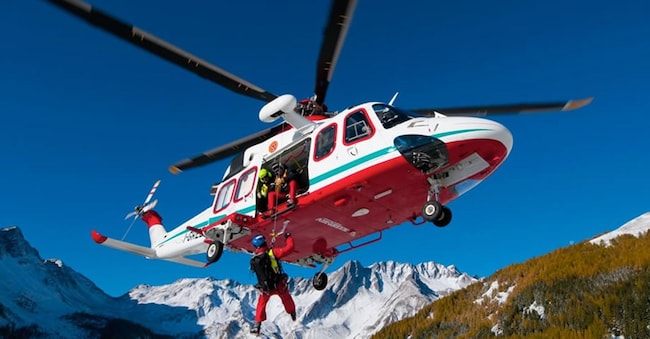
The Soccorso Alpino Valdostano was created in 1975 and is an 'instrumental body of the Region', says the director, made up of highly specialised personnel undergoing continuous training. The service provides for the constant presence of a crew ready to go H24 (the crews become two at certain times of the year, such as during winter holidays, particularly critical weekends and the month of August), made up of a pilot, a winch driver, a doctor and two specialised mountain rescue technicians: The latter are obligatorily alpine guides registered in the regional Uvgam (Unione valdostana guide alta montagna - Union of High Mountain Guides of Aosta Valley) register who have also passed a strict selection process: the course is complex and difficult and involves a one-year training course focusing on all the areas that can be dealt with: ropeways, ice falls, snow, avalanches, canyoning. In short, scenarios where it is possible, if not probable, to be called upon to operate. "Organisational skills, speed of intervention and a predisposition for teamwork are also needed. Mutual trust is essential when working in extreme situations,' the municipality recalls, 'as is cross-skilling: the specialised technicians must have basic medical knowledge, and the doctor on board the helicopter must have a fair amount of mountaineering experience.
"The group of specialised technicians consists of 45 people with an average age of around 40 years who have to undergo six checks every year," explains Paolo Comune. They are a kind of 'top gun' of the mountains, and at the age of 65 they have to leave the business.
In addition to these specialised technicians, there are another 90 mountain guides who have in turn received specific training and who perform a support function in particular circumstances (some were employed, for example, in the recent intervention on the Castore, in the Monte Rosa massif, when the detachment of a 'wind plate' caused a death and eight people had to be rescued). To complete the staff at the disposal of the Valdostan Mountain Rescue Service, there are also operators (not necessarily mountain guides), some of whom have dog skills. 'In all, we're talking about 200 people,' says the municipality.


