
3 out of 4 Italians choose the car for home-work journeys
Research by SD Worx shows that Italia exceeds the European average of 59%. Only 15% choose public transport, against an EU average of 20%

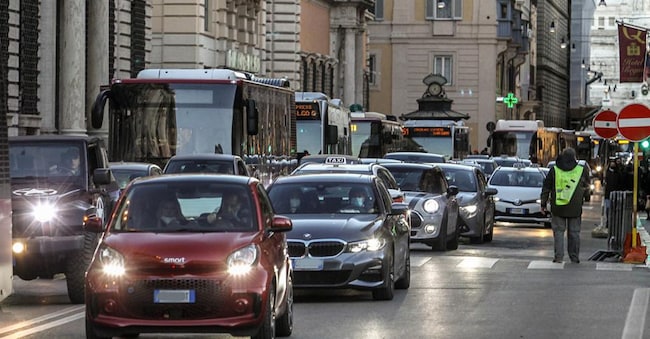
Whether it is due to infrastructure, public transport, which in both large cities and small towns does not shine in terms of efficiency, or to a cultural issue, Italia is a country where workers continue to prefer to use their private car when travelling between home and work, much more so than in the rest of Europe. This is the conclusion reached by SD Worx, the company that deals with HR & Payroll solutions, after surveying 16,500 workers in 16 European countries. In Italia, 75 per cent of the employees surveyed say they mainly drive to work, clearly exceeding the European average of 59 per cent. How many use public transport, such as train, bus, metro or tram? Only 15%, against an EU average of 20%.
The picture that emerged is consistent with the data from the '22nd Report on the Mobility of Italians' (Audimob-ISFORT, 2025), which recounts a country that is still very car-centric, in which the car accounts for 61% of all travel for work, study, family and leisure purposes. And yet Italia would also have the conditions to change course, especially since the distances of travel have shrunk post-Covid. Italians do in fact move more often, but for shorter distances. The average length of journeys has fallen to 9.2 km, and more than 80% of journeys are under 10 km, with a strong urban concentration.
Sustainable mobility, which is also encouraged through the presence of figures such as mobility managers, is an all-round challenge that not only involves choosing to travel by public transport, but also corporate policies that include measures such as smart working, flexible working hours, sustainable mobility benefits, and incentives for the use of public transport, bicycles and e-bikes.
Research by SD Worx confirms that commuting distances and times in Italia are among the lowest in Europe. To get to and from work, Italians take on average just over half an hour (35.2 minutes), which is shorter than the European average (52.6 minutes). Almost one in two workers (43%) manage to complete the journey in less than 30 minutes compared with 28% in Europe, while the average distance travelled remains one of the shortest among the countries involved in the survey at 45.9 kilometres. More than two thirds of workers (67%) travel less than 50 kilometres per day between return journeys, in line with the European figure (65%).
If the car continues to be the main choice, "understanding the dynamics of home-work mobility helps to better understand how work, time organisation and travel influence each other, without reducing the theme to a single variable," interprets Chiara Valdata, People Manager of SD Worx Italy. "And the data at our disposal show that the way people travel to work reflects a complex balance between habits, perceptions and daily needs. In Italia, average travel time and distances are relatively contained, an element that highlights an interesting potential for the evolution of mobility choices, especially in urban and peri-urban areas'.

