
A 30 per cent cap on class sizes for foreign pupils who have been enrolled for less than three years
Ahead of the Council of Ministers meeting on Thursday 24 September, the measures may be split into a decree-law containing urgent measures and a draft law introducing a ban on the burqa and niqab

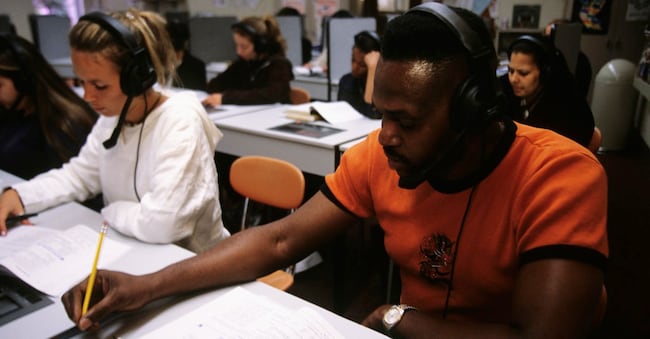
It is only a matter of days before the crackdown on foreign pupils comes into effect. But whilst the timing of its implementation appears to have been finalised – namely at the next available Cabinet meeting (probably on Thursday 24th at 4.30 pm) – discussions are still ongoing regarding how it should be structured, including with the President of the Republic.
It has not yet been decided whether the measures announced this summer by the Minister for Education and Merit, Giuseppe Valditara, and reiterated on Sunday by Prime Minister Giorgia Meloni – starting with the 30 per cent cap on non-Italian pupils in classes and the ban on burqas or niqabs in schools – will be consolidated into a single decree. Or whether, as it seems, they will be spread across a decree-law and a draft bill (or rather, a package of amendments to a bill already before Parliament).
The 30 per cent cap on class sizes
The issue will be resolved either in the pre-Council meeting or directly in the Council of Ministers. Regardless of the legislative instrument through which it is ultimately adopted, the details appear to have been finalised. As regards the 30 per cent cap, the aim is to give legal force to a provision previously contained in a circular issued in 2010 by the then Minister Mariastella Gelmini, which has often remained merely on paper. This is also due to the organisational difficulties linked to a student population that has been declining for years as a result of demographic decline, whilst the number of foreign students in classrooms is on the rise. According to the MIM database, updated as at 31 August 2025, there are 911,578 pupils with non-Italian citizenship in our schools, representing roughly 12 per cent of the total (7.5 million). The approach is to focus on pupils from abroad who have not yet completed three years of schooling and are behind in their Italian. It is envisaged that they should not exceed 30 per cent of the total number of pupils in a class. Headteachers will be responsible for distributing them more evenly across their schools or for seeking assistance from local education authorities to find a nearby school, as is currently the case for enrolments that cannot be accommodated. Additional resources may also be made available to support the schools involved, subject to approval by the Ministry of Economy and Finance (MEF). This was a topic Minister Valditara returned to yesterday during the ‘Tutti a scuola’ ceremony held in Amatrice. In highlighting ‘the need for the integration of foreign pupils, in all the crucial nuances of the term’, the Minister for Education said that we must ‘remove the causes – including linguistic ones – of unacceptable marginalisation – with particular attention to the effective mastery of the Italian language, because without knowledge of our language, without mastery of our language, there is no true integration, no academic success and no future within our society’.
The measures in the Decree-Law
Another forthcoming measure also appears to be heading in that direction; it is set to remain in the Decree-Law rather than being incorporated into the Draft Law, as should be the case for the ban on wearing the burqa or niqab at school. We are referring to compulsory Italian language courses for parents whose children are experiencing severe educational delays. The mechanism under consideration would require schools to involve social services, which would then require the families of pupils experiencing linguistic marginalisation to attend an Italian language course at an adult education centre (CPIA). The decree is also expected to include a name change for technical and vocational schools, which would become ‘licei’, thereby completing the reform of technical and vocational education promoted by Valditara, partly in implementation of the National Recovery and Resilience Plan (PNRR). It would also include a wide-ranging simplification plan for families and teachers. In addition to the allocation of 170 million to strengthen certain under-resourced areas (inspectors, school administrative offices, etc.) and to reward teachers, it would extend additional duties and remuneration for tutor teachers and careers advisers.

Brand connect


Newsletter Scuola+
La newsletter premium dedicata al mondo della scuola con approfondimenti normativi, analisi e guide operative
Abbonati