
3D as storytelling: plots, symbols and memories
From Monte Rosa to Ghana to iconic Mediterranean craft techniques

2' min read
2' min read
A surface that becomes volume and, by capturing light and touch, becomes a narrative product that also incorporates cultural references. At Cersarie 2025, ceramics is a canvas on which to engrave a new language, and this is demonstrated by the Midollino collection, designed by Giuliano Andrea dell'Uva for Ceramica Francesco De Maio. It stems from one of the most iconic weaves of Mediterranean craftsmanship, that of the reed, and restores the rhythm of a manual process that has spanned history. "The demand for 3D surfaces is growing in residential, hôtellerie and retail because it adds character without resorting to excessive colouring," explains Patrizia Famiglietti, art director of Ceramica Francesco De Maio. "For us it means expanding a family of coordinated reliefs with textured glazes and glossy and satin finishes. In the future we envisage new 3D patterns that can be modulated and combined".
In the Koinè collection by Settecento Studio, designed by Claudia Carpenito, the starting point is archaic shapes such as the handles of Messapian vases, or the imperfect semicircle. In the future, the company plans to "broaden the field of application to imitation wood and terracotta, in particular by pursuing three-dimensionality during the pressing phase, which produces a deeper, more textured effect," explains Stefano Boscolo, sales manager ofSettecento Manifattura Ceramica.
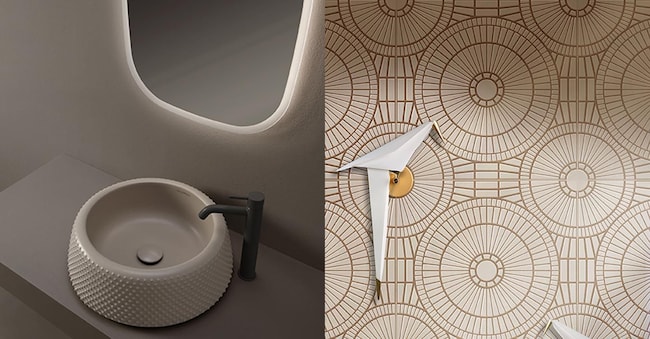
On the same coordinates Falala, the countertop washbasin by Ceramiche Flaminia redesigned by Elena Salmistraro with a dotted relief that enhances its plasticity, transforming it into a sculpture-object. The homage to sub-Saharan culture is reflected both in the shapes inspired by woven baskets and in the name itself, which in the Ghanaian language means "born in abundance".
"3D is a true design language. New technologies allow us to create surfaces where the three-dimensional sign is an integral part of the product identity. Demand is growing and represents a strategic lever for us," explains Francesco Cuoghi, General Manager of NovaBell. The company is bringing to Cersaie this year proposals such as Canvë, which interprets the memory of the terracotta tiles of the Monte Rosa lands, and Dusk, which blends mineral suggestions with different solutions: a milled line and a sculpted texture that plays with the refraction of light. Also thanks to the introduction of technological solutions such as Inphase - which alternates opacity and luminosity without physical relief, maintaining a surface smooth to the touch - and 3D Carved, a three-dimensional structure in which light and shadows intertwine.
The materiality of nature - stones, marbles, travertines - is instead the inspiration for Optimum Surfaces, which through the new Rilievo technology gives it a dual declination: architectural, with a unique format and continuous surfaces (1840×3300 mm slabs) and furnishing. "The prospects go beyond cladding," explains Davide Mularoni, president of Ceramica del Conca, which includes the Optimum Surfaces brand, "these surfaces can be transformed into large tables, continuous walls, large-scale architectural projects. For the future, we imagine materials with material effects in both the body and the surface of the slabs".

