
3I/ATLAS: what is the new interstellar object that surprises us from the depths of the galaxies
A new celestial body, 3I/ATLAS, coming from the centre of the Galaxy, arouses curiosity and questions about its luminosity and possible extraterrestrial origin

2' min read
2' min read
It appears to be a comet, quite a special one, since it comes from outside our solar system, from the central direction of our Galaxy.
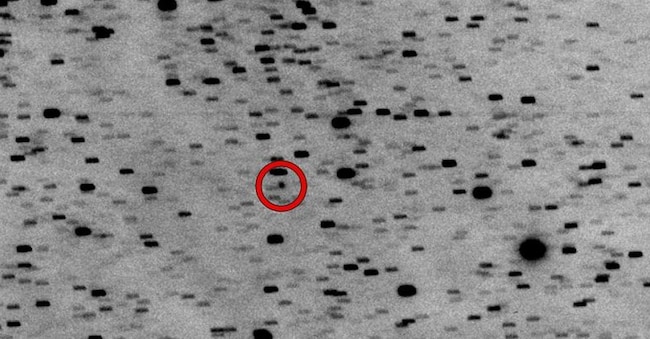
It is 3I/ATLAS, the definitive name of this new celestial body, which in recent days was provisionally called A11pI3Z, an acronym reminiscent of a Star Wars robot, even though it appears in astronomical images as a small bright dot. This is the third time in a few years, since 2017, that we have intercepted a small celestial body, a few hundred metres in length, coming from the interstellar depths, that is, many billions of kilometres, at the very least.
The first object was Oumuamua, a peculiar name in the Hawaiian language meaning 'messenger who arrives first from afar', discovered on 19 October 2017 by the Pan-STARRS 1 telescope in Hawaii, then it was the turn, in 2019, of a comet, again not a local one but of interstellar origin, the Borisov, on the kilometre in diameter, which showed an obvious small cometary luminous canopy.

Now 3I, named after Nasa's system of five telescopes, ATLAS, which monitor the sky for potentially dangerous objects.
Fear not, however, even in this case; 3I/ATLAS is still a long way from the sun, and is travelling at the considerable speed of 210,000 kilometres per hour and accelerating, but it will pass by Mars and go quietly.


