
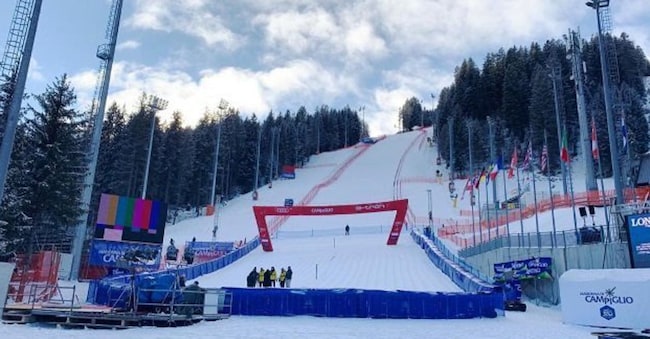
3Tre di Madonna di Campiglio, last great test for the Italian mountains before the Olympics
The historic slalom race is transformed into a laboratory for alpine tourism, with new strategies for safety, flow control and enhancing the experience beyond skiing
Key points
On a competitive level, last night's very cold night race was won by the Frenchman Clement Noël, confirming the domination of the great slalom specialists, like that of a former Olympic gold medallist, on a course that continues to be hostile for the Italians. Italy showed mixed signals: Tommaso Sala and Matteo Canins (first points in the World Cup) closed a solid run in 19th and 21st place, while Alex Vinatzer was building a first run ahead of everyone before a bump compromised his access to the second run. No final run for the third Ladin Tobias Kastlunger.
Among the elite spectators were past giants such as Alberto Tomba, Marc Girardelli, Giorgio Rocca, Ole Kristian Furuseth, Ivano Edalini, Giuliano Razzoli and Kristian Ghedina.
But the 3Tre of Madonna di Campiglio, now in its seventy-second edition, has never been 'just' an ordinary race. And this year in particular, its value goes far beyond the sporting result: it comes just a little ahead of Milan-Cortina 2026, it arrives in a complex emotional and institutional context, and it takes place in a season marked by strong climatic anomalies. This is why it represents a 'stress test' of the Alpine system in terms of safety, flow management, quality of experience and credibility of the tourism model.
Experimenting with the 'ideal number': when less is more
Heralded as a necessary revolution on the basis of the principle of 'less is more', the beating heart of this silent revolution is encapsulated in a concept that unhinges decades of mass tourism. The architect of this vision is Bruno Felicetti, General Manager of Madonna di Campiglio Cable Cars, who has transformed the concept of the limit into a luxury asset. The data that have already emerged after the first nine days of the test confirm the principles already extrapolated with scientific rigour by the University of Innsbruck, leaving no room for interpretation: 'In our ski resort, beyond 14,000 people on the slope at the same time, guest satisfaction radically collapses. We have monitored the bottlenecks and verified that up to 12,000 attendances the quality is excellent, but above 15,000 the risk of injury increases exponentially,' explains Felicetti. But the most disruptive data concerns the behaviour of the modern skier. The observation of the last few days reveals a truth that dismantles old beliefs: those who seek the perfect 'millerighe', if they have the opportunity to enter earlier (on holidays, Campiglio opened at 7.30 a.m.), are already finished at 11 a.m. "This 'early bird' population immediately demands something else, forcing us to design a 'second half' of the holiday to match the skiing".
Beyond the runway, the direction of the territory
If Felicetti governs the flows, Tullio Serafini, president of the Azienda per il Turismo, has the task of giving a soul to this new design of time. Under his leadership, the Apt has changed its face: 'We are no longer just promoters, but directors of a dual soul: the mountain soul, made up of traditions and culture, and the worldly soul linked to the Italian Lifestyle'. For him, the 3Tre has a legacy that lives on all year round through tours in the European capitals, aided by the legends who have distinguished themselves on the Canalone, starting with Stenmark: "We pamper these champions because they represent our history, but we look to the future by integrating everything that is not skiing: from trekking to night skiing, to excellent catering and the wellness of the spas".


