News

The 80th anniversary of the Republic: the turning point and new rights

The Constitution. From the health law to the education law, from the full recognition of the strike to the role of political parties and the women's vote: here is how Italia changed
by Carlo Melzi d'Eril and Giulio Enea Vigevani

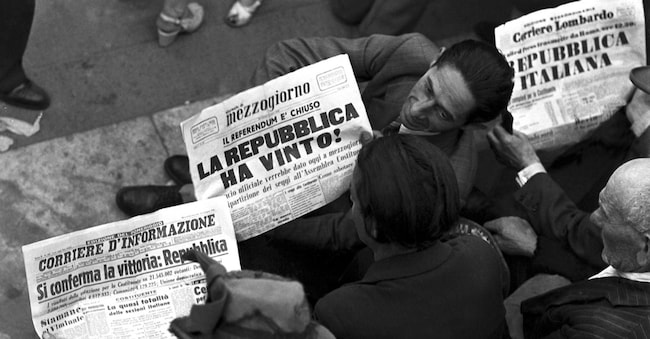
Edizioni straordinarie dei quotidiani che annunciano la vittoria della Repubblica nel referendum Istituzionale a Milano il 6 giugno 1946 (Ansa)

3' min read

Translated by AI
Versione italiana

3' min read

Translated by AI
Versione italiana

2 June 1946 is not just the day of the choice between monarchy and republic. It is the day on which the people really enter into the constitutional life of the country and, with their vote for the Constituent Assembly, entrust the new mass parties with the fundamental decisions on the destiny of the nation.

The Constitution is the child of that vote. And the new rights it introduces mark the transition from the liberal to the democratic state, where the Republic has the task of 'removing economic and social obstacles' that effectively limit freedom and participation.

Loading...

Five rights, more than others, tell of this turning point.

The first is the right to health. In liberal Italia, health was essentially an individual or public health problem. Article 32 radically changes the paradigm and qualifies it as a 'fundamental right of the individual and interest of the community'. A novel formula, which considers the effective protection of health as one of the highest functions of the Republic and, at the same time, conceives it as a right of freedom, intimately connected to the value of the dignity of the person and his right to self-determination. A conception that was perhaps too advanced for the culture of the time, so much so that it would not be fully implemented until thirty years later, with the National Health Service of 1978. And even today that constitutional promise remains fragile, amidst the welfare crisis and resistance to recognising the individual's right to decide for himself (albeit not shared by all), especially with regard to life and death.

The second is education and public schools. Articles 33 and 34 design an inclusive, pluralist school, open to all, 'even those without means'. And in that formula is perhaps the Republic's most ambitious promise: to use schooling to give everyone the chance, as Sciascia put it, to reason and, in this way, reduce the inequalities at the start. Here too, however, the distance between proclamation and implementation remains evident. School dispersion, territorial disparities and impoverishment of the public system show a promise that is still largely unfulfilled.

The third is the right to strike. The liberal state had often repressed social conflict, considering it a threat to public order. The Constitution, on the other hand, recognises the strike as a right, albeit regulated by law. It is a historic break: the conflict between workers and companies enters into the democratic order and becomes not only a legitimate, but a characterising element of it. Here too, however, the path to implementation was slow and today, amidst the precariousness and fragmentation of work, the right to strike appears less incisive than the Constituents had intended.

The fourth symbolic right of the new Republic is that of association in political parties, enshrined in Article 49. A right that is not by chance placed between the two parts of the Constitution, which recognises that the parties together have the task of integrating citizens and synthesising the various interests present in society. A centrality in Italian democracy that appears, however, deeply worn out: the crisis of representation, the personalisation of politics and abstentionism have largely emptied the constitutional idea of the party as a place of participation and collective formation of the political will.

Finally, the vote for women and their access to public office. On 2 June 1946, women voted for the first time in a national consultation and participated, in small numbers but with far from insignificant results, in the Constituent Assembly. The Republic was born, therefore, along with the recognition of women's full citizenship. Article 51 then sanctions access to public offices and elected positions 'in conditions of equality'. But even this right has been very slow to be implemented, in laws and in society. For decades, the presence of women in institutions remained marginal: for example, only in 1965 did eight women enter the judiciary, after years of obtuse prejudice. And even today, the constitutional principle continues to come up against profound cultural and social obstacles.

Of course, eighty years have not passed in vain; health and education have increased considerably, employment protections have strengthened, the spaces for political participation have expanded and, to cite just one figure, some 57% of ordinary magistrates are women. The most modern feature of the 1948 Constitution remains: not a catalogue of definitively acquired rights, but a very ambitious project always exposed to the risk of incompleteness and backwardness.

Copyright reserved ©
Loading...

Brand connect

Loading...

Newsletter

Notizie e approfondimenti sugli avvenimenti politici, economici e finanziari.

Iscriviti