
A bridge between rock and spirituality to mark the saint’s 800th anniversary
The artist, whose roots lie in rock music and religion, embodies a bridge between the sacred and the profane on his Italian tour

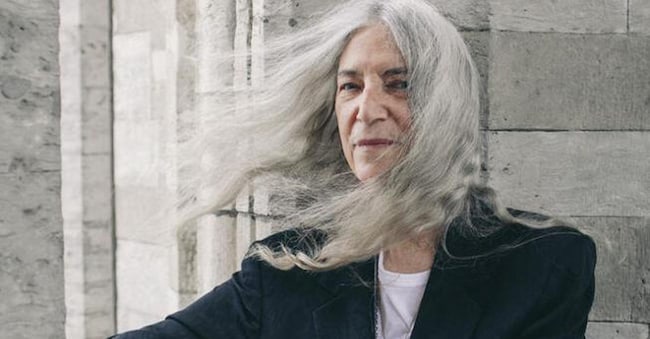
The distance between CBGB in New York and the Basilica of Saint Francis in Assisi is the same as that between a blasphemy and a prayer. The former was a filthy, deafening dive on the Bowery, frequented in the 1970s by the Ramones, Television, the Talking Heads and a very thin singer who recited Rimbaud over three chords. The latter silently houses the tomb of the saint of poverty and brotherhood with all creatures. And yet Patti Smith has inhabited both these worlds, without one cancelling out the other. The girl who made her debut in 1975 with Gloria, singing ‘Jesus died for somebody’s sins, but not for mine’, is the same woman who – fifty years later – was commissioned by the friars of the Sacred Convent to compose a poem for the eighth centenary of the saint’s death: and so Where Francis Walked came into being, written by Patti Smith whilst she was on tour to celebrate the fiftieth anniversary of the album Horses and subsequently published in the magazine *San Francesco, Patron Saint of Italia*, with an Italian translation by the Jesuit Antonio Spadaro. Those verses provide the title for Words and Music – Where Francis Walked, a show that weaves together songs, poetry and autobiographical memories, which Smith will bring to Italia between November and December. There is something about this encounter that is both exciting and moving, but to understand why the friars knocked on her door, it is not enough to recall that in 2012 Smith arrived in Assisi, prayed at length at Francis’s tomb and had lunch with the community, nor her enthusiasm for the election of the Pope who had chosen that name. We must go further back. In her autobiography Il pane degli angeli (Bompiani, 2025), the artist, born in 1946, retraces the stages of her life: her extremely impoverished childhood in South Jersey, marked by illness and spent devouring books and comics; the games of a young girl with a feverish imagination, which led her to identify with a sort of Alice who managed to find wonders where there were only ramshackle houses infested with rats; and then, at the age of twenty, her arrival in New York, the Chelsea Hotel, her all-consuming passion for Robert Mapplethorpe and the harmony of senses and intellect she shared with Tom Verlaine, her chats with William Burroughs, her artistic connection with Sam Shepard, her meeting with her band, her devotion to Bob Dylan, and the *Horses* tour accompanied by Paul Getty and Maria Schneider. A life steeped in rock ’n’ roll mythology and, at the same time, permeated by religion: the Bible in her parents’ home, a fascination with Buddhism from a very young age, her mother—who had become a Jehovah’s Witness—taking her from house to house to evangelise: ‘Buckets of urine and excrement were often thrown at us when hostile people opened the door on Saturday afternoons. It was precisely this treatment that drew me most towards them, because my inclination to side with the oppressed or the marginalised had been well nurtured by both my parents,” she writes in her memoir. In 1977, confined to bed following an accident on stage, she watched Pasolini’s The Gospel According to St Matthew several times. She was struck by the figure of that Messiah, portrayed as ‘a revolutionary whose teachings were based on love’, which, she writes, brought her back ‘to the original meaning of Christ’s message’. Francis reappears in the book on several occasions, almost incidentally. Before setting off for Europe in the late 1990s, Smith writes that she saw her father in the courtyard feeding the birds. The birds flew towards him, and she immediately thought of Giotto’s frescoes in Assisi. She did not attribute miracles to him: she recognised in him the simplicity of a saint, his belonging to a ‘sacred tribe’, describing herself as the ‘wandering daughter of the saint’. One must have read all this, and listened to Dancing Barefoot, where human love comes close to that for the Creator, or Constantine’s Dream, which moves from Piero della Francesca to encompass life, death and the devastation of nature, before turning to Where Francis Walked: ‘Lost in a forest / calling for guidance / I heard the cry / of a wounded wolf / crouched on a mound / once held sacred’. Only then does that now-worn epithet, ‘the priestess of rock’, regain some of its truest meaning. The artist will perform on 29 November at the Transart Festival in Bolzano, on 1 December at the Teatro Verdi in Salerno, on 5 December at the Teatro Feronia in San Severino and on 6 December at the Auditorium Parco della Musica in Rome. But perhaps the best news has already happened before the tour: the world is full of poets, but to speak of Francis, the friars of Assisi turned to Patti Smith.

