South China Sea

From the US to the UK to Italia: the broad coalition seeking to curb Beijing’s expansionism

‘Claims in the South China Sea are unfounded’

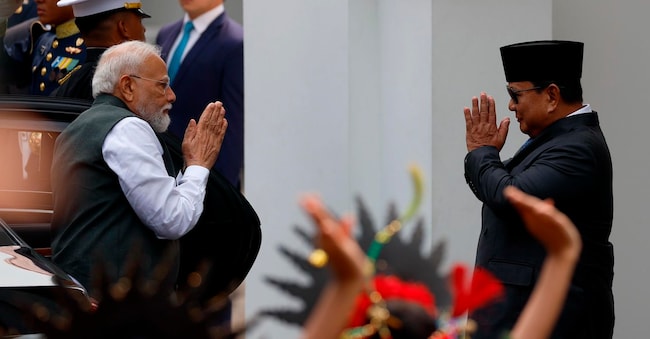
Il primo ministro indiano Narendra Modi ricevuto a Jakarta dal presidente indonesiano Prabowo Subianto  EPA

4' min read

Translated by AI
Versione italiana

4' min read

Translated by AI
Versione italiana

NEW DELHI – Just a few days after a high-profile Chinese missile test in the Pacific Ocean, on Sunday, the United States, the United Kingdom and a dozen other countries – both Western and Asian, including Italy – reiterated that China’s territorial claims in the South China Sea have no legal basis.

The occasion was the anniversary of a ruling by a tribunal established under the United Nations Convention on the Law of the Sea (UNCLOS). “We reaffirm the validity of the Arbitral Tribunal’s decision, according to which there is no legal basis for the extensive maritime claims made by China in the South China Sea, including those based on so-called ‘historic rights’,” the statement reads.

Loading...

The Tribunal had ruled that ‘there is no legal basis for China to claim historical rights over the resources of the South China Sea’ outside its own territorial areas recognised by the Convention itself. The joint statement also condemned activities deemed ‘destabilising’ in the disputed maritime areas, arguing that they pose a threat to security, peace and stability in the Indo-Pacific.

Modi’s tour of the Indo-Pacific

This statement came after an unusually busy week on the diplomatic front, largely due to the state visit by the Indian Prime Minister Narendra Modi, who visited Indonesia, Australia and New Zealand, signing agreements in various fields, but above all in strategic sectors such as defence and energy security.

Among other things, India will sell the BrahMos supersonic missiles – which it produces in a joint venture with the Russians – to Indonesia, and will buy uranium from Australia, the country with the world’s largest reserves of the mineral, which had, however, always refused to make it available to New Delhi for fear that the supplies might be diverted towards the production of nuclear weapons.

The agreements signed in recent days were made possible by a context of growing regional security tensions, exacerbated by a ballistic missile test carried out by China in the Pacific Ocean.

The launch – which was carried out from a nuclear-powered submarine and has reignited concerns about the expansion of Beijing’s military presence and capabilities – took place just a few hours before Modi’s arrival in Indonesia and just a few hours after the signing of a mutual defence agreement between Australia and Fiji.

The latter is the first formal security alliance for the small archipelago and confirms a wider trend towards deeper regional cooperation amongst the democracies of the Pacific Ocean. Subsequently, New Zealand also announced its intention to join the initiative.

A new regional landscape

Agreements such as the one between Australia and Fiji reflect a more comprehensive effort by Indo-Pacific countries to take on a greater share of responsibility for security, at a time when Washington has decided to prioritise the Western Hemisphere and is urging regional allies and partners to play a more significant role, just as Beijing continues to expand its sphere of influence.

“China’s rise as a major power in the Indo-Pacific is shaping a new regional landscape. Countries are reacting to this change,” explains Ashok Malik, head of India at The Asia Group. “It is clear,” adds Malik, “that the US presence in the region is waning and that other countries are seeking to band together to fill this void, as far as possible.”

For Malik, recent regional agreements reflect a common strategy: to strengthen cooperation between countries in the Indo-Pacific in key areas such as semiconductors, strategic raw materials, maritime security and defence, so as to limit dependence on major powers, China in particular, and to increase economic and strategic resilience.

Chinese reactions

A situation in which Beijing does not appear willing to remain a mere spectator. On Sunday, in a statement issued via its embassy in Manila, China reiterated that it will never recognise the arbitral award of the UNCLOS tribunal, describing it as ‘illegal, null and void, and without any effect’.

“The arbitration ruling does not alter the historical and factual basis of China’s sovereignty over the islands in the South China Sea and the adjacent waters,” stated the Chinese embassy in the Philippines. The diplomatic mission also added that the tribunal’s decision “will not weaken China’s resolve and determination to defend its sovereignty and its maritime rights and interests”.

Similarly, the missile launch in the Pacific a few days ago did not go unnoticed. According to Indian Foreign Secretary Vikram Misri during a press briefing in Melbourne, the test was also discussed during the bilateral meeting between Narendra Modi and the Australian Prime Minister Anthony Albanese, which took place on Thursday.

“Some concern has been expressed about this development,” Misri said diplomatically, adding that India and Australia will step up their cooperation to ensure that “peace, security and stability in the Indo-Pacific continue to be safeguarded”.

Modi has used the recent series of diplomatic meetings to repeatedly present India’s relations with its Indo-Pacific partners as being based on ‘mutual trust’, describing them during recent talks with the leaders of Japan and Indonesia as ‘the region’s greatest strategic asset’.

Copyright reserved ©
Loading...

Brand connect

Loading...

Newsletter

Notizie e approfondimenti sugli avvenimenti politici, economici e finanziari.

Iscriviti