A Carmen that breaks the bank

-U56858884387Yrz-1440x752@IlSole24Ore-Web.jpg?r=650x341)
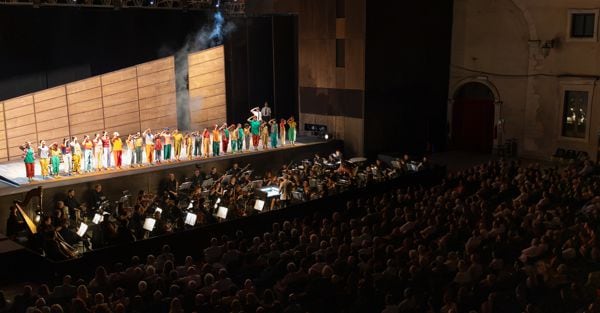
They’ve had to add quite a few chairs to the courtyard of the Palazzo Ducale in Martina Franca: the Festival della Valle d’Itria’s traditional set-up simply isn’t enough this time round. Because *Carmen* has really pulled out all the stops here, where rare works are usually staged – scores for connoisseurs and the desperately curious. So the audience is impressive, and the sight at the second performance of Georges Bizet’s masterpiece – with Fabio Luisi conducting and Denis Krief directing – evokes a true popular festival, reminiscent of the black-and-white photographs of yesteryear, when summer opera became an occasion for everyone. A celebration of discovery and connection. Opera brought to life. And yet some complain: “This isn’t a Martinà sort of opera,” mutters the person sitting next to me. A Frenchman, ‘bien sûr’, he hummed along to the best-known tunes, yet was completely taken aback by the innovations in this production: the new arrangements, and above all the striking absence of one of the anthems back home, the ‘Habanera’.
The rhythmic, straightforward song (though the descending chromatic passages are anything but easy to sing in tune) is absent from Martina Franca’s *Carmen*. This is the point of interest, the turning point, the radical rethinking that characterises the Festival’s new production – its fifty-second edition – guided by the masterful hand of Silvia Colasanti. It is no coincidence that a female composer, with her cultured sensibility, has led her to align herself with what Bizet would have wanted to stage back in 1874 in Paris: the first version, predating the criticisms of the original performers, the choristers and the impresario. Who knows if he sensed the end was near; who knows if that cutting and adding to a perfect score – we can say so now! – contributed to his state of despondency, the famous swim in the river at Bougival, and his death just a few days after the failure of what is now one of the three most frequently performed operas in the world. In the enclave of musical and theatrical culture that is Martina Franca (let us always remember that Paolo Grassi was born here), justice has been done to Bizet. Not, as has been seen elsewhere, by pointlessly including the bars intentionally omitted by the composer, but with the ‘real’ *Carmen*, entirely the work of Bizet’s own hand.
_20260731110011-U72586466841PoS-600x313@IlSole24Ore-Web.jpg)
Splendid and compelling, as is rarely the case when a score has become ingrained in our ears in a different way. At every moment, and right from the opening Overture, the new and previously unheard sections lead us into uncharted territory: softer colours, more fragrant textures. More pictorial and less rhythmic, more French and less Spanish. It would be a mistake to turn Bizet into a forerunner of Ravel. The success in Martina Franca also lies in the freshness of the conductor: for Fabio Luisi, who is also the musical director here, this is his first ‘Carmen’ – the critical edition by Paul Prévost, published by Bärenreiter – which until now has been performed almost in secret and never staged. Far from being ‘not an opera for Martinà’: this is a stunning world premiere. It deserves to be revived elsewhere, precisely because of the richness and artistry of the score: with the ‘melodrames’—spoken dialogue set against the backdrop of the orchestra (as outlined in the treatise on orchestration)— with a softer rhythmic texture (which Luisi maintained in a decidedly lulling manner), and with the brutality of the final murder—which, being non-veristic, is all the more poignant, for it is not a gesture for effect, but the culmination of a far more intricate and fully developed narrative.
-U30747887402xNl-600x313@IlSole24Ore-Web.jpg)
All the performers were excellent – a festival worthy of the name should aim to encourage them to tackle new roles as well – starting with the ‘Carmen’ sung by mezzo-soprano Deniz Uzun, with her magnificent tone and powerful low register, alongside tenor Matteo Lippi, who was impeccable and convincing, and Natalia Tanasii’s Micaëla, who was very confident, having, incidentally, only just sung the role at La Scala. Alessandro Luongo, as Escamillo, seemed just slightly fatigued, but singing outdoors can always throw up the unexpected. Take, for instance, the fireworks – fired off in rapid succession and incredibly loud – from a house near the Palazzo Ducale: the performers were heroic in carrying on tirelessly, without a moment’s hesitation. Moreover, it was during the ‘Aria delle carte’, and those gunshots almost seemed tailor-made to foreshadow her death. A resounding round of applause for all the other performers, students of the ‘Rodolfo Celletti’ Academy of Bel Canto, with a special mention for Ariadna Vilardaga and Marina Fita Monfort.
The narrative harmony between the music and the direction is perfect, because Denis Krief is a director who knows how to read a score. And he champions a school of theatre that tells a story, step by step, with a down-to-earth approach, without fanfare. His staging is as minimalist as one could imagine: seven panels, a few chairs, a couple of tables (undoubtedly borrowed from the bars of Martina Franca) and a bed, where she is plausibly murdered. Not in the street, as one might expect. And this choice – not even particularly subversive – is entirely convincing. Just as the cigarette-makers in their work clothes – brown aprons and white headscarves – are spot on: they carry mimosas, symbolic of course, but also yellow, as Mérimée’s text intended. Enough of those cloying roses.