
A ‘city plan’ to meet energy targets
By 2030, 40.1 per cent of buildings’ energy consumption is to come from renewable sources. Italia has not yet submitted a plan for green homes to Brussels

Key points
- • Slow-moving refurbishments and ambitious targets
- • The solution lies in a combination of distributed renewable energy, storage, collective self-consumption and electric mobility
- • District heating can save you up to 60%
- • The role of CERs in integrated urban policies
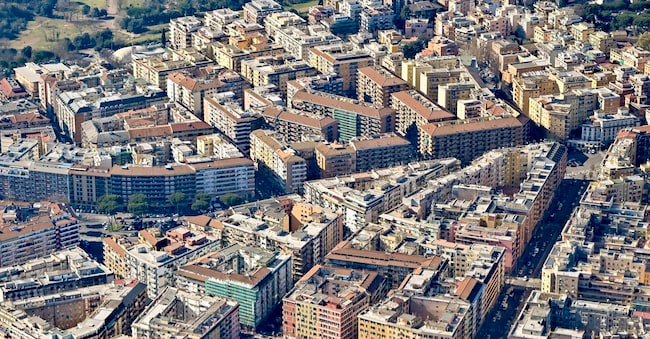
(Il Sole 24 Ore Radiocor) – Cities are the key to achieving energy targets. Without taking action on the urban fabric, it is impossible to achieve the transition sought by Brussels – not only with regard to so-called ‘green homes’, for which the deadline is now fast approaching, but also in terms of climate targets. That is why Italia is calling for a ‘city plan’ rather than a ‘housing plan’.
The objectives
The figures speak for themselves, as listed one by one by the Bocconi SUR (Sustainable Urban Regeneration) Lab: the construction sector is responsible for over 40 per cent of energy consumption and over 30 per cent of CO₂ emissions in Europe, and almost all buildings with poor energy performance are set to remain in use until 2050. At the same time, targets are being raised: at the end of January, the decree was published in the Official Gazette through which Italia completed the transposition of the RED III Directive, updating the national framework on renewable energy sources. The measure raises the national target for 2030 to 39.4 per cent of gross final energy consumption and sets a target for the building sector to meet at least 40.1 per cent of buildings’ energy consumption from renewable sources.
These figures suggest that without making sweeping changes to the energy infrastructure of our cities, it will be impossible to reduce energy consumption, keep costs down for households and businesses, and achieve the target of a zero-emission building stock by 2050. The same applies to the other interim milestones that are now fast approaching. Yet the process is struggling to get off the ground. Italia was due to submit a plan to Brussels for the refurbishment of buildings in line with the so-called ‘Green Homes Directive’ by 31 December 2025. A deadline that has not been met – and, to be honest, not just by our country.
This presents an opportunity, however, to rethink not so much a housing plan as an urban plan. ‘The real challenge is not just to renovate, but to intelligently integrate energy, infrastructure and services,’ says Annamaria Bagaini, a researcher at SUR Lab Bocconi and MUSA Spoke 1 – Urban Regeneration. Urban regeneration processes make the integration of renewable energy systems into the urban fabric more effective and sustainable, thanks to the coordinated development of local distribution networks and the integration of storage systems. This makes it possible to maximise the value of distributed renewable energy generation and promote a better balance between production and consumption at the urban and neighbourhood levels.”
In essence, the key would be to take simultaneous action on household energy consumption, as well as on generation, the grid and, last but not least, transport. ‘Charging infrastructure for electric vehicles is not merely an element of transport; it is becoming an integral part of the urban energy system, helping to modulate loads, distribute consumption points more evenly and strengthen local management of energy flows in conjunction with renewable generation, storage and smart grids’, explains Bagaini.

