A classic car is best seen on the move. Preferably on winding roads and Alpine passes
One of the world’s leading collectors of vintage cars, Californian David Sydorick, explains how he built up his collection of Zagatos and why he returned to Italia for the Louis Vuitton Classic Run.

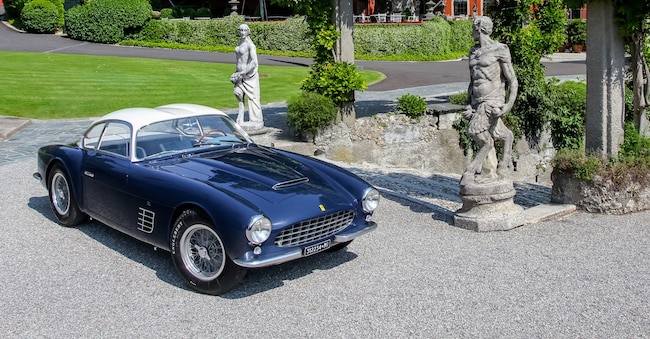
Just like falling in love – with which it shares the dizzying thrill of obsession – collecting, too, thrives on details, on the allure that arises from the finer points. For confirmation, ask David Sydorick, who, at 79, in his Beverly Hills garage, has still not grown tired of circling his collection of classic cars with Zagato bodywork. They stand out from the crowd thanks to one unmistakable detail: the double hump on the roof, with its shape that is evocative to say the least. ‘It’s strange that in the last 50 years no one has thought to imitate it,’ he explains, confessing something a collector rarely lets slip: that he has reached a point of unsurpassable fulfilment. ‘I’ve owned practically all the best Zagatos and I love the ones I have in my garage today.’
Unlike Chatwin’s Utz, in short, Sydorick has no intention of chasing after every piece of Meissen porcelain; in his case, it is a collection of dream cars produced over more than a hundred years by the Milanese coachbuilder. His is a lesson in pragmatism applied to collecting: ‘When I started buying classic cars, I wanted one of everything I liked. But that’s impossible. So I asked myself which was my favourite car, and it turned out it wasn’t a motor car at all, but a coachbuilder. Zagato, precisely, because it has always designed lightweight, aerodynamic, unmistakable cars with that double-hump roof. In short, Italian cars. And I’ve tried to fill my garage with all the most beautiful cars they’ve ever made, regardless of whether they were Aston Martins or Fiats, Maseratis or Ferraris.”
Cars which – were they to appear on the market – would easily fetch (many) millions of euros, although it is decidedly inappropriate to talk about money when trying to put a figure on a collection that all enthusiasts envy him for. Not least because, as he admits, you don’t need astronomical sums to treat yourself to iconic and beautiful cars. ‘The first car that made my heart race, when I was young, was the Jaguar E-Type’, crowned the most beautiful car in the world by a certain Enzo Ferrari. “You can still find loads of them today,” explains Sydorick. And with prices hovering around 60,000 euros for a model in good condition, it’s hard to disagree with him. Sticking with the Zagato world, you can take home some of the brand’s more popular (yet still iconic) models, such as the 1970s Lancia Fulvia Sport, for 20,000–30,000 euros.
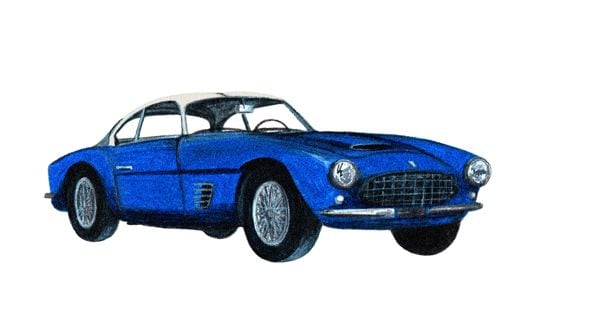
Narrowing down one’s desires does not limit one’s passion – quite the opposite, in fact. Even amongst a selection of legendary cars, Sydorick makes no secret of the fact that he has a favourite: a 1956 Ferrari 250 GTZ. An exceptionally elegant coupé with its sleek lines and blue and white colour scheme, a car that has had a chequered history, from a time when collecting Maranello coupés was still in its infancy, but which Sydorick has restored to a condition that is, if possible, even better than when it left the Milanese coachbuilder’s workshop. ‘Once, a gentleman approached me, looking first at me and then at the Ferrari,’ he recounts. ‘In the end, he said to me: “I bet you can never say no to her.” And I replied: “How could I?”’
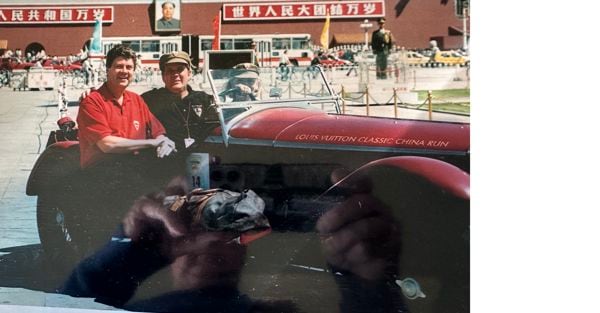
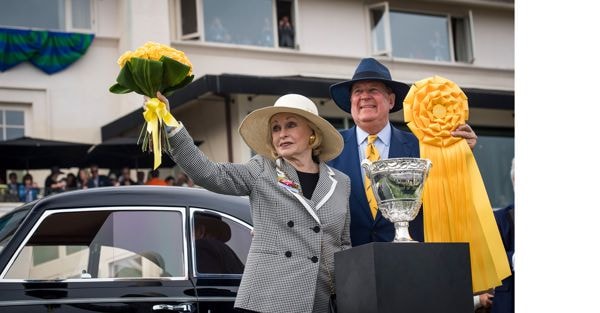
At the wheel of this 250 GTZ (one of only five in existence), the American collector has won the most prestigious awards, yet he has not yet grown tired of taking it around the world, almost as if sharing such beauty were a mission rather than a display of exclusivity. This is exactly what he has been doing recently for the Louis Vuitton Dolomites Classic Run 2026, a race-event dedicated to classic cars, on a route that began at Villa Pisani on the Riviera del Brenta and ended in Monza, to coincide with the Formula 1 Grand Prix.