
An artist's sundial in the garden or terrace, custom-designed
It is called gnomonics and is an ancient science, combining astronomy, trigonometry, optics and sculpture. Today, a few (and much sought-after) craftsmen are reviving it as a decorative technique.
by Chiara Corridori
4' min read
4' min read
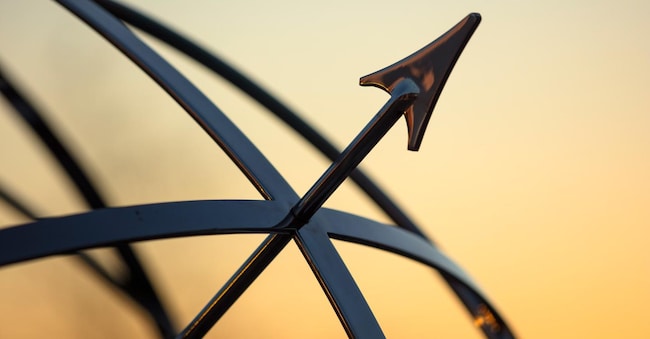
Beauty and precision. Accuracy of calculation and decorative intent. Sundials proper are instruments that mark, with natural light, midday, while sundials are a varied and complex constellation, marking the different times of the day and displaying, in addition to midday, solstices and equinoxes, monthly and seasonal calendars, anniversaries and dates. The possibilities of measurement are almost limitless: the earth turns and light, in the presence of a rod, the gnomon, produces a shadow that strikes a precise point on a surface, the quadrant, where lines and numbers are marked. Gnomonics is a very ancient science and was considered a branch of astronomy until the 16th century. In reality it is a mix of knowledge that involves mathematics, trigonometry, nautics, optics, geometry. And of course art, sculpture and painting, cabinet-making, goldsmithing, architecture. For centuries, sundials were the jewels of Renaissance gardens, Baroque estates and aristocratic residences, until the almost total decline triggered by the first time signal from Greenwich Observatory and broadcast by the BBC with a succession of six beeps on 5 February 1924.
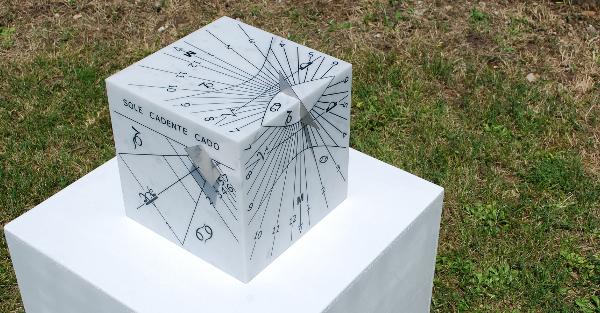
Today we are once again talking about sundials and sundials in a new key, as decorative elements for indoor and outdoor use, the work of rare and therefore much sought-after gnomonist craftsmen. These are made-to-measure creations, which are strictly site-specific because chronometric precision has an inseparable link with the geographical coordinates of places. "Each sun dial is built on a surface that has a precise orientation: one must therefore always start with a technical survey to determine it. From this, an initial calculation is made to arrive at the shape of the sciographic structure, i.e. the set of lines needed to read the clock," explains Fabio Garnero. With his business, Solaria Opere, he belongs to the group of artisans counted by the Cologni Foundation among the rare or endangered artistic trades. An architect by training, Garnero specialises in the design and construction from scratch, as well as the restoration, of sundials and sundials. "I have been working in this field since 1999. One of the works I am proud of is the sundial that I recalculated and reconstructed for the Salone degli Svizzeri in the Palazzo Reale in Turin'.
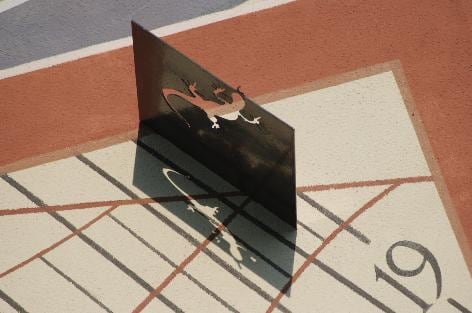
His creations are mostly pictorial executions, but Garnero also declines gnomonics in 3D, with spheres, cubes, concave hemispheres, in marble, but especially in absolute black granite from Africa. "It is among the hardest and most resistant in the world and lends itself very well to engraving. This material gives rise to sculpture-watches as shiny and magnetic as monoliths. Everything is strictly tailor-made, even the price range (from 4,000 to 100,000 euro), which varies according to the complexity of the project, the size, the type. "Before doing the sketches I listen carefully to the requirements. I ask the client's passions and desires. A sundial speaks of the person who owns it, it can be customised in infinite ways'. Thus, for example, the gnomonic work designed for the architect Francesca Chiorino and her husband Federico Sella: 'The anniversary line, with the monogram FF, is touched by the shadow of the stylus every 1 March, their wedding day'.
In his workshop in Merone, Giuseppe Giudici creates eclectic custom designs: frescoed sundials (between EUR 5,000 and 12,000), garden sundials in stone, marble and gilded bronze (from EUR 3,400), and enigmatic armillary spheres. "The invention is attributed to Eratosthenes, around 250 BC, and they represent the vault of heaven three-dimensionally," he explains. "They were once used as an astronomical instrument, also for teaching purposes. I mainly use corten to construct them. The circles that form the sphere are not curved bars, but are obtained by cutting thick metal sheets. This is an important technical aspect that ensures greater stability and robustness'. Other materials used include mirror-polished stainless steel, so that the work blends in with its surroundings and the surface dances with the light (27,500 euros for the wide, tall and 50 cm deep version). In his atelier Orologi Senza Tempo, Giudici also offers dials in transparency, which can be enjoyed in a more intimate dimension. "As well as for gardens and terraces, they can be made on lead-bound windows decorated with grisaille".
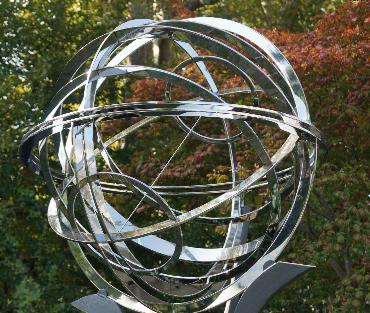
Across the Channel, in Oxfordshire, the specialist is David Harber, who exports his creations all over the world. "Sundials are successful because they exert a reassuring, meditative and cathartic effect. They create a moment of peace and suspension within our hectic lives. I started by restoring a sundial that was more than 500 years old. At that moment, I think I decided to dedicate myself to this craft. I realised that, in my life, I wanted to create elements capable of withstanding the test of time, just as they mark its inexorable passing". His clients include the royal family, actors like Jeremy Irons and Judi Dench, many entrepreneurs and collectors. Harber's challenge is innovation in an age-old industry. "The only limit to free fantasy is mathematical calculation. For the rest, aesthetics and form are an open playing field'. The types of dials range from the most basic to the most complex, and the choice is wide between obelisks, globes, armillary spheres (prices start at £7,800, but most orders range between £10,000 and £30,000). At the upcoming Chelsea Flower Show (21 to 25 May) Harber will present a limited edition, Armillary 30, to celebrate its 30th year with the novelty of an unprecedented interactive mechanism.

