The cycle traveller

Between the Apennines, the Apuan Alps and the Ligurian Sea: a cycle tour of Lunigiana

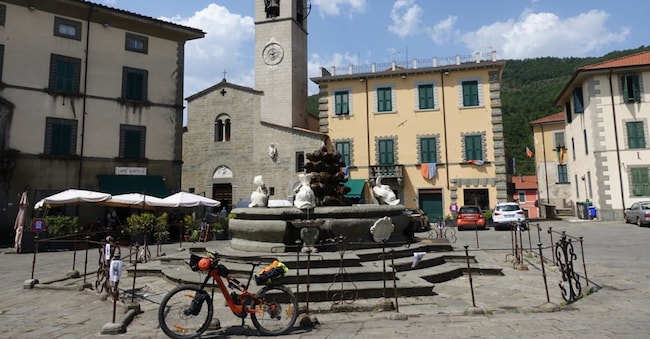
The area straddling Tuscany and Liguria is made up of small villages, unknown to most, yet rich in treasures, history and stories. From Pontremoli to the views over Versilia and the Gulf of La Spezia, this is a part of Italia often regarded as ‘lesser’, yet brimming with tranquillity and culinary delights, making it ideal for motorcycling.

6' min read

Translated by AI
Versione italiana

6' min read

Translated by AI
Versione italiana

It is an Italia perceived as ‘lesser’, off the beaten track of mass tourism, where there is no glamour, no boutiques and no celebrities. On the other hand, there is peace, quiet and even a cool climate. Here, the streams carry water even during periods of extreme drought.

This is an Italia of small villages, often threatened by depopulation. Unknown to most, they nevertheless harbour extraordinary archaeological, historical, artistic, natural and scenic treasures. Abroad, such a heritage would be showcased and turned into a source of income. In Italy, however, as we know, many treasures are left to lie dormant, because – as we hear repeated time and again – ‘we have too much of everything’.

Loading...

Only time will tell whether such undeserved neglect is a blessing or a curse.

Tra Appennini, Apuane e Mar Ligure: il giro della Lunigiana in bici

Photogallery27 foto

Where Tuscany and Liguria meet

We are in Lunigiana, that corner of Tuscany which borders on Liguria. A land of cultural influences, accents and dialects; but also of flavours and cuisine. The province is Massa Carrara, but in the local trattorias they serve testaroli with pesto, because La Spezia and the Gulf of Poets are just a stone’s throw away.

And just a stone’s throw away is the Versilia coast, with its luxury tourism, nightlife and Michelin-starred restaurants. The name derives from Luni, a Roman port city dating from the 2nd century BC, situated near the mouth of the River Magra.

It is a land of long-standing anarchist traditions at the foot of the Apuan Alps, where, right up until the 1960s, stonecutters and quarrymen extracted the world’s finest marble from the mountains, using techniques not so very different from those employed in Roman times. It is also a land of partisan resistance, of massacres and Nazi-Fascist atrocities, for it was here in 1944 that German troops tried in vain to defend the Gothic Line before being overwhelmed by the Allies.

Promoting the local area

For some years now, this area – which remains well-preserved – has been opening up to cycle tourism, promoting itself as the Lunigiana Bike Area. The first steps were taken just before the Covid pandemic. The pandemic then gave the initiative a boost. On the website, you can find free GPX tracks for a wide range of routes: short, long, easy, challenging – suitable for cyclists of all abilities, including families with children. Among these is the complete tour of the Lunigiana, which can be completed over several days by mountain bike, gravel bike or e-bike.

“It’s a grassroots initiative, launched by the cycle tourism associations in this area,” comments Mattia Olivieri of the Sigeric co-operative, an organisation dedicated to promoting the region. An effort which – far from being a foregone conclusion – has found the support of local councils and the Region of Tuscany, to the extent that some routes in the Lunigiana Bike Area can even be found on the VisitTuscany website. “To the rest of the world,” Olivieri remarks wryly, “we were just an exit off the motorway. Now cycle tourism is helping to rediscover these previously overlooked areas. Here, people find peace and quiet, reasonable prices and decent facilities.”

“We can indeed see that there is a certain amount of cycle tourism, even though we are not yet equipped to measure its impact accurately,” comments Marco Leoncini, author of various GPX tracks, including the Lunigiana Trail, a rather challenging route designed for mountain bikes.

However, the route most popular with visitors is the easier version, the Lunigiana Gravel Trail, which has a low to medium level of technical difficulty and can also be tackled on an e-bike – a route that has the advantage of reducing the effort whilst keeping the fun intact.

Loading...

Small villages, few luxuries

It is a route of approximately 210 kilometres with 5,250 metres of elevation gain: 40 per cent on dirt tracks; 40 per cent on secondary tarmac roads with very little traffic; 20 per cent on woodland paths. It can be completed, depending on your preference, in three or four days. Accommodation is in small inns – nothing too luxurious. It is a signature route, masterfully designed by Leoncini, which takes the cycle traveller through the most interesting parts of the Lunigiana.

In some sections, it runs alongside the Via Francigena, which crosses the Apennines, descends from the Cisa Pass and continues on to Rome; in other sections, however, it runs alongside the spectacular and exceptionally scenic Alta Via dei Monti Liguri.

“In just over 200 kilometres,” explains Leoncini, “it passes through three very different areas. First, the Tuscan-Emilian Apennines with their medieval villages and castles; then the stretch at the foot of the Apuan Alps, which passes through Equi Terme. And finally, the Ligurian-Tuscan Apennines, with breathtaking views of the sea.”

The ‘Gateway to Tuscany’

The starting and finishing point is Pontremoli, “clavis et ianuae Tusciae”, “the key and gateway to Tuscany”, as it was described by Sigeric, Archbishop of Canterbury, who in 990 AD travelled on foot as a pilgrim from England to Rome, leaving us a detailed account of the medieval Via Francigena. The village of Pontremoli, at the confluence of the Verde stream and the River Magra, is well worth a visit.

A must-see at Piagnaro Castle is the Museum of Stele Statues, featuring anthropomorphic sculptural masterpieces with strikingly modern lines, carved from sandstone between the 4th and 1st millennia BC.

Another must-visit is the historic Caffè degli Svizzeri in Piazza della Repubblica, where you can sample the ‘amor’ – cream-filled pastries made to a secret recipe, sandwiched between two wafer sheets. Every summer, Italian booksellers gather in that very square for the Bancarella Prize.

From Pontremoli, you start cycling along dirt tracks through the woods towards Filattiera and Villafranca. Then, in quick succession, come the three medieval castles of Malgrate, Bagnone and Virgoletta. A stop in Licciana Nardi, which honours in its name the brothers Biagio and Anacarsi Nardi, both from Licciana, key figures in the Italian Risorgimento.

The little “Athens of Lunigiana”

After Licciana, you’ll come to Piazza Medicea in Fivizzano, the little ‘Athens of Lunigiana’, a hub of cultural influence and home to one of the very first printing workshops in Italia, founded around 1470 on the initiative of Jacopo da Fivizzano. This history is recounted in the Printing Museum, which is unfortunately currently closed to visitors. In 1802, thanks to the ingenuity of Agostino Fantoni, this “pearl lost amongst the mountains” (copyright Giosué Carducci) is said, according to tradition, to have also given rise to the first typewriter and carbon paper.

If you have the time and are keen, do pop into the Edmondo Bernacca Weather Museum, dedicated to the Air Force colonel – a native of Fivizzano – who, in the 1970s, brought ‘Che tempo fa’, a daily weather forecast programme, into Italian homes.

From Fivizzano, take a short detour to the unmissable hamlet of Verrucola; then visit the splendid Romanesque parish church of Codiponte, followed by the imposing majesty of the Apuan Alps.

Thermal waters and Pleistocene skeletons

In the distance, against the green backdrop of the woodland, a tiny grey speck appears: it is the enchanting village of Equi Terme. With just five permanent residents and a wealth of heritage that deserves a leisurely visit. First and foremost, there is a hypothermal pool (water at 24 degrees) which offers relief after a cycle ride. Secondly, there are the splendid Equi Caves, a caving experience that is in itself worth the trip.

Then there is the Tecchia di Equi, a palaeontological site where the skeletons of 600 cave bears have been found, dating back to the Upper Pleistocene, 30–40 thousand years ago. Finally, the Solco di Equi, a gorge leading from the village towards the peaks of the Apuan Alps.

The next gem is Fosdinovo. Here, the landscape changes. From the top of Malaspina Castle, the view stretches out over La Spezia, the Gulf of the Poets and the Ligurian Sea. On clear days, the panorama offers a glimpse of the outline of Corsica.

Just a little further and you’ll pass through Aulla, which still bears clear scars from the Second World War bombings. As you head back up, stop off at Podenzana to try some panigacci, delicious traditional focaccia with either a savoury or sweet filling.

The Alta Via dei Monti Liguri

And once you’ve treated yourselves to these wonders, bear in mind that the best is yet to come: the final stretch from Podenzana to Pontremoli is spectacular. You’ll be cycling along sections of the Alta Via dei Monti Liguri. Partly in the shade of the woods; partly on wide, easy and well-maintained ‘balcony’ trails. Absolutely breathtaking views. From an altitude of 800–900 metres, you’ll see the coast and the sea stretching as far as the eye can see below you.

After two mountain passes – the Passo dei Casoni and the Passo del Rastrello (at an altitude of around 1,000 metres) – the final reward begins: the long descent towards Pontremoli. The route takes you to Villa Pavesi Negri Baldini, a Baroque gem.

To enter Pontremoli, you’ll cross the old bridge over the Verde stream. At the end of your walk, treat yourself to some local specialities: tordei, testaroli, torta d’erbi and, of course, ‘amor’.

Then, as is (almost) always the case, you’ll start wondering where your next cycling trip will take you. Because, as we all know, cycling is addictive!

Copyright reserved ©
Loading...

Brand connect

Loading...

Newsletter

Notizie e approfondimenti sugli avvenimenti politici, economici e finanziari.

Iscriviti

Tutto mercato WEB