
A plunge into ancient history by exploring Eastern Turkey
Back in time. From Mount Nemrut with its archaeological site to Eski Malatya, a town of Roman-Byzantine origin, to the fortress castle of Kahta occupied, over the centuries, by Seljuks, Mamluks and Ottomans

3' min read
3' min read
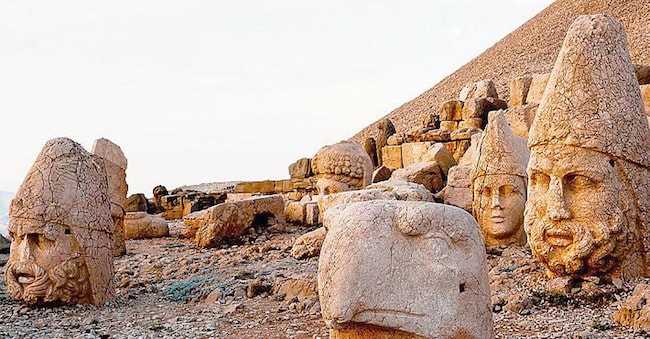
One wakes up before dawn to face the ascent to the summit of Nemrut Dağı, trusting in the appearance shortly thereafter of that ever-present pink veil that will envelop the stone dream of Antiochus I Epiphanes. The ruler of the kingdom of Commagene, a descendant of both Darius the Great of Persia and Alexander the Great, who was shrewd and shrewd in forming a non-belligerent relationship with the Romans, could not resist the temptation to erect this rocky funerary monument, considered the most epic in the whole of Turkey. It was only rediscovered at the end of the 19th century by the German engineer Otto Puchstein in the company of the Carl Humann to whom the removal of the Pergamon altar to Berlin is attributed. Just to get up there at the perfect hour of sunrise, one gladly accepts to walk like sleepwalkers on the path leading to the eastern terrace: there, in fact, rises the eastern temple of Nemrut Daği. Welcoming visitors are six towering acephalous statues on thrones, their heads two metres high, which have earned this archaeological site the reputation for mystery and intrigue that has remained intact to this day. These figures carved in stone are impressive, as are the scattered fragments of an eagle, a lion and the guardians of the temple. The western terrace, which is reached by following the second ritual path lined with relief steles, is also populated by these bewitching and at the same time disquieting presences: next to the heads, here is most recognisable of all Antiochus depicted in the act of shaking hands with Apollo, Hercules and Zeus.
Itinerary from Makatya to Arslantepe
Now that the sun's rays are pointing directly at the cracks of the heads, it seems as if we are witnessing in real time an X-ray of these figures, highlighting the complex texture of their faces, the folds of their limestone skin. And it is natural to turn one's gaze from the statues to the landscape and back again to encapsulate the same panorama that has been their prerogative since the Hellenistic age: the mountain range of the eastern Taurus and below the vast, endless landscape of the Turkish South-East. Then one attempts to read and decipher the inscriptions engraved on the stelae aided by local guides who appear as if suddenly from behind the pedestals. This colossal monument to the religious syncretism professed during the Kingdom of Commagene, a cult expressed by combining Hellenistic aesthetics with Persian and Anatolian statues and bas-reliefs, deserves the adventurous journey through these Turkish moors and precisely a departure from the Güneş Motel when the stars still illuminate the sky by the billions. Back in the city of Malatya, one must immerse oneself in the auras, colours and noises of its Sire Bazaar: past the stalls full of dehydrated apricots, one comes across the copper market where artisans from early in the morning assemble their pyramids of tools. From there, we then reach Eski Malatya, the old city of Roman-Byzantine origin and layout, dilapidated yet fascinating thanks to its old walls, while the 14th-century madrasa and minaret of Melik Sunullah have preserved many coloured tiles on their walls. Again on board one of the many darting blue minibuses, one arrives before sunset at the ruins of the Hittite citadel of Arslantepe situated on the so-called Lion's Hill: a temple and a terracotta-brick palace constitute what remains of the archaeological splendour dating back to the 4th millennium BC.
In the Cradle of the Sumerians, Assyrians and Babylonians
History has also passed over the nearby Cendere Köprüsü, the Roman bridge dating back to the 2nd century A.D. built by Septimius Severus as he marched eastwards through northern Mesopotamia: the inscriptions on the vertical blocks are still legible and exciting for those who love ancient geography and the exploits performed at these latitudes by the Legio XVI Flavia Firma. The Kahta Yeni Kale castle also presents itself with its imposing and severe frown of a fortress erected on the edge of a steep precipice occupied over the centuries by Seljuks, Mamluks and Ottomans, where overlapping dungeons, vertiginous walkways, dovecotes, cisterns and residential palaces demonstrate its strategic importance in eastern Anatolia. In this cradle of the ancient peoples of the Sumerians, Assyrians and Babylonians, it is the Euphrates that saw cuts through the rugged and spectacular Taurus mountains before flowing headlong into the Commagene plain where East and West met. A particular crossroads of cultures was the city of Arsameia, the summer capital of the Kingdom of Commagene, of which few but significant vestiges remain, rich in symbolic inscriptions that are perfectly recognisable on the ceremonial roads: here, as in Perre, another nearby geopolitical and religious centre where caravans from and to Persia converged until the Byzantine period, a tribute is paid to the history of the ancient world.

