
Dive into the waves and corals without polluting the sea: the challenge of eco sunscreens
Today, the priority is to guarantee waterproof protection for the skin and, at the same time, to avoid the dispersion of Uva and Uvb filters in order to preserve the microbiome in the water.
by Laura Belli
3' min read
3' min read
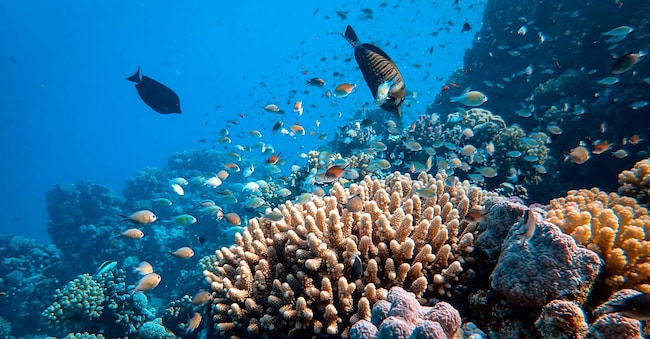
Protect yourself from the sun without disrespecting the environment by limiting the damage caused by spilling substances into the water that protect the epidermis but can harm living organisms in the sea. Moving towards increasingly responsible choices is at the heart of advanced cosmetics research. That a sunscreen product is water-resistant helps, because it avoids overspray during bathing, but it is the minimum requirement. Formulations must be designed with broad respect for the marine habitat, free of harmful and polluting ingredients, and properly tested by certified bodies and laboratories. Recyclable packs, or those made from recycled materials, are a widespread good practice, but there are brands that go further, working on all-round environmental protection projects. La Roche-Posay, for example, which has been studying the impact that sunscreens can have on marine life for almost 20 years, has created a new standard for testing and is working with the Monaco Scientific Centre to protect corals and prevent coral bleaching. The formula respectful of marine life on its products indicates that the filters respect marine life, adhere to strict protocols and have 70 per cent biodegradable formulas (filters excluded).
The seas resemble vital organs: they generate 50 per cent of the oxygen we breathe and absorb a third of the excess carbon dioxide, playing a crucial role in regulating the global climate. No less important are the coral reefs which, although they cover less than 0.1 per cent of the earth's surface, are the habitat for 30 per cent of total biodiversity. To safeguard them, Uriage has launched a scientific research project to verify the impact of its Bariésun line: studies on coral cuttings (Seriatopora hystrix species), carried out to test all the UV filter compositions used, did not give rise to structural changes or bleaching after contact.
Loading...
The suncare clean concept also inspires Nuxe's sun formulas with a patented protection system with 3 organic sun filters and 2 esters. The formulas were found to be non-toxic in four complementary tests carried out on freshwater algae, seawater algae, a bacterium and corals representing the entire ecosystem. The coral test was also conducted with concentrations far higher than those found under normal conditions. Another issue that has the character of an emergency is plastic pollution (every year, 8 million tonnes end up in the world's oceans, and in France alone we are talking about 6,000 tonnes of plastic, equivalent to almost 1.2 tonnes per kilometre of coastline): hence, the French company's support for the European projects of Oceanoplastic, the NGO that collects waste from seas and beaches, identifies the main sources of pollution and takes action to combat them.
When it comes to efforts to minimise environmental impact, you have to have an all-round view. It happens at the Europe Innovation Centre of Shiseido, the global sustainable innovation centre for formulating products that are more respectful of the marine microbiome. All the sunscreens used have been tested to prove their negligible impact on coral life and health: the specificity of the formulas and high water resistance help reduce their dispersion in the sea, and the bottles contain up to 70 per cent bio-polyethylene, derived from sugar cane, while the paper part comes from ecologically managed forests. Alongside prevention, there is also a need for proactive engagement: as the Mediterranean Sea is a biodiversity hotspot, rich in microbial life and highly sensitive to environmental changes, Shiseido is participating in the M.A.R.E. project, which provides a research platform for microbiological sampling. The goal for 2025 also includes specific research with Milano-Bicocca University on the microbiome, aimed at creating formulas that do not impact the marine ecosystem. The project will use marine DNA samples to characterise the microbial communities in the surface waters of various areas explored during the campaign, enabling the identification of species or strains with unique properties that can combat marine pollution.
Another interesting partnership is the one developed by Collistar with the Department of Life and Environmental Sciences of the Marche Polytechnic University for research projects from the Mediterranean to the Tropics, from Antarctica to the Atlantic and Pacific oceans. It took three years to arrive at the final formulas with eco-compatibility certification. Not only were hazardous compounds removed, but the entire product (including sunscreens) was tested in real, natural marine life conditions. This is the most comprehensive and advanced set of tests worldwide, based on different species of model organisms representing marine biodiversity. The result is that all sunscreens produced are coral (or reef) friendly, causing no harm or alteration to animal and plant species and marine habitats as a whole. Special attention is also paid to post-exposure treatments, with after-sun formulas that are biodegradable in fresh and salt water.


Loading...
