
A good archive is the first source of inspiration, ensures continuity and future
A journey into the heart of creativity, into two companies of excellence in Italian design that invest in the collection and organisation of materials, sketches, prototypes, objects that have written their history.
4' min read
4' min read
Piero Gandini: 'Selection comes first'.
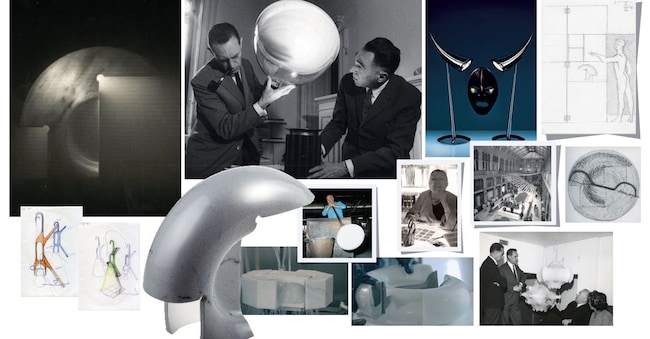
The return to Flos of Piero Gandini, who led the company for 22 years until 2019, is an event that will have more than one implication, including on the brand's archive. In this regard, Gandini, who has been in charge as executive chairman of Flos B&B Italia Group since January, retraces some decisive steps: "The company had never paid special attention to the collection and organisation of its materials. Around 2008, my mother insisted that this be done, but I was absorbed by the growth of the business and the undertaking seemed arduous. Her response was: "Then I'll do it myself". She began to collect and organise the material that was in the company, entirely at her own expense and under her direction, even setting up software to access the database. After his passing, the computer material remained in his home, while the physical part is in the company. When we celebrated the company's 50th anniversary in 2012, we were able to exhibit all the lamps produced up to that time. Mending and recomposing all this heritage, which has grown even more in the meantime, will be an issue on the agenda in the coming months, and also in the coming years. Faced with such a huge amount of material, the first problem is the method: it becomes impossible to archive everything indiscriminately, without finding priority criteria. "This is how my mother worked, giving all documents equal importance," Gandini explains. "I believe that selection is indispensable in order to manage the past and the present, which continues to produce new material'. Piero Gandini is also very clear about how to relate to the contents of the archive, with respect to production: "We are all here because people before us have created this history, with whom we must relate. But if you do it with a nostalgic and passive attitude, you run the risk of betraying, in a way, the original ideas. I always ask my team: if an unknown young designer came along today and proposed a lamp with a marble base that weighed 70 kilos and had a 2 metre arc to bring the shade to the centre of the table, would you listen to him or would you give up? The reference is to the Arco lamp by the Castiglioni brothers: it was 1962 when they presented it at Flos. What happened next is well known. Gandini concludes: 'The relationship with the past is fundamental and the best way is to keep intact the cultural attitudes that history expresses; in the case of Flos, innovation. And, because design is a great endeavour, we must also fully respect the design ideas that emerge from the archives'.
Nicola Coropulis: 'Putting the intelligence of the hands at the centre'.
A company with 113 years of history, told in a museum, connected to the production site: Poltrona Frau in Tolentino, Marche, is an example of how past and present intertwine more than ever. The Chester collection, the company's first product, is still in the catalogue: Renzo Frau produced it in leather, drawing inspiration from the upholstered fabrics of the Anglo-Saxon world. It was 1912, the workshop had just opened its doors, in Turin. "The brand's considerable age allows it to come to terms with a very articulate and structured history," says Nicola Coropulis, CEO Poltrona Frau. 'When I first went to our archive, I would have spent hours there. There is an impressive amount of documents, catalogues, advertisements, slides, autograph material, so many sources of inspiration. The real issue is to catalogue this corpus, digitise it and make it available'. A path, this one, already well underway, also in support of the anniversaries of iconic products. This year it is the turn of Gio Ponti's Dezza armchair, which turns sixty years old, celebrated by a re-edition with never-before-seen drawings by Ponti screen-printed on the leather. "For this version of the Dezza, we went back to scouring archive documents, even though the pattern used was retrieved from Ponti's archives. It is not a simple nostalgia operation, as the innovation is well present: "Silk-screen printing on leather is a technique we experimented with last year on the Vanity Fair armchair with a black and white graphic by Fornasetti. For the Dezza we went a step further, adding colour: the ink is blue on ivory leather. The theme is hands: Ponti liked to draw them. And one of our historical claims is the intelligence of the hands'. A dialogue, therefore, generative with history, in which all the designers who collaborate with Poltrona Frau willingly immerse themselves, as well as the visitors who come to Tolentino passing through the Poltrona Frau Museum: "The museum was born from the idea that our history contains within it the germs of our future, but not in a past-tense logic. Ours is not a stuffed museum. The people we want to attract to our community pass through the museum because it is an immersive journey into an experience made of history, but very much projected ahead. After all, for a company like ours, the best way to preserve tradition is through innovation, in a continuous interplay between suggestions from the past and ideas that come from present experience'.

