
A Hymn of Grecitude
"Nikos Aliagas's 'L'esprit grec' offers photos of modern-day Greece and quotes from Homer to Nobel laureates Elytis and Seferis, creating a valuable travelogue
4' min read
4' min read
There is this child in the half-light, under a cascade of sunlight that blinds and illuminates the photograph. With his left hand he touches his right arm, amber with saltiness, and Pindar whispers to him: 'The dream of a shadow, here is man'. He is a little man growing, like millions before him with a view of the Greco Mar. Nikos Aliagas, polyglot, journalist and television and radio presenter, Greek DNA and French life, who exhibits in France and around the world (last year also in Venice, at Palazzo Vendramini Grimani), tells us from behind the lens. The narrative is in black and white, light and dark, life and death, past and future, and is elevated to poetry by dozens of quotations from authors, from Homer to Sappho, from Plutarch to Xenophon, from contemporaries Nikos Kazantzakis to Nobel laureates Odysseas Elytis and Giorgos Seferis. L'esprit grec. Mes apophtegmes essentiels is a travelogue, a carnet of eternal thoughts, a florilegium of author's maxims, a beloved Greece and everyone's Greece. Above all, it is a triumph of Greekness. On the other hand, how can we fail to remember that Marguerite Yourcenar, in The Memoirs of Hadrian, had written: 'almost everything that men have said that is best, they have said in Greek'.
"He who speaks and thinks in Greek is a free man"
.Aliagas is a modern Greek, brought up in classicism: in the peace of Missolonghi, his mother Haroula, bent over the sewing machine, taught him the difference between harsh and gentle spirits, his grandfather Spyros read to him the songs of the Iliad in the shade of the olive trees and repeated to him that: 'he who speaks and thinks in Greek is a free man'. Then, the encounter with Greek thought, the attempt to decode and understand it in ancient Greek from modern Greek, and, finally, the meeting with Laure De Chantal, one of the directors of the Belles Lettres collections and her invitation to make contemporary images dialogue with ancient words. Thus, with a carnet in hand, Aliagas combined glimpses and Greek quotations, with the exactness of those words: "I discovered the Greek language almost before I knew how to read it, I felt it to be the most intimate anamnesis of my being, a sound that came from the outside, an ancestral music that had been sleeping in me forever". And Les Belles Lettres, the temple of erudition, the publishing house of the linear metres of yellow backs with the translations and commentaries of the ancients, have published L'esprit grec, the πνεύμα, to put it in the Greek way, the breath that makes us brothers with Homer. It was not easy to find such poignant dialogue without creating anachronisms or something exotic: all thanks to a profound search for the prime and intimate meaning of words. Which become eternal, poetic, timeless.
Contemporary Photos and Ancient Words
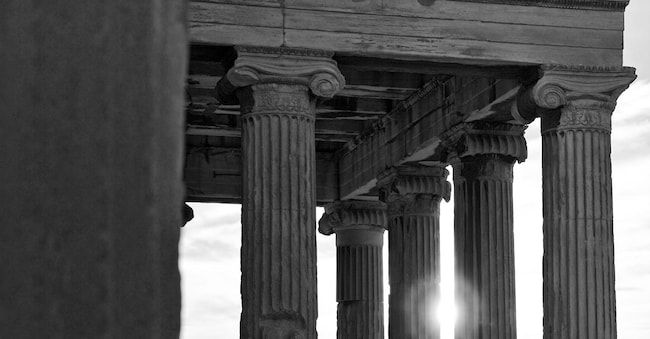
A woman at a crossroads in Sifnos, the lagoon of Missolonghi, glimpses of the sanctuary of Delphi, the villages of Ithaca, seas of olive trees, sleepy flocks, bees crowded on the canvas, eyes of embers, Corinthian capitals, faces scorched by the heat, fishermen in the sun: today's Greece is an Esperanto to the ancient. Just look at those women's hands grappling with dough, perhaps the makaruni of Karpathos. On her wrist she wears a watch, the today, and also a komboskini, the time of prayer materialised in a cotton bracelet, almost a rosary of the Orthodox. They are glances, gestures, waits, requests, shadows. They are moments: 'Learn to recognise the good moment, the right moment', wrote Pittacus. The kairós, the moment, is everyone's personal time, it is an energy that, fluid, flows through us. And it is filled with quotations: 'life is short, art is long' (Hippocrates), 'do not keep immortal hatred, you are mortal' (Menander), 'not only power reveals man, but man reveals power' (Plutarch), 'the greatness of peoples is not measured in hectares, but with blood and the burning flame of the heart' (Kostis Palamas), 'there is no official love or forbidden love. There is only love, without adjectives' (Andreas Embirikos)
The value of the Greek language
.The black and white of the images leaves room for the silences, the wind ruffling the hair, the springy scent of oregano, the liturgical chants of certain Sunday mornings, all gathered in the dazzling blue of the cover: always, in Greece, everything, every afflatus begins and ends with the sea. Even for our Europe, which in order to survive must continue to speak Greek, to think in Greek: when there are words, there is no need for violence. A millenary language, the intimate conscience of each one, is enough to return to the origins, understand the journey and draw new horizons: 'Man is made in a sour fist of yeast, he is born like an archangel, he dies like a savage. All that remains in his life is a language and a homeland, his first consolation and his last hope' (Nikos Gatsos).
Nikos Aliagas, L'esprit grec. Mes apophtegmes essentiels, Les Belles Lettres, pp. 238, euro 17


