
A greenhouse to wear: Daniel del Valle's experimental clothes
Blue and white porcelain vases worn as bustiers, flexible wooden cages filled with flowering pyxes, skirts constructed as windowsills and console tables: imagination at the service of fashion.

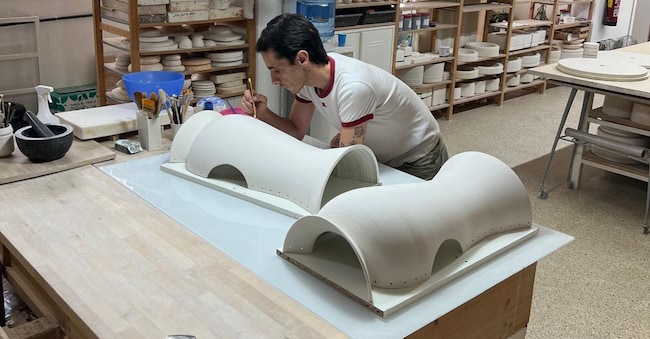
The atelier of a floral artist. A sculptor's room. A haute couture tailor's shop. An alchemist's workshop. A gardener's warehouse. A body performance space. A reliquary. There are many similarities, and just as many changes of perspective, when you enter the London studio of Daniel del Valle. In the contemporary landscape, dominated by the speed of production and the constant search for novelty, his work is distinguished by an almost meditative approach, deeply rooted in the value of time and doing. Underlying this is an authentic respect for the creative process where design is not just an aesthetic exercise, but a language, a means of exploring the relationship between body, space and material. Art, architecture, everyday objects and nature feed the imagery of the creations, with a particular focus on the structure of things, on how volumes develop and take shape. Nothing is excluded, from the wall tiles of an old swimming pool to thousands of Victorian pipes recovered from the Thames, from bread to orchids, from molten glass to the wax of the great Easter processions. From this omnivorous gaze, the project develops through sketches, draping tests and continuous experimentation with materials. Two passions recur constantly: flowers and ceramics.
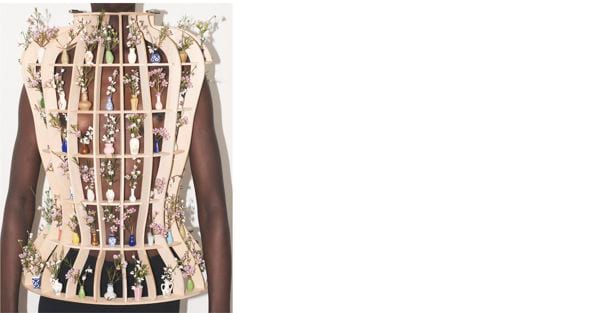
Del Valle, when he moved to London at the age of 19 from Pilas, the small village near Seville where he was born, supported himself first by working in a restaurant and then as a florist, collaborating with the renowned Paul Thomas Flowers. The fragility and strength of stems and corollas, the organic matter that grows and changes is reflected in the silhouettes of his garments. Ceramic, on the other hand, returns as an emphasis on the act of shaping, on the will that defines with patience and sensitivity, and is the basis of the balance between idea and manual skill. The shaping gesture occupies a central role in his practice and is not simply a technical phase, but an integral part of creation. Proportions, cuts, volumes are continuously recalibrated, revised and the silhouettes combine precision with strength, with an obsession for serial detail. Each garment is conceived as a small living and wearable architecture, a structure designed to dialogue with the body, following its movements but, at the same time, maintaining its own defined and separate identity, if only for its rigidity and weight.
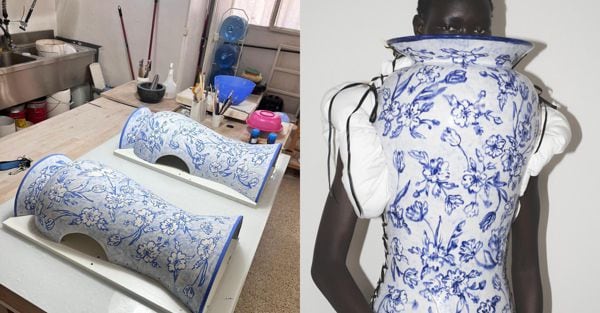
The line between craftsmanship, design, art and fashion is constantly being crossed and rewritten. Bustiers are in the shape of enormous blue and white porcelain vases, shirts are Vienna straw and rattan bibs, boleros are cribs of mosses and figurines, flowers sprout from pyxis set in belts, draperies, flexible wooden cages, shoe uppers. A catalogue of memories and sequences, which forges the present with the autobiographical remains of the past: his grandmother who kept him busy with embroidery as a child, his baker father who took him to work at night in his bakery and who today has made for him a leavened and fragrant camisole, almost a giant pouch, baked like an interminable baguette, which wraps around his torso like a golden snake. And then there is the memory of his young mother, in whose honour he rediscovered the technique of wax bouquets, those that in Spain, during Holy Week, adorned the sacred statues in the streets. Thus the dress she got married in became a work of art.
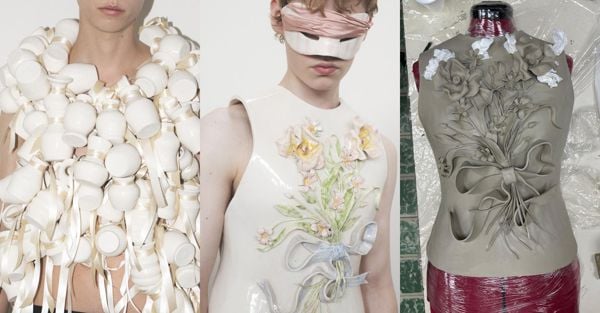
Craftsmanship lies at the heart of del Valle's vision. Over time, he has built a recognisable design language, far removed from ephemeral trends and rooted in consistent personal research. His first show, at Ladbroke Hall, took three years and was celebrated not as a fashion show, but as a show of wearable art. Her garments unfold like chapters of a poetic weaving, the broad plot combining art, nature, craftsmanship, friendship, traditional knowledge, multiple generations, personal recurring thoughts. The Vxlley is not a brand. Del Valle describes it as a garden and a great metaphor for life where everything grows and transforms. So the scroll of his Instagram account offers a walk beyond Alice's threshold, inside a subverted world, paradoxical, dreamy and a little crazy, a crossing of the park of the Leopard, macerated by the sun, with the same aroma that distils from the relics of certain saints, the peppery odour of carnations, the oily smell of magnolias and "the perfume of mint mixed with the childish one of gaggìa" with the overflowing scent of the first orange blossoms. Or he takes his imagination to the entrance of the Museum of Innocence to remind himself that the only thing that consoles the unbearable pain of passing time and lost happiness 'is to possess an object, the legacy of that precious moment, the single instant of happiness that does not fade for hundreds of years'.
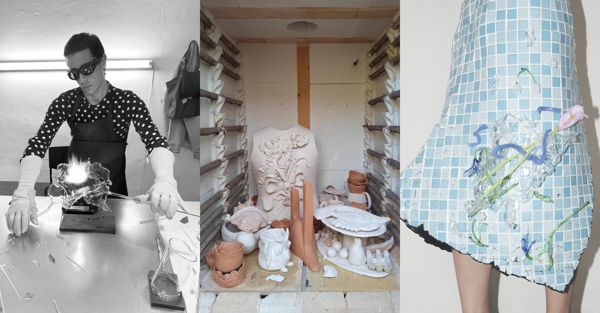
HIGH CRAFTSMANSHIP DANIEL DEL VALLE, @thevxlley.

