
A guide to help teenagers and families enjoy a more mindful digital summer
From usage limits to dialogue, Meta suggests four rules for teenagers and parents

For teenagers, summer is often a time when the amount of time spent online increases significantly: less school, less studying, more freedom, and more hours spent on their smartphones. It is in this context that good intentions for a more balanced digital life take on particular significance, especially when they come from Meta, the company that owns Instagram, Facebook, Messenger and WhatsApp. In recent times, in fact, the company has significantly expanded the tools and initiatives aimed at minors and parents: from accounts for teenagers with default safety features to parental controls, there are now various functions designed to limit the time spent on the platforms and ensure that children do not encounter unpleasant situations. But these measures do not come out of nowhere. For some time now, Meta has been at the centre of growing pressure from families, authorities and courts, particularly in the United States, where several lawsuits accuse the company of having contributed, through the various platforms it offers, to fuelling problems of addiction, mental health and the wellbeing of minors. The most recent and symbolic case comes from Los Angeles: a jury found Meta and Google guilty of developing platforms capable of causing harm to mental health. The two companies were accused of designing services intended to create addiction, particularly among teenagers: a case stemming from a complaint by Kaley G.M., a 20-year-old Californian, who stated in court that YouTube and Instagram had fuelled her depression and suicidal thoughts during her childhood.For teenagers, summer is often a time when time spent online increases significantly: less school, less studying, more freedom, more hours spent on their smartphones. It is in this context that good intentions for a more balanced digital lifestyle take on particular significance, especially when they come from Meta, the company that controls Instagram, Facebook, Messenger and WhatsApp.

In recent times, in fact, the company has significantly expanded the range of tools and initiatives aimed at children and parents: from accounts for teenagers with active default protections to parental supervision, there are now various features designed to limit the time spent on platforms and ensure that children do not encounter unpleasant situations. But these measures do not come out of nowhere. For some time now, Meta has been at the centre of growing pressure from families, authorities and courts, particularly in the United States, where several lawsuits accuse the company of having contributed, through the various platforms it offers, to fuelling problems of addiction, mental health and the well-being of minors. The most recent and symbolic case comes from Los Angeles: a jury found Meta and Google guilty of developing platforms capable of causing harm to mental health. The two companies were accused of designing services intended to create addiction, particularly among teenagers: a case stemming from a complaint by Kaley G.M., a 20-year-old Californian, who testified in court that YouTube and Instagram had fuelled her depression and suicidal thoughts during her childhood.
And although Meta has not agreed with the decision and is challenging it through legal channels, its commitment to providing features to protect teenagers remains steadfast. The latest initiative aims to analyse young people’s habits during the summer holidays and involves collaboration with Luca Mazzucchelli, a psychologist and psychotherapist, offering a practical guide for parents and teenagers: “Summer holidays should not be demonised, but understood. When the structure of the school day breaks down, young people instinctively seek connection and entertainment where it is easiest to find: online. The problem is not the device itself, but the loss of purpose in its use. Without a stimulating alternative or informed guidance, the smartphone becomes a passive time-filler,” explains Mazzucchelli.
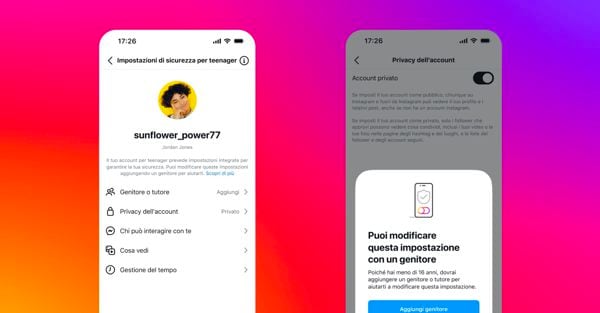
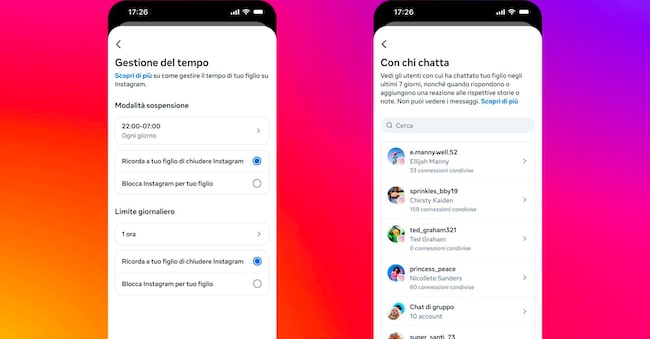
According to the expert, in fact, just four good habits would be enough to make a significant difference to our daily online routine. The first is to set aside offline time for the whole family by keeping mobile phones out of the bedroom at night or away from the table at lunch and dinner, and avoiding screens for the first twenty minutes after waking up and whilst in the car. In this regard, the ‘Do Not Disturb’ feature available on teen accounts – which is active by default from 10 pm to 7 am for 13- to 17-year-olds – allows notifications to be turned off during set times, for example. The expert’s second piece of advice is to agree on a reasonable screen time with your children to help them take responsibility for managing their free time: however, the limit must be clear and sustainable. Teen accounts also automatically send daily notifications to teenagers after they have spent 60 minutes on the app, to remind them to take a break; in addition, parents can set a limit on social media use, down to a minimum of 15 minutes a day: once this limit is reached, teenagers will no longer be able to access the app. The third piece of advice, on the other hand, concerns the ability to turn ‘empty’ time into creative time: asking what they are doing on their phone rather than how much time is spent in front of the screen would help young people understand the difference between opening an app to carry out an activity and opening it simply out of boredom or habit. And finally, the fourth and last tip focuses on monitoring and the importance of listening to young people rather than judging them: sitting down with your child and asking which game they’re playing, which creators they follow or which app they use most often can be a way to get closer to their world. Supervision within teen accounts, for example, allows parents to see how much time their children spend on the app, what topics interest them most and which users they are in contact with. However, these monitoring tools should serve not merely as a means of control, but as a bridge for communication, with the aim of encouraging constructive conversations about young people’s online habits.

