
A journey to the origins of Haute Couture at the Petit Palais in Paris
400 original dresses, sketches, fabrics, photographs and archive materials: Worth. Inventing Haute Couture brings attention back to one of the founders of fashion without indulging in nostalgia or spectacle.
by Alba Cappellieri, Politecnico di Milano
 Aggiungi Il Sole 24 Ore
ai preferiti su Google
3' min read
3' min read
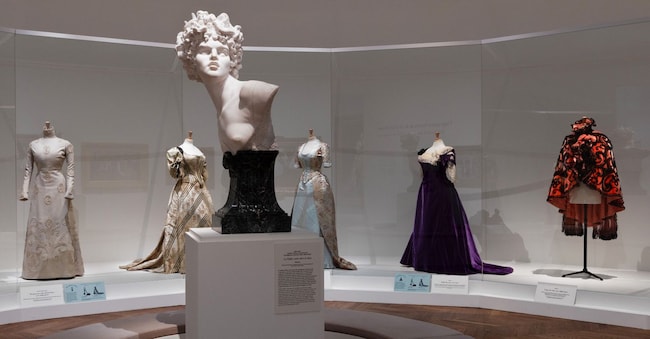
At the Petit Palais in Paris, an accurate exhibition and an interesting volume tell the story of Charles Frederick Worth, considered the founder of French haute couture and contemporary fashion. The first true modern designer, Worth revolutionised the rules of 19th century fashion by combining creativity, craftsmanship, strategy and entrepreneurial vision. In 1858, together with Otto Bobergh, he founded the Maison Worth, paving the way for a new conception of the tailor's trade: he was among the first to sign his own clothes, to show them on live models, and to introduce seasonal collections to be presented in ateliers - no longer in clients' private homes. But his most profound intuition is that fashion is not just style, but communication, identity, imagery. Curated by Annick Lemoine, the brilliant director of the Petit Palais, with Miren Arzalluz, honorary director of the Palais Galliera, the exhibition tells the story of the maison without falling into rhetorical celebration, but rather by following the evolution of the style with philological flair according to the four generations - from Charles Frederick to his sons Gaston and Jean-Philippe, up to his grandsons Jean-Charles and Jacques - and showing how the maison has always been able to remain faithful to the spirit of the founder, while adapting to the times.
The tour winds its way through more than 400 original dresses, sketches, textiles, photographs and archive materials: from Franca Florio's embroidered cloak for the ball at Franz Joseph's court in 1904, to the one adorned with lily shoots for Countess Greffulhe, a fascinating muse and icon, to the innovative perfume Dans la Nuit created in 1924 by Roger Worth with Rene Lalique, the master of Art Nouveau. But what is most striking is the consideration the Worths had for their craftswomen: pattern-makers, seamstresses, illustrators, weavers, assistants. An often invisible world that takes shape here, with respect and foresight, and makes the historic address at 7 rue de la Paix the heart of a dense network of relationships, knowledge and beauty.
One of the most fascinating chapters was the collaboration with Tassinari & Chatel, a historic textile manufacturer that produced over 10,000 metres of silk for the maison in more than 120 decorative motifs. Emblematic is the episode of 1888, when a fabric was produced with the portrait of Worth himself: 54 metres of pure visual identity, whose destination remains unknown, but which anticipates the modern concept of branding. The section devoted to the Roaring Twenties and Jean-Charles Worth opens up new perspectives: it crosses Parisian archive materials with drawings from the Victoria and Albert Museum, and brings out a freer elegance, designed for a dynamic woman who would soon become the Garconne described in 1922 by Victor Margueritte. Yachting dresses, suits with ties, swimwear, soft lines, graphic details, decorative buttons and tailored cuts speak a refined yet modern language that anticipates the themes dear to Mademoiselle Chanel.
The dialogue with the visual arts is constant: Jean-Charles Worth entrusted the decoration of his house in Neuilly, immortalised in 1931 by the photographer Ilse Bing and later by Man Ray's portraits, to the artist Jean Dunand, a protagonist of the happy Deco season, who broadened the meaning of couture as visual narrative and personal identity. In this vision, ornament is not a detail, but an interpretative key. Damask silks, metallic embroideries, elaborate weaves and sculptural silhouettes transform the dress into a precious object, capable of reflecting light, framing the body, amplifying presence. Fashion becomes ornament: symbolic, sensitive, expressive.
Worth. Inventing Haute Couture is an exhibition realised with skill, accuracy and intelligence. It brings attention back to one of the founders of fashion without indulging in nostalgia or spectacle, as unfortunately is increasingly the case. It offers tools, documents, narratives. At a time when fashion is often fragmented, suspended between extreme speed and digital immateriality, this project brings us back to the essentials: the making, the form, the meaning.

