
A journey to the borders of the Soviet Empire
Under Brezhnev, a group of Italian filmmakers filmed life in the USSR uncensored, and Loznitsa used the footage to edit an exceptional critical documentary

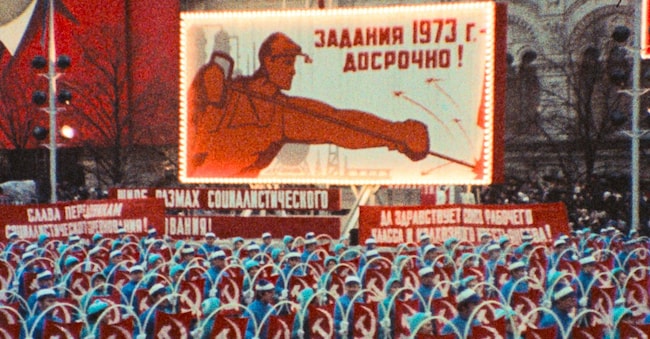
Imperium, the title of the extraordinary documentary to be screened out of competition on 5 September at the Venice Film Festival, is taken from the book of the same name by Ryszard Kapuściński (Feltrinelli, 2013), an account of the bewildering array of languages and cultures that had remained silenced but came bursting into the open immediately after the collapse of the Soviet Union. The Ukrainian director Sergei Loznitsa, who directed the documentary, devoted himself to it amidst the many projects of his prolific career as a director: his latest being the 2025 masterpiece *The Two Prosecutors*. He could not help but do so after seeing, at the UnArchive Found Footage Fest in Rome in 2024, footage by a group of Italian filmmakers, shot in the USSR between 1970 and 1973, which captures the lives of Soviet citizens uncensored, travelling through the most remote regions, from the Carpathians to the Pacific. For the first time, three Italian archives – Aamod, CSC-Cineteca Nazionale and Luce Cinecittà, which is co-producing the documentary with Kino Produzioni and Rai Cinema – have made their materials available, having first digitised them, and Loznitza edited them with Audinga Kucinskaite, working on them for a year and a half. ‘Every image was a miracle to me,’ the director explains from Vilnius to *Il Sole 24 Ore*, ‘a journey back to my childhood, but at the same time a chronicle from another world, because I had never seen the Soviet Union like this before.’
The images
I eagerly awaited every shot, each one proving to be unexpected – a far cry from the films of Soviet directors, who were subject to censorship and propaganda. The images created by these Italian filmmakers pay particular attention to people, displaying a free style, unbound by ideologies or symbols.’ The film crew, led by the anthropologist Diego Carpitella – and which also included, in various capacities, Folco Quilici, Luigi Di Gianni, Giorgio Arlorio, Giuseppe Ferrara, Rudi Assuntino and Gianni Bonicelli – produced 482 rolls of film, mainly Super 16mm colour, totalling almost 60 hours of footage, the sound recordings of which have largely been lost. Yet the absence of sound lends even greater poetry to the already dreamlike snow-covered expanses, to an almost medieval Asian continent where most people wear traditional dress, to reindeer-riding races on the edge of the Arctic, to Orthodox religious ceremonies, Buddhist prayers, folk dances, the bored faces of people at regime parades, and the woman breaking the ice on the river to wash her clothes. ‘It was the most ambitious film project ever permitted to foreign directors in the USSR, which at that time was very close to the Italian Communist Party. There is also a scene in which Togliatti visits a Soviet branch of Fiat, where the famous Zhiguli was manufactured.’
Medieval Asia
Standing alongside the cameras, there was always a representative of the local KGB, who, perhaps because he lived there, did not realise how much the reality being filmed contradicted the myth of the USSR’s unity. ‘When I did my military service in Turkmenistan, on the border with Iran,’ recalls Loznitsa, ‘the commander bid us farewell by saying: “Lads, listen, the Soviet Union doesn’t exist here”.’ It was 1987, four years before the collapse of the Soviet empire. The feeling was that disintegration was always just around the corner.” A giant with feet of clay, revealing its full fragility in *i* *Imperium* . In Yakutsk, Siberia, a long sequence captures a child dressed as an oriental prince, performing a traditional dance against the backdrop of a large portrait of Lenin. “The USSR was not a state, but an empire that imposed itself by force on territories that have never forgotten their millennia-old traditions, from cuisine to language. In the archive footage, I saw another universe running parallel to my own. Whilst, where I lived, totalitarianism showed its true face in all its ugliness, the Italian footage revealed to me another land where people led normal lives: in Armenia, Uzbekistan, Georgia and Dagestan.” The footage of Moscow’s department stores at Christmas is also striking, with people buying decorations and gazing in amazement at the few luxury items on display in the shop windows. ‘Life was difficult,’ continues the Ukrainian director, ‘but the years under Brezhnev were the regime’s golden age, certainly better than the Stalinist period or the Second World War. People in the 1970s and 1980s managed, more or less, to scrape together some food. In Kyiv, even though Ukraine was a very fertile land, every morning in the 1980s I had to queue for ages to buy milk and, if I was lucky, I could buy some cheese, rarely any sausage. Even vodka and wine were very hard to come by.
People’s sadness
‘Elsewhere in the country, people were forced to make pilgrimages from shop to shop just to buy bread.’ What strikes you most are the people’s faces: sad, melancholy, very serious. It was also very rare to see a child laughing: ‘As well as hunger, there was oppression, control and restricted freedom of movement. Not only was it almost impossible to leave the country, but even to travel from one city to another, you had to obtain permission from the local authorities. Farmers didn’t have passports. As a bibliophile, I often found nothing in bookshops. To buy a Bible, I had to give false personal details. It was very dangerous to attend Mass. Young people were checked at the church entrance and often imprisoned. Then there were the unhealed scars of the tragedies of the civil war, the World War, the concentration camps and the gulags. I’m not surprised by the people’s despondency.”
The situation in Ukraine
It is impossible not to address today’s most contentious issue, which concerns the director’s country of origin, Ukraine, a nation ravaged by war and internal strife. Loznitsa, now 60, has supported the cause of independence from the very beginning, as seen in the 2014 documentary Maidan and the film Donbass (2018) on corruption in his country. ‘As a citizen, I have always been against aggression and have not returned to Ukraine since 2021. In Kyiv, my city, there are only a few places that can protect people, such as the underground station, which, however, can only accommodate 60,000 people – not all of Kyiv’s 3 million inhabitants. At a time when the Russians are bombing day and night and Ukraine is unable to protect its citizens, we must seek a diplomatic solution.”


