A kiss? ‘An oral, interspecific interaction involving the movement of the lips and more, without the exchange of food’
The world’s craziest prizes, the Ig Nobel Prizes, were awarded for the first time in Europe, in Zurich. It was the University of Oxford that won the prize for biomechanics with this brilliant definition. The winner received one thousand billion Zimbabwean dollars, presented by a Nobel laureate dressed as a mushroom.

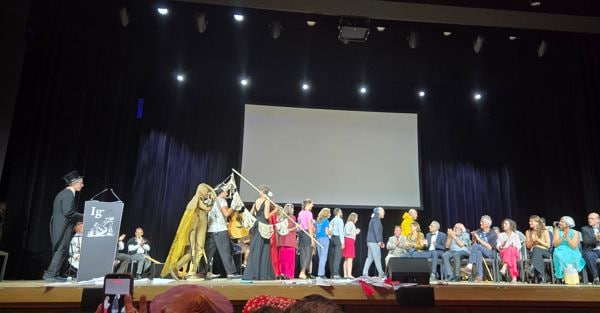
But what, after all, is a kiss? ‘A non-agonistic interaction involving direct, bidirectional, interspecific oral contact with some movement of the lips and other parts of the mouth, and no transfer of food, in ants, birds, polar bears and humans’. It took the University of Oxford to come up with such a definition and thus win what is perhaps the most coveted – and certainly the craziest – of all scientific prizes: the Ig Nobel Prize, in this case for biomechanics, which was awarded to all the authors of the enlightening study ‘A comparative approach to kissing’: Matilda Brindle, Catherine F. Talbot and Stuart West, who also established – amongst other things – that kissing has existed for at least 22 million years. The prize is one trillion Zimbabwean dollars, presented by a Nobel laureate, as the now 35-year-old tradition of the Ig Nobel prizes dictates. In high spirits, they all took to the stage at the University of Zurich for the first ceremony to be held in Europe, following 35 years of ceremonies in the United States at Harvard, MIT and Boston University.
(The governor of Zimbabwe also received an Ig Nobel Prize in mathematics at the time, for managing to print banknotes ranging from one cent to one trillion dollars). This ‘relocation’ was made necessary by the difficulty in obtaining visas that would allow the laureates to travel to the US, and it is set to become standard practice: every two years the ceremony will be held in Zurich, and in the other years at various locations across Europe (in 2027 in Antwerp, in Flanders).
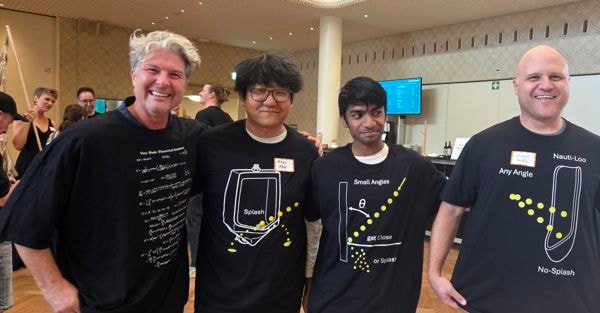
Announcing the winners at the packed Zurich Congress Centre (tickets sold out in a matter of hours), Marc Abrahms, a Harvard mathematician who has been making scientists and science enthusiasts around the world laugh for 35 years with his caustic and irreverent humour: he is the founder of the Ig Nobel Prizes and the ‘Annals of Improbable Research’. The awards were presented by Nobel laureates Esther Duflo, Abhijit Banerjee, Michel Mayor and Tim Hunt.
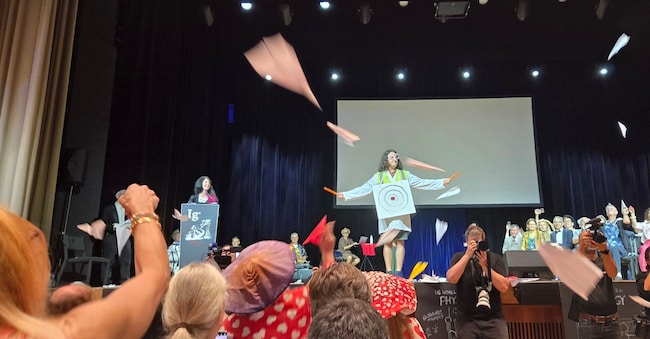
Following the traditional paper aeroplane throwing, the Ig Nobel Prize in Economics was awarded to Paul K. Piff, Daniel M. Stancato, Stéphane Côté and Dacher Keltner of the University of Berkeley, Irvine and Toronto ‘for having accumulated evidence that people from the wealthier classes are more likely to steal sweets from children’, in the study ‘Higher social class predicts increased unethical behaviour’. ‘The probability that the rich will steal sweets from children is twice as high!’ – said Piff, who, without laughing, also explained that for twenty years he has been gathering evidence to show “that wealthier people are more miserly, more dishonest, more likely to evade tax, and more indifferent to other human beings”.
The Ig Nobel Prize in Chemistry was awarded to Sanchari Banerjee, Nathan Coussens, François-Xavier Gallat, Nitish Sathyanarayanan, Jandhyam Srikanth, Koichiro Yagi, James Gray, Stephen Tobe, Barbara Stay, Leonard Chavas and Subramanian Ramaswamy for discovering that the proteins in the milk of viviparous cockroaches are three times more energy-dense than cow’s milk (we asked the winners if they had tasted cockroach milk and they replied ‘of course’ , going on to explain that ‘it’s sweet: it contains 27 per cent sugar’). Milk of unspecified origin was served to the four Nobel laureates on stage.