
A lion learning to die with dignity
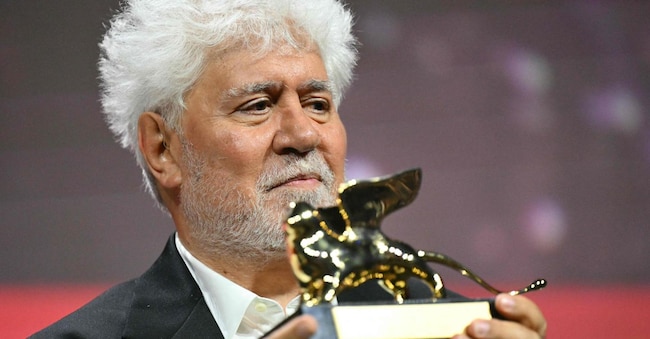
Pedro Almodóvar's 'La stanza accanto' deservedly won, the Grand Jury Prize went to Delpero's Italian 'Vermiglio'. Volpi to Kidman and Lindon. Pity only the screenplay to Salles. "Queer" big excluded
4' min read
4' min read
These are lions roaring, scratching, biting. Huppert's jury, at the head of a strong team (Gray, Haigh, Holland, Mendonça Filho, Sissako, Tornatore, von Heinz, Ziyi), looked to quality, but above all to politics for a competition that saw only one exceptional film, the one that won, The Next Room by Pedro Almodóvar, a very good one, Ainda Estou aqui by Walter Salles, an Italian surprise, Vermiglio, and for the rest, well-packaged films, which conveyed stars with which to dazzle the red carpet, or held up to the Cencelli of geographical or genre distribution.
But Almodóvar's victory makes up for everything. The Next Room starring Tilda Swinton and Julianne Moore reaffirms euthanasia as a fundamental right, that of being able to choose how to end one's life with dignity when pain makes it unbearable. Swinton is Martha, a war correspondent, suffering from terminal cancer, and Ingrid, played by Moore, is a renowned writer, who resumes dating Martha as soon as she learns of her illness. Almodóvar tapers the feelings, calibrates them, there is participation but not laceration, while the bright colours are limited to the clothing. His baroque vein is set aside to give a message of humanity and hope, positive in solidarity and the transmission of love through a relationship based on generosity and acceptance.
The Grand Jury Prize for Maura Delpero's Vermiglio was a nice surprise, an encouragement to Italian cinema with a different, original, universal look. With photography by Michail Kričman, who makes the landscape a character alongside Tommaso Ragno's schoolmaster and his young bride Lucia (Martina Scrinzi), Delpero tells the story of families broken apart by the Second World War, deprived of male figures capable of going to the front. He does this in an Alpine context, with the dialect of the Trentino Val di Sole, where the shy and sacrificed way of life touches chords of ancestral family memories, common to all.
The direction went to Brady Corbet's The Brutalist starring Adrien Brody, who holds on his shoulders the story of László Tóth, a Hungarian architect who emigrated to the United States in 1947 and imported the Brutalist current to America. From poverty to his renewed fame in his homeland, from a history of opiate addiction to family reunion, to the ghosts of the Holocaust: perhaps too many threads unwind in a way that is not always linear and sobering, except for him, Brody, who always lives up to his character, even in the ashes. At this point, we would have liked to write that the women's Volpi Cup went to Fernanda Torres for Ainda Estou aqui by Walter Salles, awarded only for the screenplay by Murilo Hauser and Heitor Lorega on which the director of Central do brasil has turned a story of dictatorship in his country, from the memoir of the same name by Marcelo Rubens Paiva. The film's protagonist is initially him, Marcelo, a former centre-left deputy, but above all his kidnapping by the army. Then enters the scene his wife Eunice, Fernanda Torres, who pursues the truth about her husband's murder, obtaining his death certificate more than twenty years after the crime, with a determination and strength to bow down to. Despite the statuesque Torres, the best female performance was won by Nicole Kidman for Babygirl by Halina Reijn. Here too, the reading of the award is political. A female director who changes the imagery of eroticism and power: no longer a mature man with a young girl, but, on the contrary, a top manager who indulges in the risk and fantasy of a sexual thrust with an intern. Kidman was unfortunately not in the auditorium due to mourning the death of her mother. Although the theme addressed by Delphine and Muriel Coulin's Jouer avec le feu is an important one, Huppert must have weighed in as president to have Vincent Lindon awarded the male Volpi. We are in a proletarian, provincial France, where the always excellent Lindon is the 50-year-old railwayman Pierre. A widower, he finds himself single-handedly raising his two sons, Louis (Stefan Crepon) and Fus (Benjamin Voisin), passing on ideals of a convinced leftist. While Louis moves to Paris to study at university, Fus, a metalworker, loses himself in his fascination with the extreme right. The film is a political and sociological examination of the rise of right-wing extremism that finds confirmation in the recent elections in Germany and the division that corrodes France even after Macron's appointment of Barnier, infuriating Mélencon. It adds the psychological vein of incommunicability between a father and son in ideological betrayal.
It's a pity about Daniel Craig as Lee, the protagonist of William S. Burroughs' partly autobiographical novel Queer, even though the film followed too many leads and ended up tangling itself in a mishmash of genres, from Indiana Jones to Hollywood classics. However, the first part about Lee's falling in love with a wild, self-centred young man (Drew Starkey), thanks to which Craig comes out of the macho parts, is beautiful.


