
A ‘Mega-Earth’ has been discovered; it is rocky, but its mass is 23 times greater
The ‘giant’ is about 2.5 times larger. A ‘Mega-Earth’ located about 87 light-years away from us has been described in a study led by Max Kroft of the University of Wisconsin-Madison, which is due to be published in *The Astronomical Journal*.

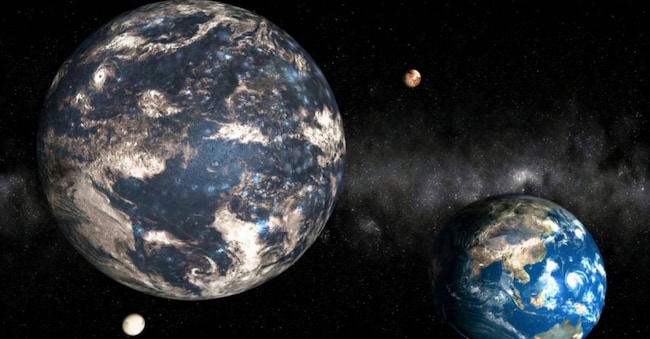
Astronomers were astonished by the discovery of a giant rocky planet similar to Earth: it is about 2.5 times larger but has 23 times the mass. This ‘Mega-Earth’ lies some 87 light-years away from us and is described in a study led by Max Kroft of the University of Wisconsin-Madison, which is due to be published in *The Astronomical Journal* and is available on arXiv, the publicly accessible platform for pre-peer-reviewed research papers.
The cosmic scene
“Dense planets like this one are not rare,” said Kroft, “but they are usually small, rocky planets similar to Earth or Mercury. This planet, on the other hand, is two and a half times larger than our own.” Ever since the discovery of the first ever exoplanet – the first outside our Solar System – it has become clear that an incredible variety of planets, varying in size and mass, exist around other stars. A veritable zoo of planets that, until recently, could only be imagined in science-fiction novels, and which we have slowly begun to understand and catalogue according to their common characteristics. These range from Sub-Earths – rocky planets smaller than Mars, with a mass less than that of Earth – to Super-Earths, which are rocky and between 2 and 10 times the mass of Earth, right up to hot Jupiters – gas giants orbiting very close to their star – or even bizarre ‘cotton-candy’ planets, which are extremely light and puffy gas giants.
What’s new
Over 8,000 planets have been discovered to date, and astronomers were convinced they had seen it all – but that is not the case. The newly discovered planet, named GJ 523b, does not belong to any of the families known to date and has therefore been informally classified as a ‘Mega-Earth’. It is, in fact, rocky but has an incredibly large mass for a planet of that type – a mass usually associated with gas giants, such as Jupiter or Saturn. Observations initially made using the TESS space telescope – which specialises in ‘hunting’ for planets by observing their transits across their star – and subsequently with the Wiyn telescope in Arizona indicate that GJ 523b has a mass approximately 23.5 times that of Earth and a radius 2.55 times greater; it orbits its star every 17.75 days and is relatively young, with an estimated age of nearly 170 million years.
The Enigma
A combination of size, mass and age that poses a puzzle for planetary formation models. Typically, according to the models, very massive planets, such as GJ 523b, gradually attract vast quantities of gas, particularly hydrogen, and eventually grow even larger to become gas giants, as in the case of Jupiter. “The question is: why hasn’t this planet followed that path, given that it has a mass more than 20 times that of Earth?”, said Kroft. To solve this puzzle, the authors explain, the challenge now is to identify other anomalous planets like GJ 523b; only then “might certain trends emerge”, concluded Kroft.

Brand connect


Newsletter Scuola+
La newsletter premium dedicata al mondo della scuola con approfondimenti normativi, analisi e guide operative
Abbonati