A masterpiece supercar: Maranello's Gran Turismo on the track and on the road
The Ferrari 12-cylinder under the microscope. What it feels like driving the heir to the 812, which pays homage to the legendary V12 engine and takes a leap forward in aerodynamics.
4' min read
4' min read
Tradition inseparable from innovation. At least at Ferrari's, where with the new 12Cilindri they have managed to combine the legendary V12 engine that has now reached 830bhp, free of all electrification and turbochargers, with an unprecedented style with clear references to the past. To find out how it goes we went to Luxembourg, where we had the chance to test it on the track inside the Goodyear development centre. The reason is linked to the renewed collaboration, after 30 years, between the American tyre manufacturer and the Modenese manufacturer.
The Style
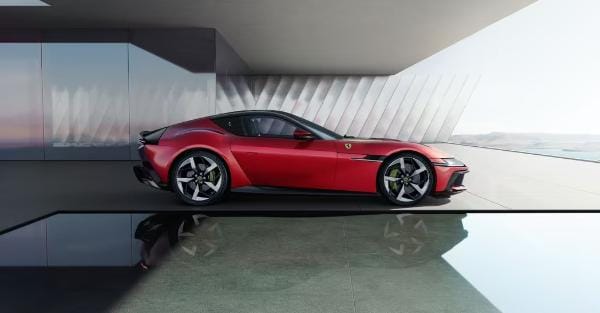
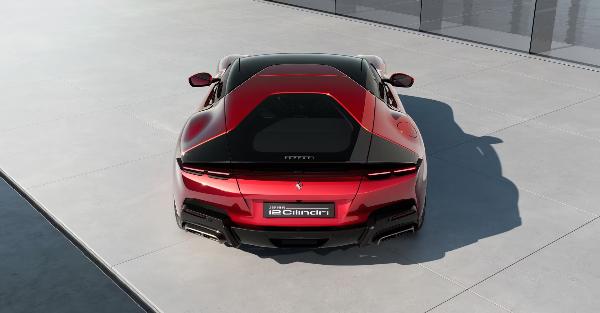
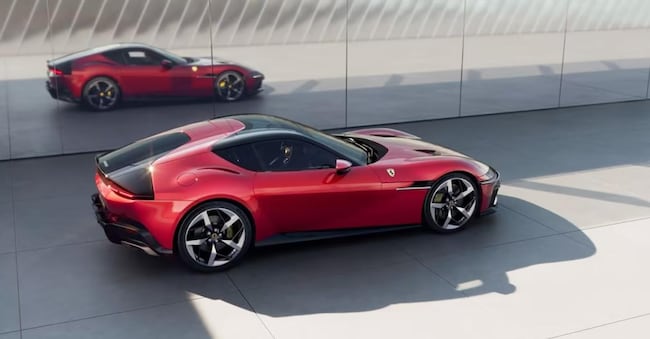
Masterpiece is a term often abused when talking about supercars, especially if they are built in Maranello. With the Ferrari 12Cilindri, however, there is no better term to describe it, because in this case the team headed by Flavio Manzoni has outdone itself by creating a Grand Tourer with strong references to the past (starting with the front end) but without any nostalgic effect or, on the contrary, deliberately marked lines. In addition to the unprecedented styling, the Ferrari 12Cilindri takes a leap forward in aerodynamics. One example? The two mobile wings at the rear that, managed by software and silicon intelligence, keep the car glued to the road when needed without dirtying its line with questionable fixed wings. These mobile appendages allow two configurations: Low Drag (LD) and High Downforce (HD). In LD mode, the movable element aligns with the body to reduce drag, while in HD mode, maximum vertical load is generated to ensure optimum aerodynamic balance.
The interior
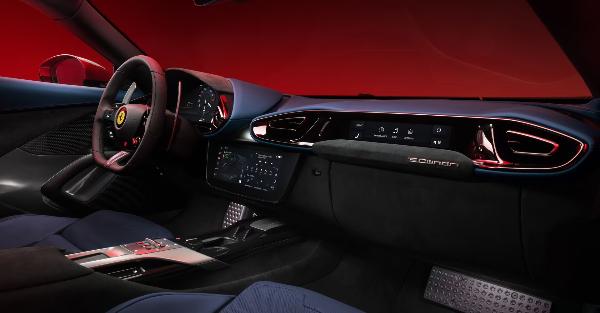
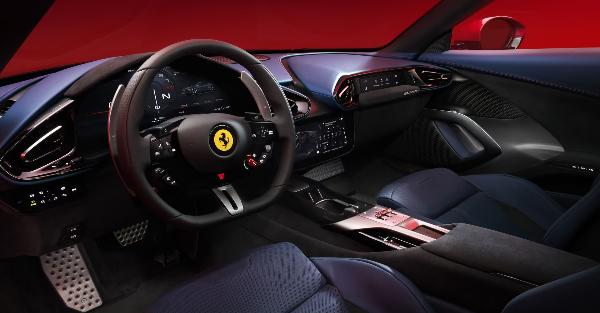
Climbing aboard the Ferrari 12Cilindri you get the clear impression that the cockpit is designed to be a faithful companion. Because the 12Cilindri wasn't created to set the fastest time on the track (it's not for nothing that the people at Maranello didn't reveal the time it set at Fiorano) despite having all the qualities to do so, but its main mission is to be a true Gran Turismo. Which translates into becoming the perfect weekend getaway car, thanks to a large boot (for the type of car) and a cabin designed to get you off with a sore back even after transfers of several hundred kilometres. In detail, the interior is characterised by the dual cockpit shape. There are three displays: the 15.6" instrumentation that provides driving information and vehicle dynamics and is matched by the steering wheel with capacitive controls (already seen in the latest generation Ferraris) and a physical manettino. In the centre of the dashboard is an infotainment system with a 10.25" touch display that offers compatibility with Apple Carplay and Android Auto, while the passenger has an 8.8" screen.