
The PRIN farce: record times for those assessing them, six weeks of torment for those writing them

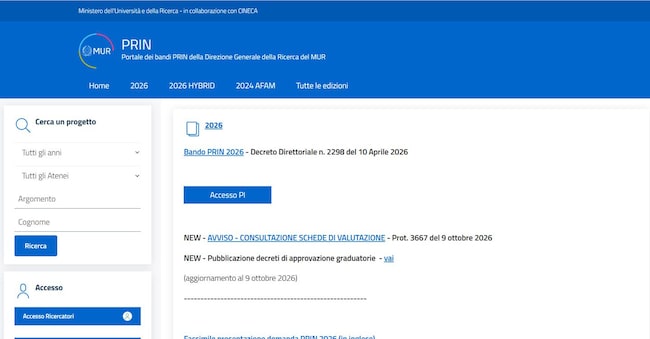
The rankings for the PRIN 2026 calls for proposals are being published over the next few days. The Ministry of Universities and Research is delighted: evaluations were completed in around four months (compared to fifteen for PRIN 2022), with a slight technical delay due to issues with Poste Italiane’s digital signature. ‘A vibrant scientific community,’ said Minister Bernini. The figures bear this out: 4,279 applications for the standard PRIN, 395 for the PRIN Hybrid, and 10 for the Synergy Grant.
There is, however, another record that the Ministry does not mention: those applications were processed in just over six weeks.
The call for applications was published on 10 April 2026, with a deadline of 1 June at 3.00 pm — applications open from 17 April — right in the middle of the second semester’s teaching, with the long weekends of 1 May and 2 June in between. Rumours about the imminent publication had already been circulating for a few weeks, and many academics had already set to work — unfortunately, based on the criteria from previous editions. The 2026 criteria, however, had changed radically: a budget of 1–1.2 million per project (compared to the 250,000 euros of the 2022 PRIN), involving 4–6 research units from different universities — double the number in previous editions. The call for proposals was so ambiguous that it required several rounds of FAQs to clarify outstanding issues, the last of which was issued about a week before the deadline.
It was as if a bomb had gone off at Italian universities, marking the start of what has been dubbed, in the corridors, the ‘cursed PRIN-spring’. Research offices — already understaffed at many universities — were still finalising the PRIN 2022 reports when they found themselves having to manage this new wave, with rules that were largely still to be deciphered. Academics, for their part, diverted energy away from teaching and ongoing research to focus on the PRIN calls. This decision to divert time and energy has, given the success rates announced by the Ministry — less than 5 per cent for the standard PRIN, compared with 12 per cent for ERC Starting Grants and 20–35 per cent for the equivalent French and French and German equivalents — has proved dubious, to say the least.
This approach to publishing calls for tenders reflects a poor understanding of the timescales and processes involved in research, because good ideas take time. It creates inefficiencies, because the inability to plan leads to errors and poorer quality for both organisations and individuals; for the latter, it also leads to greater stress and job dissatisfaction. And it creates inequalities. Such tight deadlines penalise above all those with care responsibilities — primarily female colleagues — who struggle to compete on an equal footing, either giving up the role of principal investigator or participating whilst accepting a workload that risks leading to burnout. Even for younger researchers, building a network of at least four institutional partners in six weeks is far from straightforward.

