
A more sustainable solution for the Messina Strait Bridge
Born with excessive constraints and costs, needs critical analysis to reduce expenses and environmental impact

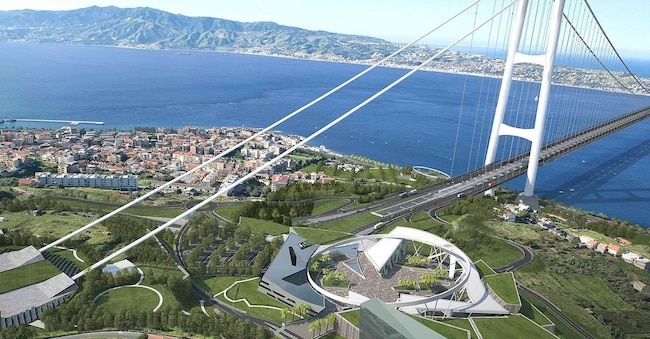
It is never too late to admit you have made a mistake and run for cover, perhaps with a better solution. The re-examination requested by the Court of Auditors for the Messina Strait Bridge project should, however, be extended to the premises with which it was originally decided to set it up and which are no longer relevant (or rather: never were).
The bridges project was born more than a couple of decades ago with a functional approach to increase costs disproportionately (to the benefit of builders and the industrial allied industries); there was no awareness that public finances were travelling towards unsustainable limits, and therefore 'the more you spend, the better you spend', in the sense that there is money to be made for many different actors. Consent to mega spending projects is always assured and can also have positive effects in terms of votes for the proposing politicians.
The best way to increase costs is to introduce seemingly insignificant constraints into the project, which, however, in a cumulative manner and with the development of the executive projects lead to an exponential growth of the investment. There were two initial approaches, given as basic assumptions and therefore never really analysed without bias:
- the inclusion of two railway tracks in addition to the motorway lanes: the weights, vibrations, slope limits and high speeds expected for rail increase the construction costs and time n times compared to a slim motorway-only bridge suitable for limited traffic, mainly cars
- the approach of wanting to set a single span world record at all costs (m 3,300 vs. the Dardanelles bridge of m 2,023). Consequently, it is sufficient to assume that the two load-bearing towers must be placed on land and it is inevitable that the length of the main span must be the width of the Strait of Messina. Positioning the towers a few hundred metres out to sea (as is the case with the Turkish bridge or even the second longest bridge in Japan: Akashi Kaykilō: note that both are built in seismic areas) reduces the overall weight of the bridge, balances the towers more easily (since the main span has a heavier counterweight in the secondary spans) and has other technical and economic advantages.

