Hanover

A new generation of female researchers investigating the provenance of art

At the European conference on provenance, young Italian scholars presented case studies on the looting of Montecassino and the Venice Biennale art market

5' min read

Translated by AI
Versione italiana

5' min read

Translated by AI
Versione italiana

From 3 to 5 November, Hanover was the capital of provenance research. The Arbeitskreis Provenienzforschung, the world’s largest association of researchers in the field, with over 680 members from 17 countries, brought together scholars, legal experts, curators and market professionals at venues across the city: the Sprengel Museum, the Landesmuseum, the August Kestner Museum and the ZeitZentrum Zivilcourage. There was a large audience both in person and online, where part of the proceedings was streamed live. One statistic was particularly striking: at a glance, around 95 per cent of those present were women. This reflects a profession which, at least in Europe, is now overwhelmingly female.

The title of the conference, ‘Provenienzforschung (neu) verorten’ (Re-positioning Provenance Research), reflects a period of self-reflection within the discipline. In recent years, the conference has also been seeking to become increasingly international, moving beyond Germany’s borders and inviting a diverse range of organisations to participate. This year, in particular, the presence of young Italian researchers stands out, with case studies that closely concern our cultural heritage. This is an important sign for a country where research into the provenance of works looted during the Second World War has not yet reached the level seen in Germany, the Netherlands or Austria.

Loading...

Montecassino, a memory halved

Benedetta Tortora, a PhD student at the University of Naples Federico II, opened the panel on 3 November dedicated to the relationship between provenance and memory with a presentation on the sacking of Montecassino and the way in which the Capodimonte Museum and Royal Park preserves the memory of this event. In 1943, the Superintendency had moved a significant part of the Neapolitan collections to safety within the abbey. In the autumn of that year, months before the Allied bombing of February 1944, the ‘Hermann Göring’ Division removed the crates under the pretext of saving them. Some never reached their destination and ended up in the Reichsmarschall’s personal collection.

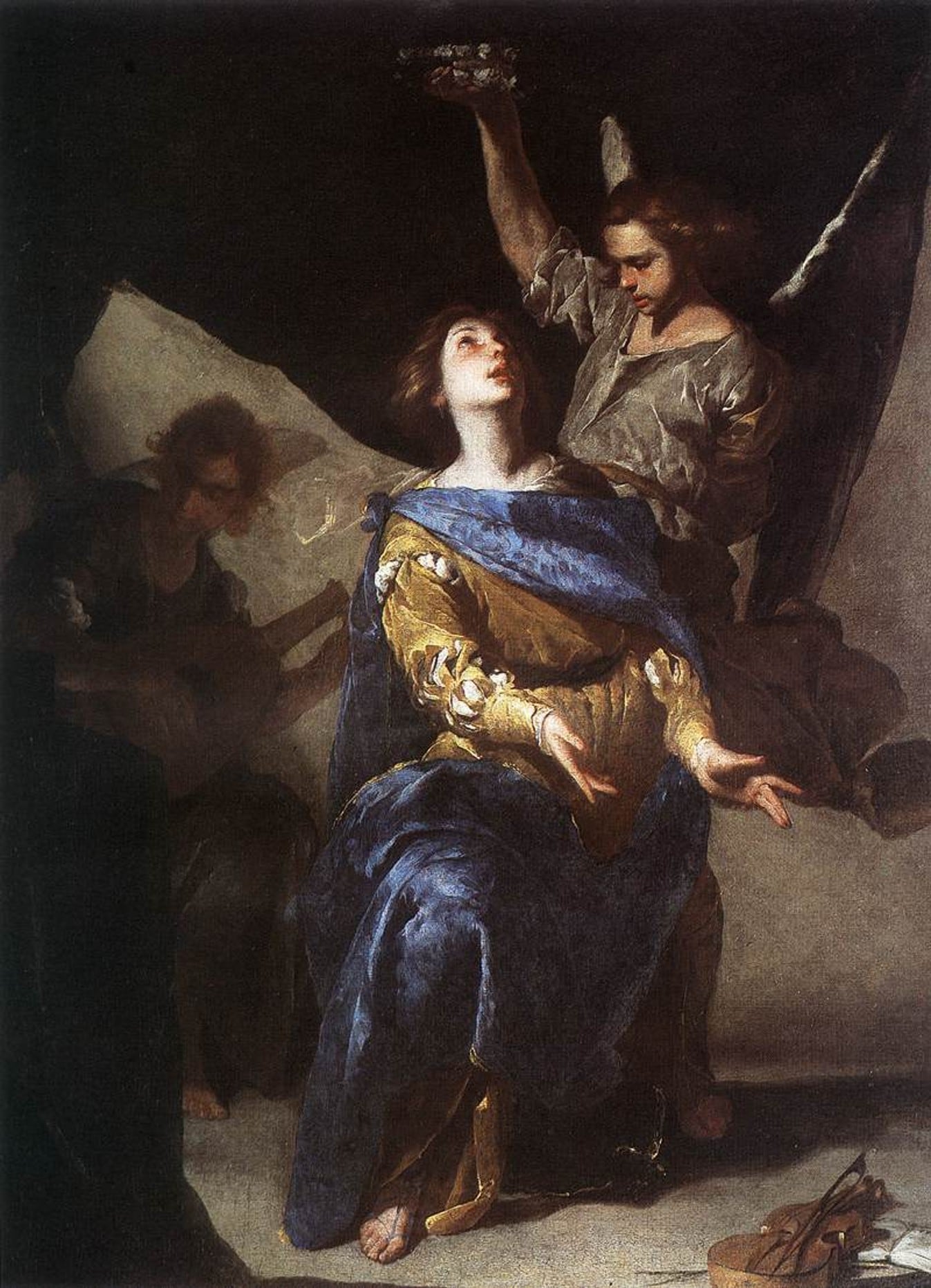
Tortora, however, focuses on what happened afterwards. The recovered works returned to Naples from a single looting incident, but with the collections divided between archaeological artefacts (the National Archaeological Museum of Naples – MANN) and paintings (Capodimonte), the documentation was also split, and each museum now holds only half the story. The researcher then warns against overlapping narratives – that is, stories that obscure what the works are meant to convey. This is the case with Titian’s ‘Danaë’, returned in 1947 and exhibited in Rome, at Villa Farnesina, in the ‘Exhibition of Works of Art Recovered from Germany’. A salacious legend has grown up around the painting concerning the private use Göring is said to have made of it in his bedroom; according to Tortora, this was revived by Rodolfo Siviero himself and by *Time Magazine* (“Art: Nudes for Hermann”, 24 July 1944). This account shifts the focus away from the systematic looting of a public museum towards gossip about a high-ranking official. Tortora also cites a work by Bernardo Cavallino sold in March 1941 and intended for the museum Hitler was planning in Linz: the transaction was given the go-ahead by the Ministry, but not by the Export Office. His conclusion is that these stories should be corrected, or reinforced, in the narrative that Capodimonte presents to the public.
 

«L’estasi di Santa Cecilia» di Bernardo Cavallino

The Biennale: a showcase and a market

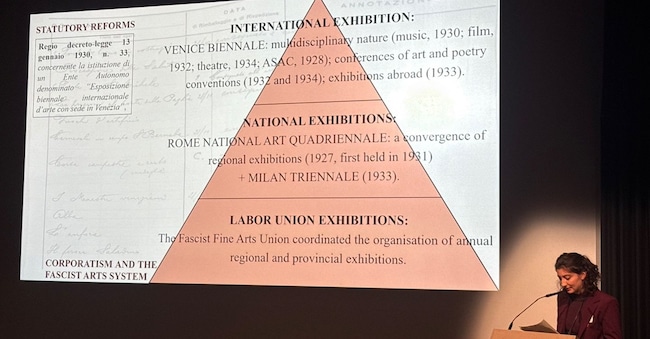
Camilla Brunazzo-Chiavegato, an art historian, presented her study on 4 November on the Venice Biennale as an art fair – a role the exhibition maintained until the early 1970s. During the exhibition, visitors and collectors could purchase the works on display; the fair’s commission was included in the final price. Alongside the works for sale were loans from private collections, which the Biennale committee facilitated by acting as an intermediary.

Brunazzo-Chiavegato’s research traces the changes in the system during the regime and brings to light the names of all those involved, as well as some little-known aspects. For some collections belonging to Jewish families, exhibiting at the Biennale became a means of salvation, as the works on display could then be exported abroad. In the post-war period, however, the event also facilitated the laundering of stolen works: their inclusion in the exhibition and subsequent sale served to ‘whitewash’ their incomplete or absent provenance. For Brunazzo-Chiavegato, the loans from the years immediately preceding the war were decisive; indeed, the Biennale’s registers and catalogues, which document who owned what at that time, are a valuable source for reconstructing the provenance of the looted collections.

A recent case illustrates just how significant they can be. On 3 April 2026, the New York State Supreme Court ordered the return of Modigliani’s ‘Seated Man with a Cane’, painted in 1918, to the heirs of Oscar Stettiner. Stettiner was a Jewish art dealer who had left Paris in 1939 as the Germans advanced, leaving the painting behind in his gallery. During the occupation, an administrator appointed by the Nazis sold it without his consent. In 1946, a French court recognised Stettiner’s right to restitution, but the work had by then disappeared. It resurfaced at Christie’s in 1996, when it was purchased for $3.2 million by a company owned by the family of the merchant David Nahmad. Today, its value is estimated at between 25 and 30 million.

For years, the defence had maintained that Stettiner’s Modigliani was a different painting. It was the Biennale itself that disproved this claim. The grandson, Philippe Maestracci, demonstrated that his grandfather had loaned that canvas to the 1930 Venice exhibition, a loan documented by photographs and archive records. Together with the Stettiner Gallery label on the back and post-war documents, this was the evidence that convinced Judge Joel M. Cohen. Nahmad has announced an appeal, and the case is not yet over. The case demonstrates, however, that an exhibition archive dating back almost a century can decide a case worth tens of millions.

The Italian-German network

5 November was dedicated to the national working groups of the Arbeitskreis, which deal with the provenance of assets looted by the Nazis and the Fascists. The Italian group, AG Italien, was presented by provenance researcher Katharina Hüls-Valenti. The Italian chapter brings together Italian and German researchers, both early-career and established, divided into ‘active’ members and members who follow the work. Since 2025, the Italian group of the Arbeitskreis has been collaborating with ICOM Italia’s Provenance Working Group. In recent years, it has organised international workshops and conferences in Venice, Florence and Rome, and next year it will be holding an event in Lucca.

Loading...

Generally speaking, the picture that emerges from our time in Hanover is that of a generation of female scholars who are coming of age and finding, within the international network, the tools, methods and visibility that they still struggle to obtain at home.

Copyright reserved ©
Loading...

Brand connect

Loading...

Newsletter

Notizie e approfondimenti sugli avvenimenti politici, economici e finanziari.

Iscriviti