
A new hi-tech laboratory has been opened in Bari, where researchers are studying how to give robots and prosthetics the sense of touch
At the heart of the research are ultra-thin sensors capable of converting touch and pressure into an electrical signal. There are numerous potential applications, ranging from agritech to the biomedical sector

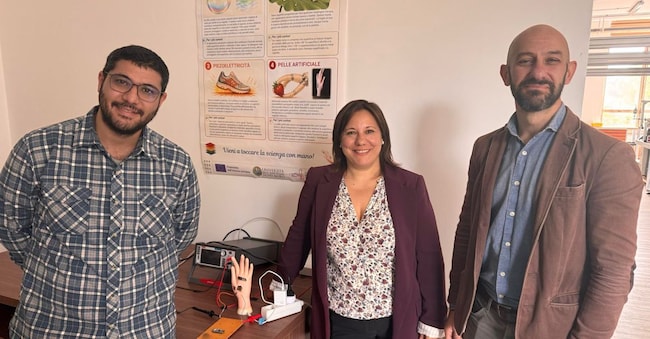
In the not-too-distant future, prosthetic limbs and robotic hands could acquire a sense of touch. A group of physicists from the Inter-university Department of Physics at the University and Polytechnic of Bari is, in fact, designing ultra-thin sensors capable of converting touch and pressure into electrical signals and recovering energy from the soles of shoes. Leading the team is Professor Anna Maria Coclite, who has opened her ThinFilm Lab in the Apulian capital to continue research that began at the University of Graz in Austria.
Research
The sensors at the heart of the research carried out by the ThinFilm Lab in Coclite are made from piezoelectric material that generates an electric current when touched or deformed. Whilst biomedical applications remain a major long-term objective, the group is focusing on agritech and energy generation in the short term.
The research into thin-film sensors stems from Smart Core, the project funded in 2016 by a €1.5 million Starting Grant from the European Research Council. The aim was to create an artificial skin capable of detecting humidity, temperature and pressure. In 2023, a €150,000 ERC Proof of Concept grant was awarded to assess its potential for commercialisation.
Areas of application
It is in the field of agriculture that the team of scientists from Bari is carrying out its first experiments. The benefits of this research could be significant in this sector. At present, robotic arms rely on visual sensors, assessing the ripeness of fruit and vegetables solely on the basis of their appearance. The application of thin-film sensors to robotic grippers could, however, give the robots a sense of touch, enabling them to better distinguish ripe fruit from unripe fruit and allowing the robot to automatically adjust the gripper’s opening as required, without needing to change the settings for each piece of fruit.
Scientists are also experimenting with the use of thin-film sensors on soles or flooring to understand how they can store and release energy. Based on the same mechanism, the sensors could in fact be used to recover energy from the pressure exerted whilst walking. For example, thanks to this discovery, using sensor-coated soles could allow you to recharge your mobile phone whilst walking.
Brand connect


Newsletter Scuola+
La newsletter premium dedicata al mondo della scuola con approfondimenti normativi, analisi e guide operative
Abbonati