
A new housing model to promote healthy longevity
Scientific research in the field of ageing has amply demonstrated that the living pattern adopted by a senior has a direct and indirect primary impact on his or her ability to remain healthy for much of their remaining life

3' min read
3' min read
Today in Italy there are about 14.2 million people over the age of sixty-five. Demographics tells us that currently an over-65 person has a life expectancy of up to about eighty-six years (women a little more, men, a little less); it also shows that at that same age, the expectation of remaining in 'good health' only reaches around seventy-six years (in this case, without great gender differences). It is clear that no reform of the health system will ever be able to guarantee, on average for ten years, intensive care and medical treatment to what is already almost a quarter of the entire Italian population and will exceed 30% within the next ten to fifteen years.
The issue does not only concern our country; it is at least since the beginning of the century that the World Health Organisation (WHO) has put the raising of the so-called healthy life expectancy (HALE) at the centre of its action on a global scale and emphasised the need to act on all factors that favour healthy longevity.
Scientific research in the field of ageing has amply demonstrated that the living pattern adopted by a senior has a direct and indirect primary impact on his or her ability to remain healthy for much of their remaining life. The WHO has also set the goal of 'ageing in place': to ensure that people in their 'third' and 'fourth' age can live as long as possible in an independent home that feels like 'home', in a community of which they are active members and where they can cultivate their interests. A living environment where they can also easily benefit from the various services they need as they grow older.
As time goes by, the house where one has lived, with one's children, perhaps for twenty or thirty years, and to which one feels attached, becomes inadequate for healthy ageing. Left alone or at most with two people, it is usually unnecessarily large; it needs maintenance; it is energy inefficient. In addition, it is full of architectural micro-barriers that become no small nuisance or even cause a lack of security as one ages. Retirement homes, nursing homes and various types of 'sheltered housing' can only be a solution for people who are not self-sufficient and in need of intensive personal medical care.
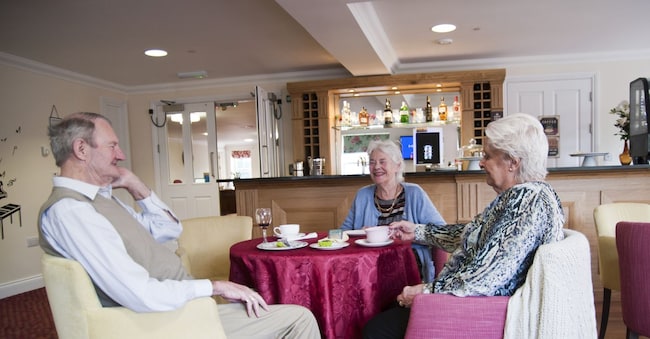
A much more effective alternative, centred on guaranteeing the autonomy of the person, is represented by innovative senior housing, which is increasingly widespread internationally, especially in Anglo-Saxon and northern European countries. Although there are several variants, the model is always characterised by the integration of independent living with the provision of a certain set of services to the resident, which may vary as his or her health conditions and needs change. The dwelling is in a residential facility, in some cases located in a green area and in any case equipped for a range of activities for the benefit of the senior. In addition to services related to prevention, basic health checks and personal care, opportunities for cultural, recreational and socialising activities are usually offered; measures for personal safety in the flat and residential area are provided. Thanks to all these activities, the person can live in his or her own independent home, but not isolated; this is particularly decisive for the more than eight million over-65s living alone today.

