
Festino, the night that brings Palermo to life: 400,000 people expected
From street food to hotels, from transport to cultural events: the 402nd Festino di Santa Rosalia is set to generate an estimated economic impact of over 5 million. Mayor Lagalla said: “The Festino has now become a defining feature of our identity.”

Key points
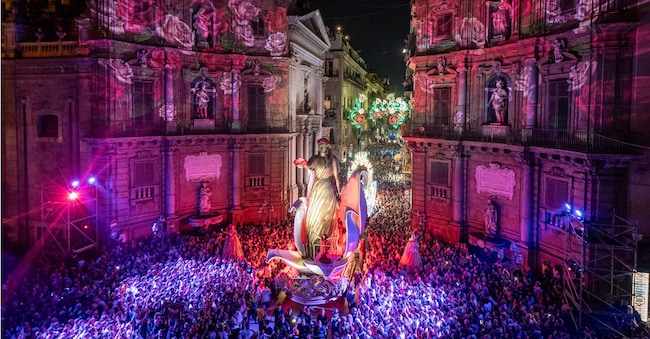
When Santa Rosalia’s procession sets off from the Royal Palace this evening and turns onto the Cassaro, Palermo will already be a different city. The Cassaro is now known as Corso Vittorio Emanuele, the street that runs through the historic centre, crosses Via Maqueda at the Quattro Canti and continues towards Porta Felice and the Foro Italico. Road closures, crowded balconies, market stalls, bars bustling non-stop and the aroma of street food will accompany the procession: panelle and crocchè, sfincione, bread with spleen, stigghiole, drinks and sweets.
14 July is not just the night of devotion to Saint Rosalia. It is also the time when Palermo sees a huge surge in consumer activity – spanning the catering, retail, transport and services sectors – all concentrated into just a few hours.
Around 400,000 people are expected to attend the 402nd Festino, compared with over 350,000 at the previous edition. An extra 50,000 visitors could generate between half a million and 750,000 euros in additional spending. There is as yet no official study on the economic impact of the event, but a conservative estimate suggests that direct spending on the night of the Festino alone amounts to between 4 and 6 million euros.
The calculation is based on an average spend of between 10 and 15 euros per person. Some people buy nothing at all, others limit themselves to a drink or a slice of sfincione, whilst others add the cost of dinner, parking or a taxi. With an average of €12.50 per person, the evening’s turnover amounts to around 5 million. This is not a measure of GDP generated, but an indication of the scale of money that can circulate in the city.
“The town is currently enjoying a great deal of media attention,” says Mayor Roberto Lagalla: “Its Festino, which we have rebranded as a symbol of our identity and not merely as a religious festival, is increasingly placing it amongst the major events that attract tourists seeking authentic experiences.” The last two editions have won awards at BEA World and BEA Italia. “The BEA awards have recognised the importance of the event,” adds Lagalla.


