
A Panorama that enhances art and territory
The fourth edition of the widespread exhibition organised by Italics lands in Monferrato, an opportunity to discover a new territory: this is how art can be a driver of socio-economic development

3' min read
Key points
3' min read
The exhibition-event Panorama organised by the Italics gallery consortium for its fourth edition from 4 to 8 September has come to northern Italy, to Monferrato, for the first time. The curator Carlo Falciani, an expert in Tuscan mannerism and a contemporary art enthusiast, has designed a journey to be travelled slowly, a meditative path inspired by the principles of "La civil conversazione" by Stefano Guazzo (born in Casale Monferrato in 1530), the exhibition develops themes across the ages in each town: portrait and identity in Vignale, work and roots in Camagna, transience and death in Montemagno, the sacredness of art in Castagnole, thanks to the works of 63 artists representing 62 galleries.
Let us go beyond the exhibition itself, which is in any case very successful and which in its contemporary sections benefits from the gaze of a curator who comes from antiquity, thus avoiding the deja vu effect and focus rather on two aspects of Panorama: redefining the role of the gallery owner and having a possibly positive impact on the place where it takes place. For five days, the gallery owners at Italics are presented in their role as cultural operators, leaving the commercial aspect of their work, which usually has the upper hand in narratives about the category, completely on the sidelines. The gallery is thus emphasised as a centre of artistic research and its widespread diffusion throughout the territory. Commercial dealings are disincentivised by order of the stable and popular and educational functions prevail instead. We at Arteconomy24 are also going to go out of our way for once and not talk about the prices of the works on display (published in Plus24 of 7 September). Ceci n'est pas une pipe.
The effects
.Let us come to the impact on the territory, take Camagna, 500 inhabitants, here for a few months there has not even been a tobacconist's shop and to buy a packet of cigarettes you have to go to the neighbouring municipalities. The landscapes are beautiful and art fits in perfectly where humans leave off, like Arcangelo Sassolino's installation or Franco Vimercati's photographs exhibited in the former Cotolengo. It was precisely with the regenerative power of art in mind that the Langhe Roero and Monferrato Tourist Board and the Alessandria province (Alexala), directed respectively by Bruno Bertero and Marco Lanza, wanted and strongly supported the presence of Italics in the area, also benefiting from a contribution of 200,000 euro allocated by the Piedmont Region. The long-term impact will be seen, but at least the guest park that has happily roamed these places is really important: from Francesca Lavazza to Giovanna Melandri, from Tommaso Sacchi to Charley Vezza and even Achille Lauro. There were also many collectors present: Ilenia and Bruno Paneghini, Marco Curina, Teresa Sapey, Daniele Giani, Franca and Antonio Sersale, Giovanna Marianacci; of possible second homes for them at decidedly inviting prices there were plenty.
Synergies
.Examples of virtuous partnerships between art and business abound in the area, such as the Scassa tapestry shop, a real champion in the sector that creates tapestries with artists or taken from famous works of art, from Klee to de Chirico, from Ernst to Mirò.
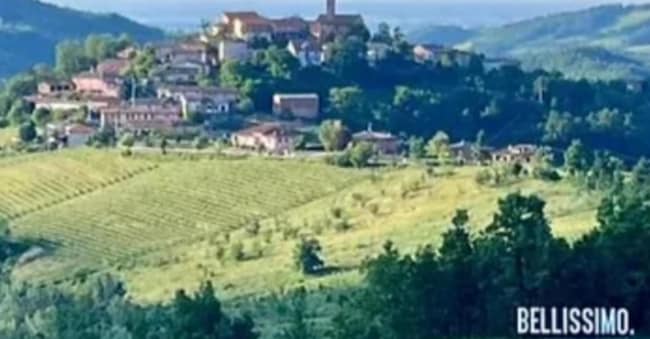
Langhe Roero and Monferrato have been a Unesco World Heritage Site since 2014 and it all started in 2004 thanks to two local sparkling wine producersLuigiterzo Bosca and Lorenzo Gancia. They wanted to revitalise their municipality, Canelli by having it recognised as a World Heritage Site. Their proposal was initially rejected, but not tamed, they brought together 105 municipalities in the area, greatly increasing the specific weight of the proposal and finally obtaining the coveted recognition; now Canelli is full of tourists. In the days of Italics, the Bosca family, of the eponymous sparkling wine, inaugurated Palazzoirreale, a centre dedicated to art and financed by the company. The inaugural exhibition is a solo show by Patrick Tuttofuoco, for now the investment has amounted to 100,000 euros and there is the will to continue with long-term planning. Art as a component of the landscape is already present in these territories, however, and in the municipality of Casasco this summer the environmental installation BELLISSIMO by Giulio Alvigini was inaugurated, a very apt caption. The investment for this public commission was EUR 10,000. Appointment in 2025 with a new edition of Italics, will the next one be in Central Italy? Who knows? In the meantime, Monferrato, having sobered up from its artistic hangover, is preparing for the grape harvest.

