
A strategic partnership has been established by the Chair in Philosophy and AI
This is a multifaceted collaboration aimed at exploring new initiatives in the fields of education and scientific research on the major issues of our time

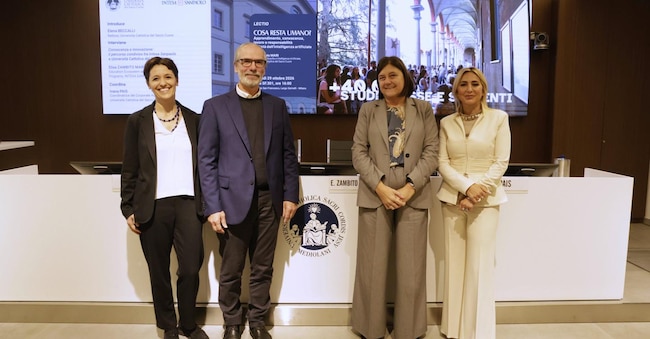
A revolution that concerns not only technological but also anthropological and ethical aspects. A challenge that plays out between humanism and technology, bridging the two cultures, and for which we must all prepare ourselves. Unprecedented scenarios in which, however, one point remains firm: the recognition of our ‘need for meaning’ and ‘the assumption of responsibility towards society’. Two essential pillars for navigating the change brought about by artificial intelligence. This was the central theme of the lecture ‘What remains human? Learning, knowledge, work and responsibility in the age of artificial intelligence’, delivered on Thursday 29 October by Professor Luca Mari, Professor of Measurement Science at the Catholic University of the Sacred Heart, where he holds the university chair in Philosophy and Artificial Intelligence, supported by Intesa Sanpaolo as part of the ‘Philosophy of the Digital Age and Artificial Intelligence’ programme, which forms part of the three-year degree course at the University’s Faculty of Arts and Philosophy.
First public meeting
The event was the first public meeting organised by the Chair in Philosophy and Artificial Intelligence, supported by Intesa Sanpaolo and established with the aim of training professionals capable of addressing the cultural, ethical and social challenges associated with generative AI. ‘The journey that led to the creation of this Chair reflects our vision of the university and the approach we have chosen to study artificial intelligence: an approach that draws on the integration of knowledge, with a primary role reserved for the humanities, which are invaluable allies in understanding the implications of artificial agents in the lives of individuals and society. In other words, on humanity,’ explained Elena Beccalli, Vice-Chancellor of the Catholic University of the Sacred Heart, as she introduced the initiative to a lecture theatre packed with students, as well as a large number of people watching via livestream.
Framework Agreement
The Chair is one of the initiatives established under the Framework Agreement on collaboration between the Università Cattolica del Sacro Cuore and Intesa Sanpaolo, aimed at exploring new projects in the fields of education and research. The partnership also includes the establishment of three observatories dedicated, respectively, to democracy, the relationship between humanism and business, and demography. ‘I believe it is truly pioneering that Intesa Sanpaolo has chosen to invest in issues that go beyond the strictly banking sphere, recognising the value of a collaboration open to a wide range of major issues. It is, in fact, a forward-thinking agreement, as it aims – with a long-term and forward-looking perspective – to address the major issues of our time, which, to be tackled effectively, require a cross-disciplinary approach that transcends the boundaries of individual disciplines. It is therefore a prime example of a virtuous relationship between universities and businesses, perfectly in line with the vision set out in the University’s Strategic Plan.
Multidisciplinary Chair
Elisa Zambito Marsala, Head of Education Ecosystem and Global Value Programmes at Intesa Sanpaolo, is also convinced of this. “We wholeheartedly support the multidisciplinary Chair for Professor Mari in Philosophy and Artificial Intelligence at the Università Cattolica del Sacro Cuore, with whom we have developed a strategic partnership based on shared values and the common belief that knowledge must be a driving force for value and innovation for the benefit of people. This partnership takes the form of observatories, development programmes aimed at the younger generation, scholarships and research initiatives designed to interpret this era of great transformation, placing human skills and our country’s unique characteristics at the centre.”
“Training young people: a strategic lever”
This is because, he added, ‘we believe that the education of young people is a strategic lever for supporting the major economic, technological and social transformations of our time. Artificial intelligence is profoundly redefining learning processes, work and the ways in which we build knowledge: this is why it is essential to foster the development of transferable skills, critical thinking and guidance tools that enable students to interpret change and play a leading role in it. Through dialogue between universities, the research sector and the business world, we aim to help raise awareness of the opportunities and responsibilities associated with innovation. Through its teaching, this Chair strongly emphasises, amongst other things, the value of a multidisciplinary approach, which educational programmes must increasingly embrace, and forms part of Intesa Sanpaolo’s broader commitment to education, the development of talent and collaboration with universities, with a view to supporting the cultural and professional growth of young people and helping them build their future.”

Brand connect


Newsletter Scuola+
La newsletter premium dedicata al mondo della scuola con approfondimenti normativi, analisi e guide operative
Abbonati