The Pisa Knowledge Alliance is launched

Six institutions and a united voice to strengthen research, training and innovation

Agreement between the Pisa Knowledge Alliance, the University of Pisa, the Sant’Anna School of Advanced Studies, the Scuola Normale Superiore, the National Research Council, the National Institute of Nuclear Physics and the European Gravitational Observatory. An ecosystem worth over 630 million euros

Alleanza Pisana della Conoscenza

4' min read

Translated by AI
Versione italiana

4' min read

Translated by AI
Versione italiana

This is the first step in a collaboration whose strategic aim is to provide a unified voice for Pisa’s education, research and innovation system. With the signing of the Memorandum of Understanding, the Pisa Knowledge Alliance has been established, comprising, at present, the University of Pisa, the Sant’Anna School of Advanced Studies, the Scuola Normale Superiore, the National Research Council (CNR), the National Institute of Nuclear Physics (INFN) and the European Gravitational Observatory (EGO).

The agreement

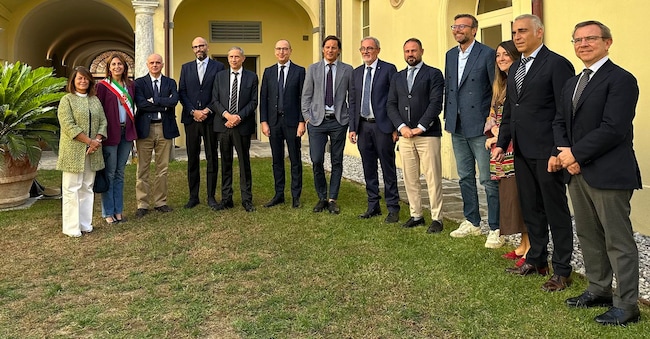
The agreement was signed on Thursday 15 October at the Scuola Superiore Sant’Anna in Pisa, the very place where, several months ago, the process of consultation that led to the drafting of the document began. For the first time, institutions that have been collaborating closely for years have chosen to share the priorities with which they will present themselves to institutional partners, businesses and national and international scientific networks. From strategic positioning to coordinated communication, from talent mobility to the promotion of research, from synergies for the development of human resources to a network of shared infrastructure: there are eight strategic areas around which the alliance will develop – areas not previously covered by specific agreements, but to be developed within this new integrated ecosystem.

Loading...


Joint statement by the legal representatives of the six signatory institutions

“Our institutions have been working together for years. By signing this agreement, we are making a joint commitment to the future of Pisa and to the contribution that this collaboration between the University and research bodies can make to the country in the areas of education, research and innovation. Bringing together complementary expertise and infrastructure enables us to develop projects and achieve results that would be difficult for any one organisation to achieve on its own.
The Pisa Alliance for Knowledge, whilst upholding the identity and autonomy of each institution, aims to give greater weight to the initiatives we can support together. We want those who choose Pisa for their education and career to find an environment capable of nurturing their ideas, bringing together all the expertise available and opening up new possibilities for study, research and innovation. It is by these concrete opportunities that the value of our commitment will be measured”.


An ecosystem worth over 630 million euros

The network that forms the Alliance comprises over 45,000 university students, more than 1,600 PhD students and nearly 6,000 people, including lecturers, researchers, technologists, research assistants and technical and administrative staff. Three universities, two major national research organisations and a world-leading gravitational wave observatory, all concentrated within a relatively small geographical area, collectively generate over 630 million euros a year through education, research, technology transfer and the management of scientific infrastructure.
This scale is accompanied by an already highly developed network of relationships. A survey has identified over 50 strategic framework agreements, signed by at least two Alliance organisations and now open to wider participation within this integrated ecosystem. The survey deliberately excluded agreements on individual projects, which further expand the scope of collaborations. The Memorandum provides a common framework for these relationships and paves the way for cross-cutting agreements and initiatives, which can be extended to all six partners in areas of shared interest.


The eight areas of collaboration

The Memorandum identifies eight strategic areas, which concern both the Alliance’s external role and joint work between institutions.
Institutional coordination will serve to articulate shared positions in relations with regional, national and international institutions, with particular attention also being paid to the healthcare system. Communication and promotion of the Alliance will raise the profile of the Pisa system’s expertise, achievements and opportunities through shared tools and initiatives.
The relationship between culture, knowledge and the local area will be strengthened through shared cultural programming, outreach initiatives and opportunities for public participation. Mobility and the circulation of talent will involve students, lecturers, researchers and technical and administrative staff, with the aim of facilitating exchanges and access to opportunities and services, whilst also providing coordinated forms of support for scholars and students in situations of crisis or vulnerability.
Strategic positioning and international rankings will be the subject of a review of data, indicators and best practice, to better reflect the quality of research and education. Skills development and the coordination of human resources will enable the identification of strategic professional profiles for the future and the assessment of possible forms of collaboration in planning and recruitment, whilst respecting institutional autonomy and current legislation.
With regard to shared research infrastructure, institutions will deepen their mutual understanding of laboratories, major equipment, libraries and technology platforms, assessing methods of coordinated access that are compatible with technical, organisational and security requirements. Finally, the promotion of research, knowledge transfer and innovation will involve dialogue with businesses and public authorities, the exploitation of intellectual property and support for spin-offs and start-ups, thereby facilitating the alignment of local needs with scientific expertise.


The Alliance’s next steps

The six institutions undertake to sign, within six months of the signing of the Memorandum, a Framework Agreement setting out operational procedures and mutual commitments to cooperation, as well as, subsequently, any implementing agreements necessary to realise the shared objectives. Both instruments for implementing the Memorandum will also involve local and regional institutions, through necessary consultation and coordination.
The Framework Agreement may also be open to formal accession by other research bodies based in the Pisa area, with the aim of consolidating a stable platform for cooperation and strengthening Pisa’s role as one of the leading Italian and European centres of knowledge.

Copyright reserved ©
Loading...
Loading...

Brand connect

Loading...

Newsletter Scuola+

La newsletter premium dedicata al mondo della scuola con approfondimenti normativi, analisi e guide operative

Abbonati