A podcast to highlight Gabriele Devecchi
The first one, funded by the Italian Council, was promoted by the archive to bring attention back to this protagonist of the T

5' min read
5' min read
The first and only podcast financed by the'Italian Council, the programme of the Ministry of Culture created in 2017 to promote the production, knowledge and dissemination of contemporary Italian creation in the field of visual arts, is now available. It is dedicated to Gabriele Devecchi: a Milanese artist, designer, architect, goldsmith and lecturer who died in 2011, a multifaceted but also underestimated figure. It was proposed by his three children Alice, Matteo and Giacomo Devecchi who, after carrying on the artist's archive activities discreetly from 2015 to the present, have now decided to come out into the open, focusing on repositioning the figure of their father in the history of art and design.
The project was financed by the Italian Council with €30,000, to which the family added another 20 per cent investment; it was developed together with the digital agency Pale Blue Dot and has as its author Alberto Saibene.
The Story
The podcast is divided into six episodes, starting with Devecchi's membership of Gruppo T in the early 1960s, together with Giovanni Anceschi, Davide Boriani, Gianni Colombo and Grazia Varisco. "Back then, they were called 'those of the little cars' by the more conservative avant-garde," says their daughter Alice Devecchi, "because they used mopeds inside the works to create movement, challenge the viewer's perception and stimulate the interaction between person and object." Their first exhibition, which was deliberately not called an exhibition, but "Miriorama" to emphasise the multiplicity of the image, was held in 1960 at the Pater Gallery; then there were several one-man shows until 1962, when there was the pinnacle exhibition of programmed art in the Olivetti shop in the Galleria Vittorio Emanuele, based on an idea by Bruno Munari and with a text by Umberto Eco, which travelled throughout Italy and abroad, even touching on the United States and Japan.
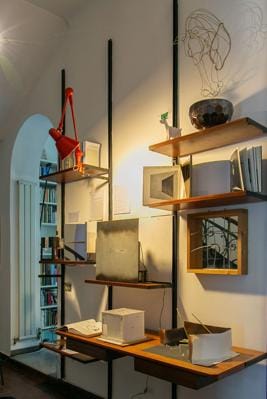
Space environments
.The members of Group T continued to work together and individually, creating not only moving works, but also spatial environments, into which the visitor is invited to enter, becoming part of the art installation. The group never officially disbanded, but in 1968 there was their last exhibition together, 'Cinetisme, Spectacle, Environment' in Grenoble, with a 'programmed obstacle course'. In 2010, to celebrate 50 years since the birth of the T Group, the exhibition 'Miriorama 16' was held at the Fondazione Mudima in Milan, with 40 works and environments.
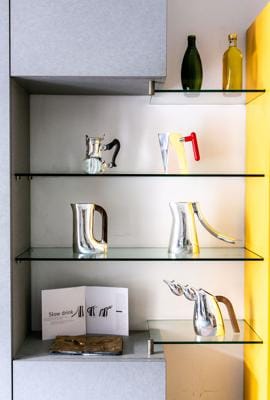
Silvers
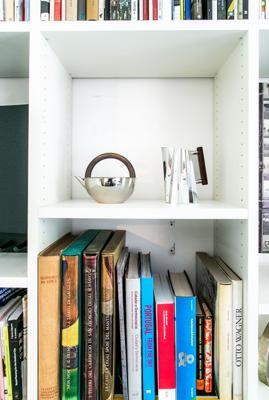
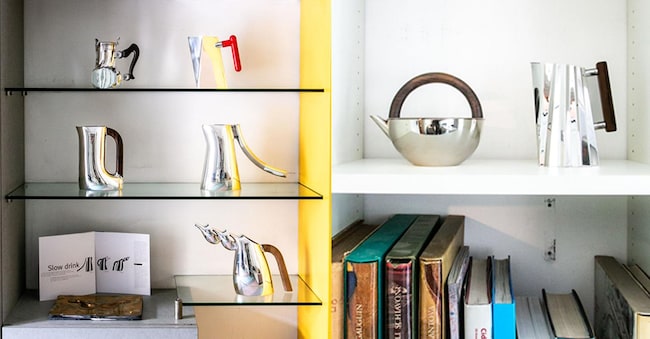
.But Devecchi's artistic production did not only take place within the T Group. In 1969, his father Pierino Devecchi, himself an artist who had joined Futurism at a young age, entrusted him with the family silverware company, which he had founded in 1935. It was a classic silverware house, although he had already shown visionariness by involving Gio Ponti and Luigi Caccia Dominioni. Gabriele Devecchi was able to innovate by designing avant-garde objects, which later entered museum collections such as those of the Triennale, the Museo del 900, the Gallerie d'Italia and the Victoria & Albert Museum. The British museum, in particular, has two coffee pots from the mid-1980s that reinterpret the classic coffee pot by inserting it into geometric shapes. Another iconic collection is the Slow Drink, with a carafe with a sculptural spout that shows the passage of water, slowing the gesture and drawing attention to the object. Also famous is the Arganto collection, which gave its name to the podcast.