
A secure financial future starts with trust in your adviser
The theme of longevity and advisory choices was the focus of discussions on the first day of the EFPA Meeting 2026

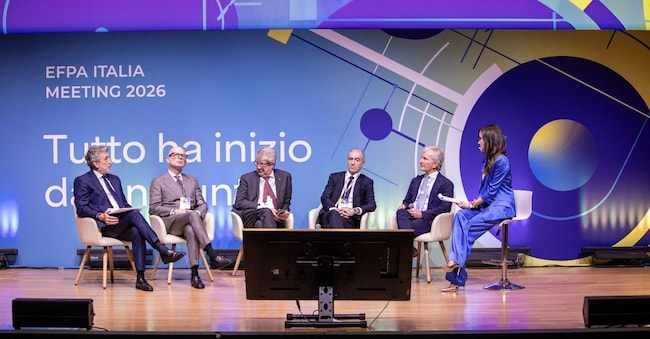
Financial planning in a world where longevity is becoming the norm is important, but ‘everything starts somewhere’, as was highlighted on the first day of the EFPA Meeting 2026, which is entitled ‘Planning better, living longer’. One point highlighted on the first day also concerns the difficulty advisers face in focusing on planning when the approach of European regulatory frameworks for the sector seems to remain more product-centric than portfolio-centric. However, both the starting point of the path charted by the various presentations and its ultimate destination is the issue of trust – the trust that a human adviser can build with the saver, which no algorithm can ever replace.
Five operational pillars
The opening address by Fabrizio Quaglio, President of Eppa Italia (the body responsible for certifying the competence of financial advisers), and the subsequent round-table discussion with senior representatives from the sector’s leading institutions provide a comprehensive and strategic overview of the future of financial advice. In his debut as president, Quaglio outlined the guidelines for his presidency, structuring them around ‘five operational pillars’. Firstly, Quaglio proposes that the EFPA certification be regarded as the true ‘degree’ in the field of financial consultancy – a rigorous training standard capable of validating the profession. The second pillar aims to demonstrate empirically, through scientific research, the qualitative difference and the superior client protection outcomes achieved by certified professionals compared to those without such qualifications.
In the third point, the president addresses the challenge of an ageing population — with Italia ranking second in the world after Japan —, highlighting the need to establish ethical standards dedicated to protecting the most vulnerable clients and to promote an intergenerational pact in which the adviser acts as a bridge between the generations. The fourth objective concerns strengthening external communication, so that savers fully recognise the value and significance of professional certifications. Finally, the fifth pillar concerns the integration of artificial intelligence as a tool to support day-to-day operations. Quaglio emphasises that, whilst AI enables information to be retrieved instantly, it is human expertise that allows us to ask the right questions and handle concepts with understanding, confirming that trust and personal relationships remain an irreplaceable asset that no machine will ever be able to replicate.
A comprehensive comparison
This policy framework is immediately explored in the round-table discussion, which begins with an analysis of the data from the Finer research. The discussion revealed that 89 per cent of clients supported by certified advisers prioritise future financial security, compared with 77 per cent of clients of non-certified professionals, demonstrating how technical expertise influences long-term savings decisions. Commenting on this point, Fabrizio Quaglio draws attention to the profound perceptual gap characterising the younger generations: 63 per cent of Generation Z, in fact, expect to face old age relying solely on the state pension and government benefits. Faced with this illusion of security, Quaglio reiterates that the adviser’s expertise is indispensable in guiding young people towards informed wealth planning over horizons of 10, 20, 30 or 40 years.
The urgency of this cultural transformation is explored in greater depth by the demographic analysis carried out by Marco Tofanelli, Secretary-General of Assoreti, who highlights how the gradual decline in the working-age population, compared with the growing number of people aged over 67, risks undermining the sustainability of the public welfare system and GDP growth. Tofanelli highlights the achievements of the advisory networks, whose assets under management have increased fivefold over the last decade, rising from 250 to over 1,000 billion euros. However, he notes that the total resources allocated to supplementary pensions and pension funds – which within the network system have risen from 4 per cent to around 25 billion – still account for only 13 per cent of Italian GDP, compared with much higher percentages in Anglo-Saxon and Northern European contexts. In criticising the approach of the Retail Investment Strategy (RIS) and the European concept of ‘Value for Money’, Tofanelli highlights the risk of reducing the value of advice to the mere industrial cost of the individual product, rather than assessing its effectiveness and value within the context of long-term portfolio planning aimed at supporting retirement provision and the real economy.

