Hybrid warfare

From schools to flights, a spate of false alarms in the space of a month

Since the second half of October, thousands of emails containing threats of imminent bomb blasts have caused days of chaos across half of Europe, with hundreds of schools evacuated and flights diverted.

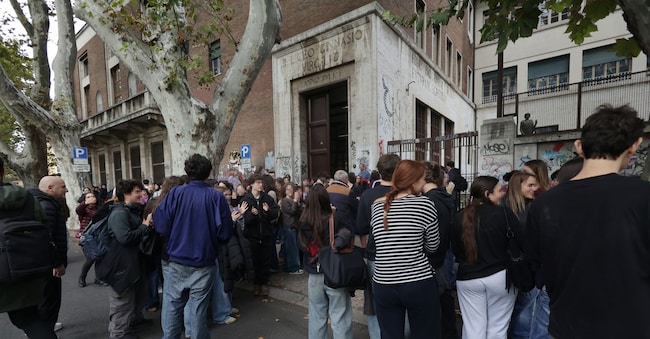
Allarme Bomba nelle scuole in tutta Italia , il liceo Virgilio — Mercoledì  11  Novembre  2026  — Roma—Italia —(foto di Cecilia Fabiano/ LaPresse)   Bomb Alert in many Italians Schools, Virgilio High School  —Rome — Italy  —  November 11, Wednesday  2026 - News - (photo by Cecilia Fabiano/LaPresse LAPRESSE

4' min read

Translated by AI
Versione italiana

4' min read

Translated by AI
Versione italiana

The false bomb alerts that have affected around 6,000 schools across Italia are merely the latest in a long series of incidents that have been affecting much of the continent for the past month. Since the second half of October, waves of emails, messages and phone calls threatening imminent bomb explosions have repeatedly caused days of chaos across half of Europe, with hundreds of schools evacuated and flights diverted.

The first warnings

Prior to the bomb threats on 11 November, there had been a number of incidents affecting several European countries, from the United Kingdom to Serbia. The incidents began on 19 October, when false reports of bomb attacks affected hundreds of schools in Northern Ireland, Scotland, Hungary and Serbia. On that occasion, many schools were evacuated as a precaution. It has not yet been clarified whether the incidents in the various countries were linked.

Loading...

In Northern Ireland, the threatening message is believed to have originated from Islamic extremists. According to the Northern Irish police, up to 300 schools had received the same email, containing a general threat, which was also sent to a number of schools across the United Kingdom. In Hungary, police reported that emails had been sent to local media claiming that bombs had been planted in over 70 schools across the country. Many schools were evacuated, but the authorities subsequently confirmed that no explosives had been found. In neighbouring Serbia, the state broadcaster RTS reported that over a hundred schools had received similar threats.

Threats against Italian schools

Italian schools, too, had already been targeted by false bomb threats before the escalation on 11 November. On 2 November, an email signed ‘Islamic Revolutionary Guard Corps’ was sent to the headteachers of 279 schools, announcing that a bag containing explosives and a detonator had been left behind and would be set off in an hour’s time. They also added that, to prove this was no joke, they would detonate a bomb on a flight bound for Rome.

The regions affected on that occasion included Lombardy, Veneto, Friuli, Liguria, Lazio and Tuscany. ‘We are faced with the actions of truly irresponsible individuals who are using email to spread panic not only amongst pupils and teachers, but also amongst families, who have the right to feel that school is a safe and secure place, protected even from the actions of those who think they can play on people’s fears, creating a climate of tension and intimidation’ commented the governor of Veneto, Alberto Stefani.

Attacks on flights

On top of the attacks on schools, there have been several nightmarish days in European airspace: last week, numerous flights were forced to make emergency landings. The first incidents date back to 3 November, when reports were received in several cities of explosives on board a number of scheduled flights, including two on routes passing through Italia. In Rome, the alarm was raised shortly before 9 am following an anonymous email sent to the company ADR, warning of bombs on two Ryanair flights arriving from Lisbon and Dublin. Security protocols were immediately activated, and two Eurofighter jets from the Italian Air Force were scrambled to escort the flight from Dublin until it landed on the runway at Fiumicino.

The alerts had targeted several airlines and countries. Two aircraft were inspected in Warsaw, and a third in Murcia, Spain. A fourth, operated by Wizz Air, had taken off from Bergamo and landed in Sofia. Local Bulgarian media had reported that a flight from Israel had landed at Sofia Airport after a threat of an attack had been received via email. A Ryanair aircraft from Manchester, meanwhile, had made an emergency landing at Murcia Airport in southern Spain due to another threat.

Chaos in the Skies

Two days later, on 5 November, the same scenario played out: a new wave of false bomb alerts had caused chaos in European airspace, affecting around twenty aircraft, at least seven of which were departing from or arriving in Italia. In Italy, the alert concerned two flights bound for Rome and four to or from Milan Malpensa, and was triggered in the early hours of the morning. The message, written in Italian, was signed ‘Combattenti dello Stato Maschile’ (Fighters of the Male State), a name referring to the Russian ultra-nationalist movement ‘Muzhskoye Gosudarstvo’. ‘The explosion will take place in 60 minutes. Today your sky will be red,’ the email read. A Ryanair flight from Pescara to Charleroi was also targeted by the hoaxes after the word ‘bomb’ was found written in the toilets. Added to this list were at least twelve jumbo jets on other European routes: from France to Belgium, from Austria to Denmark, from Portugal to Greece. And then there were the Czech Republic and Bulgaria, where MiG-29 fighter jets were deployed to escort three flights, whilst four flights had landed and been inspected at Madrid airport.

There was no respite the following day either, on 6 November. ‘This is only the beginning,’ was the promise made in a claim of responsibility sent by email to several news organisations and signed by Mikhail Andropov – the same name that appeared in the email sent to schools on 11 November. ‘Very soon we will blow up your aeroplanes, cruise ships, underground stations and trains,’ the message continued; its authenticity has not been verified.

Copyright reserved ©
Loading...

Brand connect

Loading...

Newsletter

Notizie e approfondimenti sugli avvenimenti politici, economici e finanziari.

Iscriviti