
A stronger NATO at Ukraine's side, warning to China
The final communiqué made explicit the 'irreversible path' towards the Kiev Alliance, which will be provided with new anti-aircraft defence systems and EUR 40 billion per year. On the summit the shadow of the US elections and the pressure on Biden

4' min read
4' min read
WASHINGTON - Ukraine's irreversible path towards joining Nato. New long-term promises to support Kiev and its resistance against the Russian invasion, in the form of funding, arsenals and training. And a warning to China, condemned as a major facilitator of Moscow's aggression. All in the context of the modernisation and 'greater strengthening by a generation of the collective defence' of the countries of the North Atlantic Treaty Organisation, claimed as 'the greatest alliance in history' and 'forged to preserve peace'.
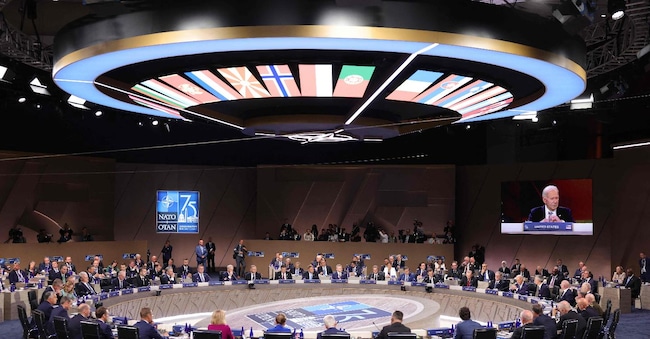
The NATO summit, which marked the 75th anniversary of the Atlantic Alliance, put down on paper in its final communiqué stances that were intended to be new and determined. Although critics warn that their effectiveness remains to be proven. And if the American leadership, which hosted the summit in Washington, is today in a storm, with Atlanticist President Joe Biden besieged by doubts about his re-election bid, raised by influential former House Speaker Nancy Pelosi, and by the possibility of a return to the White House by Donald Trump and his America First.
"The future of Ukraine is in NATO," states the text of the communiqué issued last night by the 32 NATO capitals, taking up the challenges. It adds that, with Kiev continuing its "democratic, economic and security reforms", the Alliance countries support "its irreversible path towards full Euro-Atlantic integration, including entry into NATO". A formal invitation is not triggered, it will happen when "there is an agreement between the allies and the required conditions are met". Support for Kiev, however, 'constitutes a bridge' to that entry.
Beijing, in a later chapter of the statement, is indicted for its siding with Moscow in the war in Ukraine. It is its 'decisive enabler' through its partnership with Russia and support for its industrial-military base. So much so as to justify a warning, however diplomatic: 'It cannot facilitate the biggest conflict in Europe in recent history without a negative impact on its own interests and reputation'.
Uncertainties over American leadership, however, are pushing the Alliance to implement plans today to secure first and foremost initiatives on Ukraine. At the summit, Biden presented the determined face of the statesman committed to strengthening the Atlantic Alliance, recalling its historical successes and making substantive announcements, through new expressions of support and collective military aid amounting to some EUR 40 billion per year. But numerous actions, to try to insulate them from political risks, will henceforth pass from the US directly under NATO control, in particular the coordination of supplies and the training of Ukrainian forces.


