
A summer full of light amidst the fjords and the imposing nature of the Great North
An itinerary that touches on small villages and big cities such as Hellesylt and Bergen along the north coast

3' min read
Key pointsand po
3' min read
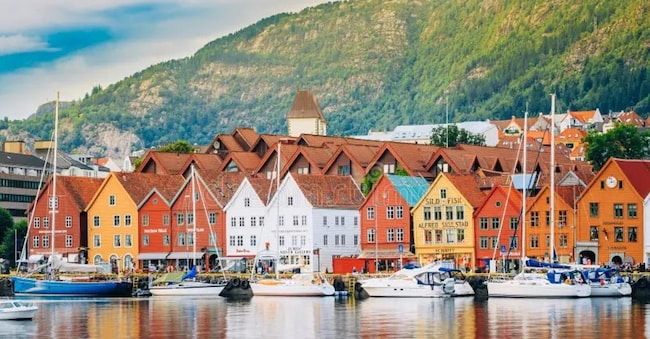
A few neat and tidy streets overlooked by typical coloured wooden houses, an explosion of shades of red, yellow, orange and blue. Then, there are two small supermarkets, a school, a pizzeria, a church. And, all around, the majestic, enchanted nature of the Norwegian fjords. We are in Hellesylt, 250 inhabitants that rise to 600 if we also count the families living in the surrounding valleys. Situated at the bottom of Sunnylvfjiord, it is a tiny paradise just over an hour's ferry ride from the much more famous village of Geiranger, which lies in an inlet of the Geiranderfjord, a Unesco World Heritage site: a spectacular fjord with snow-capped mountains that sink kilometres into the sea and its many waterfalls. Here in Hellesylt there used to be a Grand Hotel, a two-storey white wooden building at the mouth of the harbour. It has long since closed. And patrons can only resort to the hostel, perched on the hill, which is in fact the only accommodation in the village, in the municipality of Stranda. And yet this very village - despite its small size and the scarce supply of overnight accommodation - can be a stop on a tour of Norway's most beautiful fjords. From June until August, when nature blossoms, the very cold winter temperatures are a memory and the nights - as you approach the Arctic parts of the country, where from April to late summer the sun never sets - are not completely dark.
From Bergen to the North Fjords
.About 500 kilometres of road separate Hellesylt from Bergen, the second most populated city in Norway, on the southwest coast, also surrounded by mountains and fjords, young and lively, taken by storm by tourists who want to visit its Hanseatic quarter, Bryggen, also a Unesco heritage site. Bergen can be the starting point for venturing into this northern area of Norway, dominated by an imposing nature, well known but not scarred by large tourist flows: the tranquillity and cleanliness of these places will surprise you. This coastal area can be reached by car, stopping not only in Hellesylt, but also in other small fjord villages such as Flam (population 500) or coastal towns such as Molde. Just near Molde begins the Atlantic Road, one of the most beautiful in the world, more than eight kilometres winding through breathtaking scenery, including open sea, fjords, mountains, cliffs and islets. Or villages and towns can be reached by ferries departing from Bergen, starting with the famous Hurtigruten, the mail boat that has been sailing from port to port for 130 years. Another alternative, for those who love cruises, is the proposal of the Msc Crociere company, which reaches the fjords of the North, leaving from Kiel (in Germany) or Copenhagen and stopping also in Hellesylt, Flam and Molde.
Flam, a fairytale village
While Molde is a large village of almost 32,000 inhabitants, with a discrete and varied range of accommodation (including hotels and holiday homes run by local families) and a good number of shops and restaurants, Flam presents itself with a rich offer of excursions, by boat or dinghy, to the fjords. Or, again by car, you can drive into the hinterland, populated by breeders of Highlander cows, a breed of cattle of Scottish origin. In the harbour area, at the end of Aurlandsfjord, you will find a hotel, a diner, a supermarket, some souvenir shops and a hostel a short distance away. The accommodation offer is much more extensive than in Hellesylt but is still small, consisting mainly of a few small guest houses and a few cottages made available by the locals. What is magical here is not only the fjord. Practically everything in Flam seems to be immersed in a fairy-tale dimension, between lakes, mountains and plains, amidst the particularly intense colours that the forests take on in fine weather. One way to visit the surroundings is to ride the Flamsbana train, the steepest railway in the world. It is twenty kilometres long and will take you up to the vantage point of Myrdal, over 800 metres above sea level, in a wooden convoy that seems to have come out of the past. For those who like to travel by train, one option is always to take the train that connects Oslo, the capital of Norway, to the Flamsbana mountain station and then rent a car and wander through villages, isolated farms and churches.

