
A team of sixty meteorologists at the service of organisers and athletes
A team of 60 meteorologists is continuously processing the scenarios of the race courses. The stations on the race fields will remain in legacy on the territories

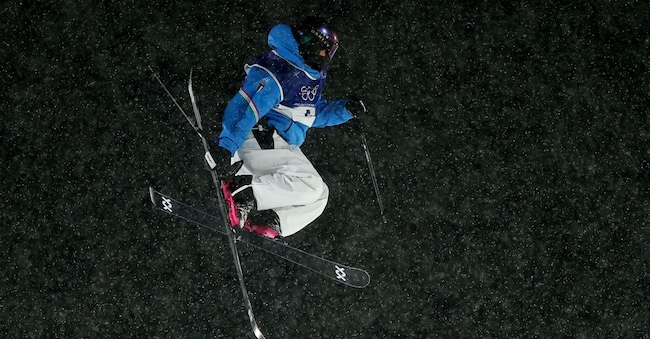
When at 7pm on Monday evening the Big Air ski jump in Livigno was swept by wind and snow, everyone looked anxiously at the control booth providing the teams and the organisers with information about the weather conditions on the competition fields. Luckily the news arrived that the weather would soon improve and so the start of the final (in which Flora Tabanelli would win bronze) was postponed to 21.
There is a control room that provides the teams with a whole host of key information: that of the weather conditions the athletes find on the competition fields. This data is indispensable to prepare athletes, equipment and ensure the safe running of the competitions of these widespread Olympics and the new weather stations installed in the venues will remain as a legacy. "The competitions take place in complex mountainous settings and accurate and reliable weather information is required to ensure that the events take place in safe and fair conditions for all athletes," says Filippo Bazzanella, Head of sport planning and services of the Milan Cortina 2026 Foundation.
The Ws4wg service
The organising committee has thus set up a team dedicated to sports weather services, the Weather services for winter games (Ws4wg). The central node is at the Sport operations centre (Soc) in the headquarters of the Fondazione Milano Cortina, to which the network of meteorologists and observers on the competition fields refers. "There are about 60 specialists and they collaborate with the four local public meteorological agencies involved in the Olympic region," the manager continues, "realities that over the years have acquired a profound knowledge of the microclimatic dynamics of the competition fields. These agencies know which key weather aspects require the most attention and how best to operate them'. The agencies involved are the regional environmental protection agencies (Arpa) of Lombardy and Veneto in addition to the offices of the provinces of Trento and Bolzano. The four agencies collect and process data from the main European and Italian providers including Eumetsat, the European centre for medium-range weather forecast and the Cosmo Consortium for forecast modelling. "In addition to the information provided by these centres, there are also those collected by the agencies in the territories by a network of instruments such as weather radars, automatic weather stations, Lidar or active remote sensing technology that uses laser pulses to analyse the atmosphere, measuring humidity, temperature, wind speed and the base of the clouds, and finally manual surveys," explains Bazzanella. Sensors have been placed, for example, at the shooting range in Anterselva and at the ski jump in Predazzo where the wind can seriously affect the race, along the alpine ski slopes in Bormio and Cortina. These stations installed for the Games will then remain as a legacy in the area'.
Io requests
A preparatory work to fulfil one of the requirements of the IOC: to issue weather bulletins with updates even every hour. It depends on what the forecast models and short-term integrations collected in real time from the stations in the area provide. This work increases the accuracy of the forecasts in the hours closest to the competition. Alongside the mathematical models, an essential contribution comes from the four agencies operating on the race fields. Their experts have a deep knowledge of the territories that often do not follow the standard dynamics of the models due to the complex orography. "This is the last step before we reach the end of the process," explains Matteo Pasotti, Weather specialist. "The margin of reliability on average is very high, although it depends on the parameter considered and the forecasting horizon considered. For the air temperature, the average error is almost zero for the hours closest to the race and is contained within 2 degrees plus or minus for the following day'. The data are then validated by meteorologists and made available to the Olympic distribution circuit on a website.
The job of sports manager and skiman
Predictions that end up in the hands of sports managers and skimans, professionals who work backstage in symbiosis with the athletes. The former have to prepare the race course. "We use information with forecasts on air temperature, snow consistency, humidity, at the start, halfway through the course, and at the finish line," explains Omar Galli, sport manager of the Stelvio slope in Bormio, where Giovanni Franzoni and Dominik Paris scored the double silver and bronze medal in the men's downhill, "and some teams then go out independently to measure temperature and consistency. Some teams then go on their own to measure temperature and consistency on the slope'. Data also analysed by the skimans: it is they who materially prepare the tools, decide the sharpening of the blades and the mix of wax to use. A similar role is played by the engineers dedicated to tyre management in Formula One. "The human factor makes the difference," emphasises Galli. The experience of the skiman counts, and every champion has his own personal skiman. The night before the race they prepare two or three pairs of skis, then before the race they choose which one to use according to the latest weather forecast.


